I have signed off on a lot that passed testing at the fabric stage and failed at the finished garment stage. The difference was 47 days of production and one finishing step the line lead decided to skip to hit the ship date.
This is a post about what "we test every lot" actually means when you see it on a non-toxic activewear marketing page. It is not always a lie. But it is almost never the whole story.
What does the marketing page say about non-toxic activewear testing?
The language varies, but the claim is consistent. "Third-party tested." "OEKO-TEX certified." "Tested for harmful chemicals." "Certified safe."
Sometimes the claim is more specific: "Every piece is tested to ensure it meets our standards." Or: "We test every lot for PFAS, phthalates, and heavy metals."
The implication is clear. Someone, somewhere, is running tests on the garments you are buying. And those tests are catching the bad stuff before it reaches your skin.
According to The Good Trade's 2026 guide to sustainable activewear, the best non-toxic activewear brands back up their claims with third-party certifications like GOTS, OEKO-TEX Standard 100, Bluesign, or Fair Trade.
But here is what the marketing page does not say: what exactly is being tested, when, and how often.
How does OEKO-TEX 100 certification actually work?
OEKO-TEX Standard 100 is the most common certification you will see on non-toxic activewear labels. It is a solid standard. It tests for a comprehensive list of harmful substances: formaldehyde, heavy metals, allergenic dyes, phthalates, and, where applicable, PFAS.
According to OEKO-TEX's own factsheet, the certification uses risk-based testing with stricter limits for items worn close to the body, like bras, underwear, and leggings. Every component is tested: fabric, thread, elastic, labels, prints, and zippers.
But here is the part the marketing page leaves out: OEKO-TEX certifies a representative sample, not every production lot.
The brand submits one sample per product style. If that sample passes, the certificate covers future production runs made to the same specification. The certificate is valid for one year, with spot checks and annual recertification.
This is not a flaw in the standard. It is how product certification works. You cannot run $2,000 worth of lab tests on every production run and still hit a $68 retail price on a pair of leggings.
But it does mean the certificate on the marketing page may have been issued six months before your leggings were made. And a lot can change in six months.
What actually happens between the certified fabric and the finished garment?
I have worked on floors where the fabric arrives with all the right paperwork. OEKO-TEX certificate. Test reports. Mill attestations. Everything checks out.
And then the fabric goes through finishing.
Finishing is where the fabric gets its hand feel: the softness, the drape, the moisture-wicking properties. It is also where a lot of the chemistry happens.
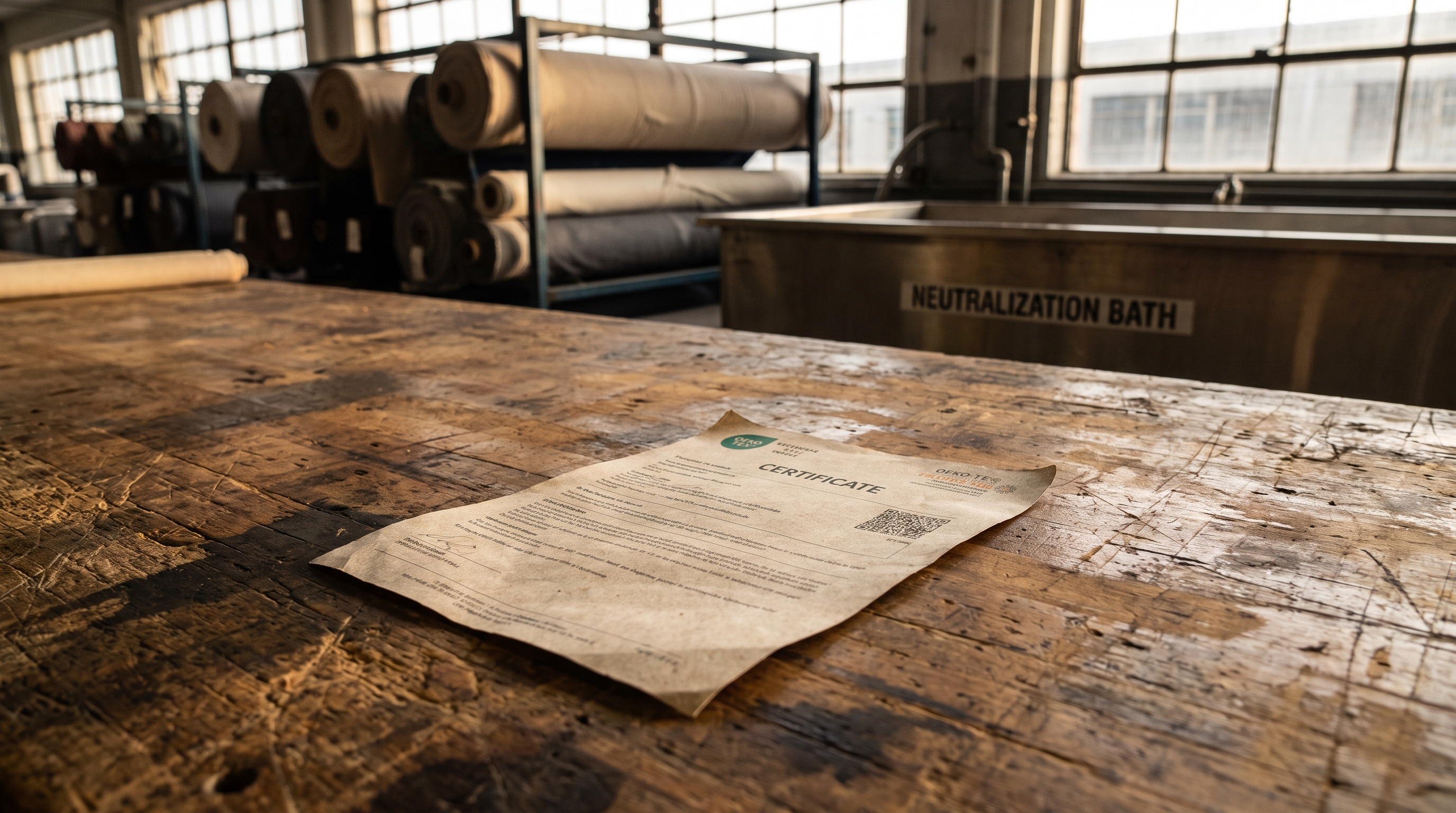
According to Testex's guide to pH testing in textiles, the finishing process involves neutralization steps to bring the fabric's pH into a safe range for skin contact. Strong acidity or alkalinity can cause dermatitis or immune reactions. The proper approach is to neutralize with glacial acetic acid and sodium acetate buffer solution.
But neutralization adds time to the production schedule. And when the line is running hot to hit a ship date, the neutralization step is one of the first things to get cut.
I have seen it happen. The line lead's job is to hit the date. The chemist's job is to hit the spec. When those two conflict, the chemist loses.
The same dynamic plays out with optical brighteners, softener baths, and moisture-wicking finishes. All of these add chemicals to the fabric after the original certification sample was pulled.
According to Bureau Veritas's performance textile testing services, a finished garment can start with certified materials and still end up carrying substances that were introduced later in the process. The final bra, legging, or short, after it has been dyed, treated, finished, sewn, washed, packed, and shipped, can have chemicals introduced at multiple stages along the way.
What does lot-by-lot testing actually mean?
When a brand claims to test every lot, I want to know three things:
- What is a "lot"? Is it a production run of 500 units? 5,000? 50,000?
- Where is the sample pulled? From the fabric roll before cutting, or from the finished garment after all finishing steps?
- What is actually tested? The full OEKO-TEX panel, or a subset of quick checks?
The honest answer is that most brands do not test every lot. They test once per product style, once per factory relationship, or once per year for recertification.
According to Mamavation's investigation into non-toxic activewear, roughly 80% of "non-toxic" claims carry no third-party certification at all. The brands are relying on fabric-level certifications, ingredient-level inputs, or supplier assurances.
This does not make them dishonest. It makes them normal. The economics of apparel production do not support lot-by-lot testing for every SKU.
But it does mean the "we test every lot" claim, when you see it, is worth interrogating.
What is the real trade-off here?
The trade-off is between cost and certainty.
A full OEKO-TEX 100 test panel runs $1,500 to $2,500 depending on the lab and the scope. If a brand is producing 20 SKUs across 4 production runs per year, that is $120,000 to $200,000 in testing costs alone. For a startup doing $2 million in revenue, that is 6 to 10% of gross sales going to lab fees.
No one does that. Not even the brands with the best intentions.
What most brands actually do is test a representative sample, rely on supplier certifications, and assume that production consistency will keep the finished product within spec.
That assumption is usually correct. Most of the time, the fabric that passed testing last quarter will pass testing this quarter. The factory is not switching chemistry on every run.
But "most of the time" is not the same as "always." And the gap between those two is where the risk lives.
What should a brand founder do about this?
If you are sourcing non-toxic activewear and you want to back up your claims, here is what I would do.
First, get the test report, not just the certificate. The certificate tells you that a sample passed at some point. The report tells you what was tested, when, and what the results were.
Second, ask for the lot number on the test report to match the lot number on your production run. If your supplier cannot tie a test report to a specific lot, the testing is not lot-by-lot. It is product-style testing with a marketing claim attached.
Third, pull your own samples for independent verification. This does not have to happen on every lot. But it should happen often enough to catch drift. Once per quarter. Once per new factory. Once per new colorway that might use different dyes.
Fourth, test the finished garment, not just the fabric. The fabric certificate tells you what went into the process. The finished-garment test tells you what came out.
Our plastic-free activewear guide covers more on what to look for in a material spec, but the testing question is where the claims meet reality.
What would I want to see in a supplier's lab report?
If I were reviewing a supplier for a non-toxic activewear line, here is the documentation I would ask for:
- OEKO-TEX 100 certificate for the finished garment, not just the fabric. The certificate should be current (within the past 12 months) and should list the specific product styles being ordered.
- Full test report showing results for formaldehyde, pH, heavy metals, allergenic dyes, carcinogenic dyes, phthalates, and PFAS. The report should show the sample date, the lot identifier, and the actual measured values, not just pass/fail.
- Lot traceability documentation showing that the test report corresponds to the specific production run being shipped. If the supplier cannot provide this, the claim is not lot-by-lot.
- Finishing process attestation confirming what chemicals are applied during finishing and whether the neutralization and wash-off steps were completed per spec.
This is more documentation than most brands ask for. But it is the only way to back up a "we test every lot" claim with evidence.
OHZEHN-TEX(TM) builds this traceability into the supply chain by default, but the principle applies to any sourcing relationship: if you cannot tie a test report to a lot number, the testing is not lot-by-lot.
What is the honest answer?
The honest answer is that most non-toxic activewear is not tested lot-by-lot. The economics do not support it. The supply chains do not enable it. The certifications do not require it.
What you get when you buy certified non-toxic activewear is a reasonable assurance that a representative sample passed testing at some point in the past, and that the factory has committed to maintaining consistent production practices.
That is not nothing. It is better than the 80% of non-toxic claims that carry no certification at all.
But it is also not "we test every lot." And if a brand is making that claim, they should be able to show you the lot-specific test report. If they cannot, the claim is marketing, not evidence.
I have stood on floors where the paperwork said one thing and the line did another. The gap between the marketing brief and the ship date is where the corners get cut. The only way to close that gap is to test what actually shipped.
Sources
https://www.thegoodtrade.com/features/best-sustainable-activewear/ https://www.oeko-tex.com/fileadmin/user_upload/Marketing_Materialien/STANDARD_100/Factsheet/STANDARD_100/OEKO-TEX_STANDARD_100_Factsheet_EN.pdf https://www.testextextile.com/understanding-ph-testing-in-textile/ https://www.cps.bureauveritas.com/needs/performance-textile-testing-services-activewear https://mamavation.com/product-investigations/non-toxic-activewear-guide-pfas-workout-leggings-yoga-pants.html https://ohzehn-tex.com/plastic-free-activewear/ https://www.oeko-tex.com/en/our-standards/oeko-tex-standard-100/ https://www.aatcc.org/technical-manual-24/ https://definitearticles.com/blogs/magazine/most-non-toxic-activewear-isnt-actually-tested