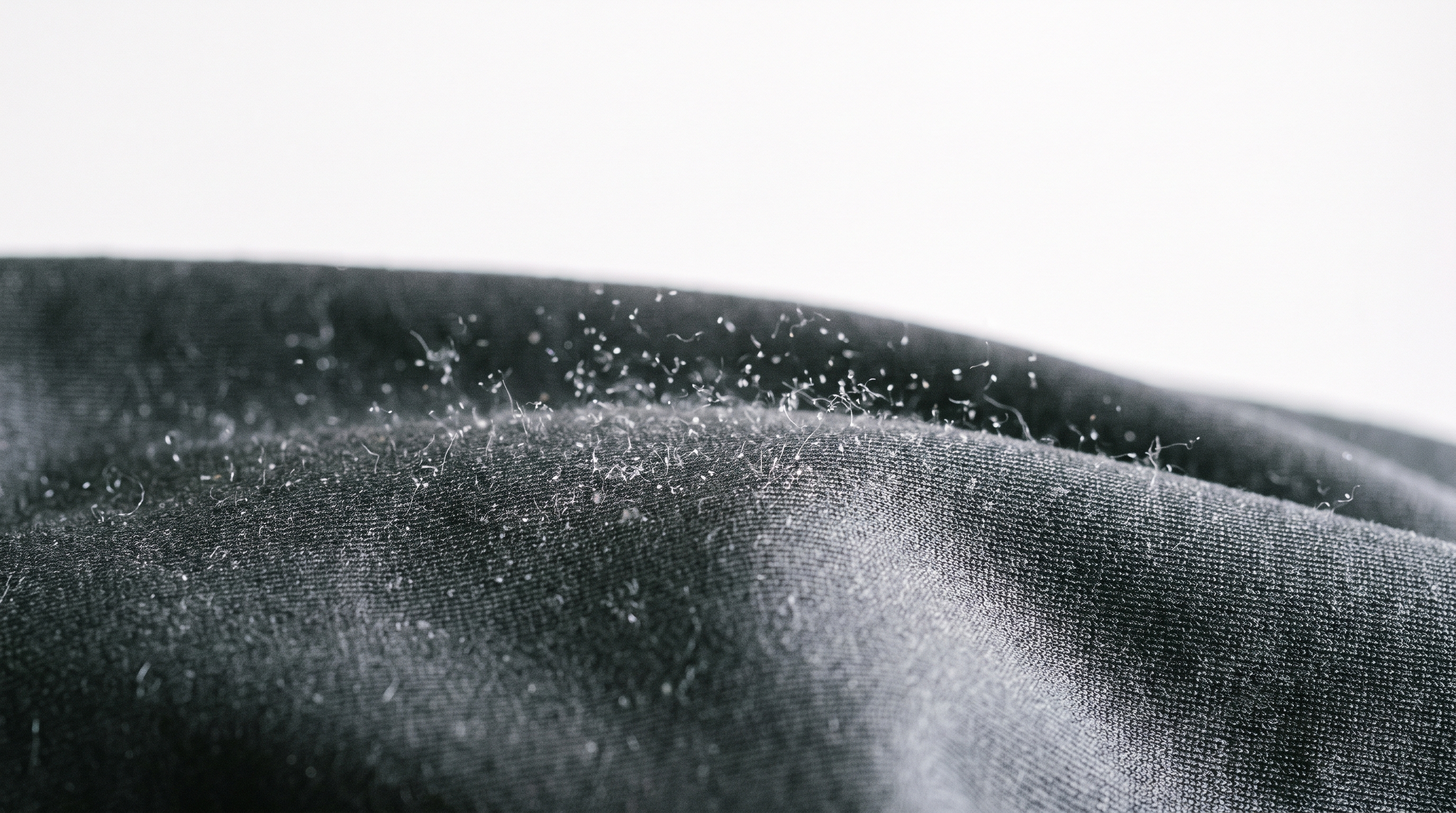
Microplastics in clothing have become a category-level concern. The term "polyester" is now Gen Z slang for cheap or fake. Shareholder activists are filing resolutions. Peer-reviewed research keeps arriving. And one of the largest activewear brands in the world says it has tested 80 fabrics for microfiber shedding.
The data exists. It sits in a private industry portal. Consumers cannot see it.
This is an audit of what Lululemon claims about microfiber transparency, what its shareholders have demanded, and what its product pages actually disclose.
What does Lululemon say about microfiber shedding?
Lululemon is a signatory to The Microfibre Consortium, an industry group that operates a private data portal for textile shedding research. The company has committed to submit testing data each year to The Microfibre Data Portal and to prioritize action on microfiber shedding prevention.
According to As You Sow's 2026 shareholder resolution filing, Lululemon has submitted shedding test results for 80 of its fabrics to the Consortium's data portal. That is a substantial testing footprint. Lululemon sells thousands of SKUs, but 80 base fabrics represent a meaningful sample of the materials moving through the supply chain.
In April 2026, Lululemon became a co-funder of a joint research project between The Microfibre Consortium and ZDHC Foundation. The project, now in Phase 2, aims to strengthen industry understanding of fibre fragment pollution in wastewater. The research focuses on monitoring methodologies and industrial filtration. It does not address consumer-facing disclosure.
The company's "Be Planet" campaign, launched in October 2020, includes commitments to ensure 75 percent of products contain sustainable materials by 2025 and 100 percent by 2030. As of fiscal year 2024, Lululemon reports sourcing 77 percent recycled polyester, beating its 75 percent target a year early.
Recycled polyester is still polyester. It sheds microfibers at comparable rates to virgin polyester. The environmental benefit of recycled content is separate from the shedding question.
What does the Lululemon product page actually say?
We pulled the spec sheet on Lululemon's Wunder Under leggings, one of the brand's best-selling product lines.
The product page lists fiber content: 45 percent polyester, 42 percent nylon, 13 percent Lycra elastane for the Full-On Luon fabric. The Luxtreme version lists 69 percent nylon and 31 percent Lycra elastane. The Everlux version lists 61 percent nylon, 31 percent polyester, 8 percent Lycra. Each fabric trades off polyester and nylon in different ratios.
What the product page does not list: any data on microfiber shedding.
No milligrams per wash. No shedding tier. No link to the Microfibre Consortium data. No consumer guidance on which fabrics shed more or less. No filtration recommendations. No note explaining that 80 fabrics have been tested and here is where to find the results.
The 80-fabric test results exist. They are locked in a private industry database. A consumer comparing leggings at checkout has no access.
How much microplastic does polyester actually shed?
A 2021 study published in PLOS ONE examined microfiber release from consumer apparel textiles during domestic laundry. Researchers tested multiple fabric constructions, yarn types, and mechanical treatments. The findings established baseline shedding rates that brands and regulators now reference.
Key numbers from the study:
- Mechanically-treated polyester samples released 161 plus or minus 173 milligrams per kilogram per wash
- Nylon samples with woven construction released 27 plus or minus 14 milligrams per kilogram per wash
- Overall microfiber loss ranged from 9.6 to 1,240 milligrams per kilogram of textile per wash
The variance is significant. A loosely-knit, mechanically-treated polyester can shed 100 times more than a tightly-woven nylon. Construction matters as much as fiber type. Filament yarns shed less than staple yarns. Woven fabrics shed less than knits. Post-consumer recycled polyester, made from chopped PET bottles, often uses shorter staple fibers and can shed more than virgin filament polyester.
A 2025 study in Fibers and Polymers added another variable: washing conditions. The research found that the combination of detergent and washing time has the greatest influence on increasing microfiber shedding. Longer cycles with more detergent increase fiber release regardless of fabric type.
"Research highlights interventions that can materially reduce microfiber pollution including filtration technology in textile mills, material and design innovations that reduce shedding, new testing methodologies, and manufacturing changes."
That quote is from As You Sow's shareholder resolution filing against Lululemon. The emphasis is on interventions that brands can take. Testing data is step one. Consumer disclosure would be step two.
What did shareholders demand from Lululemon?
As You Sow, a shareholder advocacy nonprofit that uses securities law to push corporate environmental accountability, filed a resolution ahead of Lululemon's June 25, 2026 annual meeting. The resolution requested that the board issue a report evaluating whether opportunities to reduce microfiber pollution from its garments will strengthen the company's long-term value and mitigate emerging material risk.
The specific asks included:
- Evaluating ways to make fiber shedding data publicly available, including to consumers
- Discussing existing, planned, or available manufacturing treatment technologies to minimize fiber shedding, such as ultrafiltration and reverse osmosis
- Assessing the risk that competitors with lower-shedding products could gain market share
- Reviewing regulatory trends in Europe and California that may require shedding disclosure
The resolution was withdrawn before the vote. As You Sow noted the status as "Resolution Withdrawn, Agreement Reached."
Lululemon agreed to something to avoid the shareholder vote. The terms of that agreement are not public. As of September 2026, no public microfiber shedding data appears on Lululemon's consumer-facing website or product detail pages. The 80-fabric dataset remains in the private Microfibre Consortium portal.
What is the gap between claim and disclosure?
The gap is between private industry data and consumer-facing disclosure.
Lululemon has tested 80 fabrics. The data exists. The company signed an agreement with shareholder activists. But a consumer shopping for leggings on lululemon.com sees this: 45 percent polyester, 42 percent nylon, 13 percent Lycra.
No shedding rate. No tier system. No link to the research. No comparison tool.
Meanwhile, peer-reviewed data shows polyester sheds roughly six times more microfibers per wash than woven nylon. A consumer comparing Full-On Luon (45 percent polyester) to Luxtreme (69 percent nylon) has no way to know which sheds more without reading academic papers. The brand knows. The consumer does not.
The gap also extends to product marketing. Lululemon promotes its recycled polyester content as a sustainability win. The company beat its 75 percent recycled target a year early. But recycled polyester is still polyester. It still sheds. The marketing emphasizes circularity. It does not mention shedding.
What are other brands in the category doing?
Patagonia commissioned a microfiber study at UC Santa Barbara's Bren School of Environmental Science in 2015. The company has publicly shared findings on its website and acknowledged the problem directly. Patagonia discloses ongoing efforts to reduce shedding through fabric engineering and construction changes, including tighter knit structures and different yarn types.
Patagonia has not published garment-level shedding data on product pages. But it has published the research it funded. Consumers can read the methodology and the findings. The company has also sold the Guppyfriend washing bag, a third-party microfiber capture device, as a consumer-facing solution.
The NRDC PFAS scorecard graded apparel brands on their PFAS elimination commitments. Levi Strauss earned an A-minus for successfully eliminating PFAS from its supply chain. Patagonia earned a B as the only outdoor brand with a commitment to phase out all PFAS by 2024. Columbia, REI, and Wolverine Worldwide received F grades.
There is no equivalent industry scorecard for microfiber shedding disclosure. The Microfibre Consortium operates a private data portal. Consumers have no visibility into which brands share data, what the data shows, or how fabrics compare. A brand could test 200 fabrics or test zero, and the consumer would never know.
Some smaller brands have begun listing microfiber shedding as a product attribute. These are mostly natural-fiber brands that can claim zero synthetic shedding because their products contain no synthetics. The competitive disclosure, where a synthetic brand publishes its own shedding rates, has not arrived.
What is the regulatory context?
Canada's Competition Bureau launched a greenwashing investigation in 2024 following a complaint by Stand.earth. The complaint alleged Lululemon overstated climate action in its "Be Planet" marketing while absolute Scope 3 emissions doubled since 2020. The investigation is ongoing as of September 2026.
A proposed class action in Florida alleged Lululemon's Be Planet campaign deceived consumers. The complaint stated that the company's 2022 emissions were equivalent to burning over 720 million liters of gasoline. The case was dismissed in February 2025; the court found consumers failed to plausibly allege economic injury. The dismissal hinged on standing doctrine, not the merits of the greenwashing claim.
California has proposed microfiber filtration requirements for washing machines sold in the state. France requires microfiber filters on new washing machines starting in 2025. The European Union is studying textile shedding as part of its broader microplastics strategy. None of these regulations currently require brands to disclose shedding rates on product pages.
There are currently no laws in the United States that require apparel brands to disclose microfiber shedding data to consumers. Brands can test 80 fabrics, submit the data to a private portal, and keep it hidden from the consumer comparing leggings at checkout.
What should a brand founder ask their supplier?
If you are sourcing activewear fabrics and your customer is asking about microplastics in clothing, here are the questions to put to your supplier or mill:
- Has this fabric been tested for microfiber shedding using a standardized method like AATCC TM212 or ISO 4484-1? These are the two dominant testing protocols. AATCC TM212 uses a standardized domestic wash. ISO 4484-1 is the European standard. Results from different protocols are not directly comparable.
- What is the shedding rate in milligrams per kilogram per wash? The peer-reviewed range spans from 9.6 to 1,240 mg/kg. Anything under 50 mg/kg is relatively low for a synthetic. Anything over 200 mg/kg is high.
- Is the fabric construction woven or knit? Filament yarn or staple yarn? Woven filament fabrics shed least. Knit staple fabrics shed most. This is a bigger variable than fiber type alone.
- Has the fabric been submitted to The Microfibre Data Portal, and can you share the test report? If your mill is a Consortium member, the data may already exist. Ask for the report.
- What wastewater filtration is in place at the dyeing and finishing facility? Ultrafiltration and reverse osmosis capture microfibers before discharge. Standard primary treatment does not.
- If the fabric contains recycled polyester, is it post-consumer or post-industrial? Mechanical recycling of PET bottles produces shorter staple fibers that may shed more. Chemical recycling can produce filament-grade output. The spec matters.
For reference, the plastic-free activewear guide covers how natural fibers compare on shedding. Cotton and wool also shed, but those fibers biodegrade in aquatic environments within months. Polyester and nylon persist for centuries.
What does this mean for the spec?
The activewear category is facing a disclosure gap. Private industry consortia collect data. Peer-reviewed research publishes findings. Shareholders file resolutions. But product pages remain unchanged.
Lululemon's 80-fabric shedding dataset is a start. The company has done more testing than most. Making that data available to the consumer comparing leggings at checkout would be a next step. A simple tier system, high shedding, medium shedding, low shedding, would give consumers a decision-relevant signal without requiring them to parse milligrams per kilogram.
OHZEHN-TEX(TM) is developing ingredient-brand standards for natural-fiber activewear. Shedding data is part of the spec. The standard will require public disclosure of test results, not submission to a private portal.
The question for Lululemon is not whether the data exists. It exists. The question is whether consumers will ever see it.
Sources
https://www.asyousow.org/resolutions/2025/12/24-lululemon-reduce-plastic-microfiber-shedding https://corporate.lululemon.com/our-impact/planet/circular-innovation https://www.microfibreconsortium.com/ https://www.textileworld.com/textile-world/fiber-world/2026/04/the-microfibre-consortium-and-zdhc-advance-joint-research-to-strengthen-wastewater-monitoring-of-fibre-fragmentation/ https://trellis.net/article/lululemon-revises-goals-for-preferred-materials-and-supplier-renewables/ https://www.schimiggy.com/lululemon-fabric-guide-cheatsheet/ https://pubmed.ncbi.nlm.nih.gov/34242234/ https://link.springer.com/article/10.1007/s12221-025-01083-z https://www.patagonia.com/stories/planet/our-footprint/toward-an-end-to-microfiber-pollution/story-141340.html https://www.nrdc.org/press-releases/new-pfas-scorecard-popular-apparel-brands-levi-strauss-earns-outdoor-brands-fail https://onestopesg.com/esg-news/how-sustainable-is-lululemon-really--1754835500705 https://www.kelleydrye.com/viewpoints/blogs/ad-law-access/class-action-alleges-lululemon-engages-in-greenwashing https://topclassactions.com/lawsuit-settlements/lawsuit-news/lululemon-class-action-claims-greenwashing-ads-lie-about-sustainability/ https://ohzehn-tex.com/plastic-free-activewear/