I have stood on finishing floors where the lab report says one thing and the roll says another.
This is not a story about fraud. It is a story about what gets tested, what gets skipped, and what sits in the gap between your marketing page and your supplier's certificate of analysis.
The subject today is antimony. Specifically, antimony trioxide, the catalyst residue that sits in 80-85% of all virgin polyester fiber produced on this planet. If your non-toxic activewear line includes polyester leggings, sports bras, or performance tees, this is in your fabric. The question is whether anyone ever tested for it.
What does antimony trioxide do in polyester production?
Antimony trioxide (Sb2O3) is a polymerization catalyst. It speeds up the reaction that turns raw terephthalic acid and ethylene glycol into polyethylene terephthalate, the polymer we call polyester or PET.
The catalyst does not get fully removed after polymerization. It stays in the polymer matrix. Finished polyester textiles contain antimony at concentrations ranging from about 125 to 470 micrograms per gram of fabric, according to peer-reviewed research published in Regulatory Toxicology and Pharmacology.
This is not contamination in the sense of something that went wrong. This is how the process works. The antimony is supposed to be there. The question is what happens when that fabric meets human skin and human sweat.
What happens when sweat meets polyester?
Human sweat is mildly acidic, typically pH 4.5 to 6.5 depending on the person and the workout. When polyester fabric contacts sweat, a small percentage of the antimony in the polymer leaches out into the moisture sitting against your skin.
The peer-reviewed data, from a 2021 study calling for standardized testing procedures, puts the number at 0.05 to 2% of total antimony mobilized into artificial sweat. That translates to roughly 0.1 to 1 microgram per gram of fabric released per extraction cycle.
"Antimony showed the highest mean hazard quotient for male and female adults wearing polyester clothes; for one of the examined items (polyester T-shirt) the HQ was even above the safety limit."
The conditions of a typical workout, increased body heat, friction, and moisture, create exactly the environment that accelerates dermal absorption. Leggings and sports bras press against absorbent skin during exercise that opens pores.
Why does this matter for a non-toxic activewear claim?
IARC, the International Agency for Research on Cancer, classified antimony trioxide as Group 2A in 2023. Group 2A means "probably carcinogenic to humans." This was an upgrade from the previous Group 2B classification ("possibly carcinogenic") that had stood since 1989.
No epidemiological study has established a direct link between wearing polyester clothing and cancer. That is the honest answer. The hazard exists at the chemical level. The exposure dose from a single garment is low. But cumulative exposure from daily activewear wear, multiple hours, multiple washes, multiple years, is not well studied.
If you are building a brand around non-toxic claims, this is the kind of gap that matters. Not because you need to panic. Because you need to know what your lab report does and does not cover.
What does standard textile testing actually catch?
Here is where the floor truth diverges from the marketing truth.
OEKO-TEX Standard 100, the certification most activewear brands rely on for "tested for harmful substances" claims, tests for over 300 potentially harmful substances. The list includes banned azo dyes, formaldehyde, heavy metals like cadmium and lead, pesticides, chlorinated phenols, phthalates, and per- and polyfluorinated substances.
Antimony is on the OEKO-TEX limit list. The Standard 100 limit for antimony is 30 mg/kg (30 ppm) for baby products and products with direct skin contact.
But here is the catch. That limit applies to extractable antimony under OEKO-TEX's test conditions. Different test parameters, different pH, different temperature, different extraction time, yield different results.
The peer-reviewed research recommends ISO 105-E04 over EN 1811 for antimony extraction testing because ISO 105-E04 uses pH 5.5, which is closer to actual human sweat. A reduction in temperature from 37 to 20 degrees Celsius resulted in a decline in antimony mobilization. A shift in pH from 5.5 to 7 reduced extraction further.
If your supplier's lab ran the test at room temperature or neutral pH, the number on the report understates real-world exposure.
What does "we test every lot" actually mean?
I have heard this claim from dozens of suppliers over the years. Some mean it. Most do not mean what you think it means.
"We test every lot" can mean:
- We run internal QC checks on tensile strength, color, and weight
- We send every lot to a third-party lab for a standard compliance package
- We have an OEKO-TEX certificate on file for the base fabric and apply it to every lot
- We run a full chemical panel on every lot including heavy metals and extraction testing
These are very different things. The first three are common. The fourth is rare and expensive.
If your supplier says they test every lot, ask: What tests? What parameters? What is the antimony extraction result, lot by lot, at pH 5.5 and 37 degrees Celsius?
Most cannot answer. Not because they are hiding something. Because nobody asked.
What about recycled polyester?
Recycled PET (rPET) uses the same antimony-catalyzed polymer, just reprocessed from post-consumer bottles or textile waste. The antimony does not disappear in recycling. In some cases, the structural integrity of recycled PET is lower than virgin PET, which may increase leaching when exposed to the acidic environment of human sweat.
The data here is limited. But the assumption that recycled polyester is "cleaner" or "safer" than virgin polyester has no basis in the antimony question. If anything, the opposite may be true.
Recycled polyester addresses one set of concerns, virgin feedstock extraction, carbon footprint, and ocean plastic. It does not address the catalyst residue question. Both can be true at once.
What alternatives avoid antimony entirely?
Some polyester producers use titanium or germanium catalysts instead of antimony. These are more expensive and less common, but they exist. If you want polyester without antimony, this is the spec to request. Ask for catalyst documentation, not just fiber content.
Bio-based polyesters and certain chemical recycling processes can also avoid antimony, depending on the production pathway. The supply is small but growing.
The cleaner answer is to move away from polyester entirely. Natural fiber activewear, Tencel lyocell, merino wool, organic cotton, avoids the antimony question along with the microplastic shedding question. The cost math is different. The performance envelope is different. But for a non-toxic positioning, natural fibers give you a simpler story to tell. Our plastic-free activewear guide covers the category in depth.
What would I want to see in a supplier's lab report?
If I were signing off on polyester lots for a non-toxic activewear line today, I would request:
- Total antimony content via XRF, reported in mg/kg. This tells you how much antimony is in the polymer, not how much migrates.
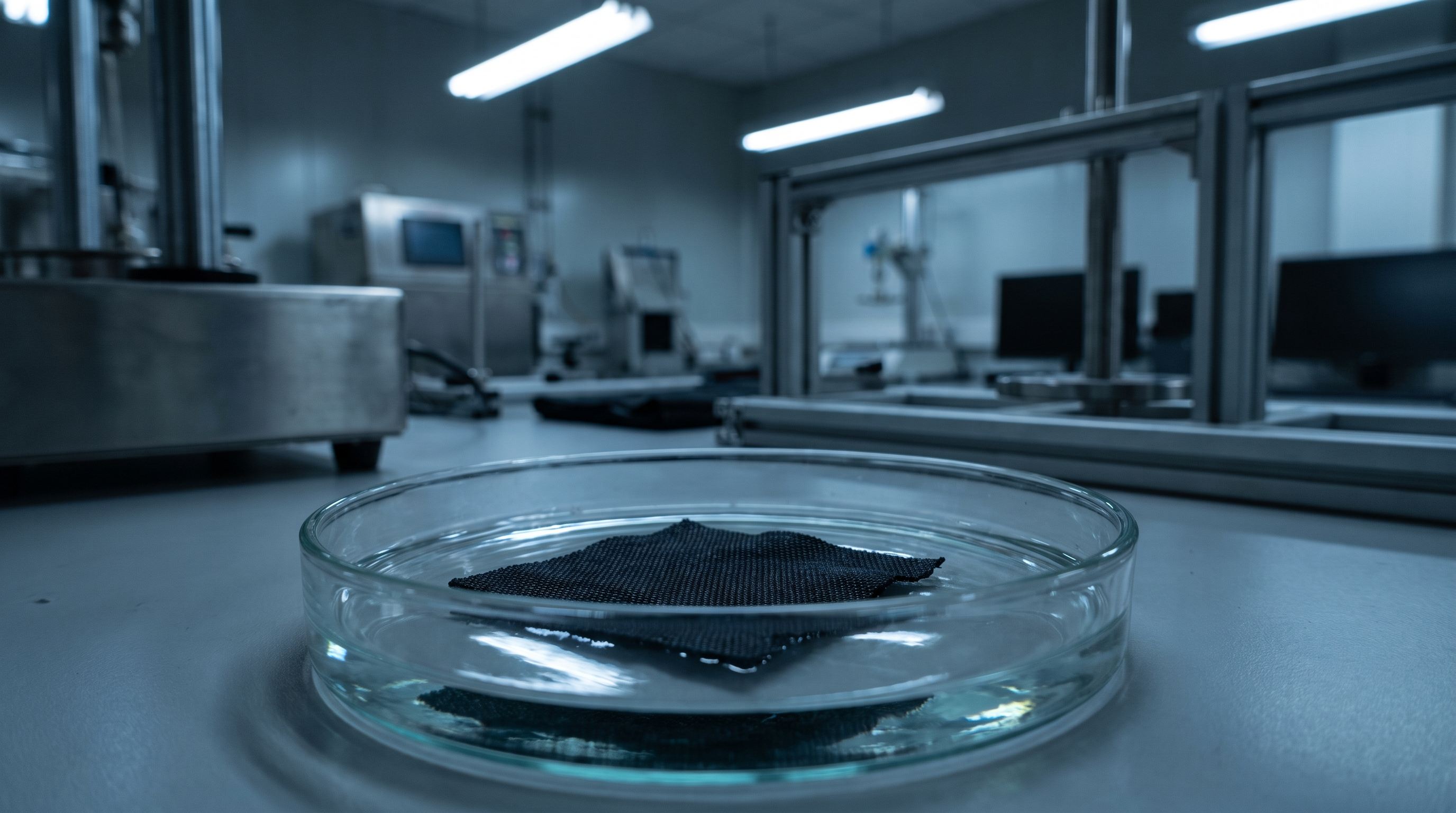
- Extractable antimony via ISO 105-E04, at pH 5.5, 37 degrees Celsius, with at least one 24-hour extraction cycle. This tells you what actually migrates under sweat-like conditions.
- Sequential extraction data if available. Some labs run three consecutive 24-hour extractions to model cumulative release over time.
- Catalyst documentation from the fiber producer. If they use a non-antimony catalyst, this is the proof.
Most suppliers will not have the second or third item on file. That does not make them bad partners. It means nobody asked. You can be the one who asks.
The lab cost for antimony extraction testing is not trivial, but it is not prohibitive either. For a brand building a non-toxic claim, it is a defensible line item.
The honest trade-off
Polyester is in activewear because it performs. It wicks, it stretches, it recovers, it dries fast, it holds color, and it costs less than most alternatives. The antimony in the polymer is a residue of a production process optimized over decades for performance and cost.
Removing antimony adds cost. Switching to natural fibers adds more cost and changes the performance envelope. Neither option is free.
The trade-off is not polyester versus purity. The trade-off is whether your brand's non-toxic claim rests on what your lab report actually tested for, or what you assumed it tested for.
If you are going to claim non-toxic, know what is in the fabric and know what was measured. If you are going to use polyester, at least ask the antimony question.
OHZEHN-TEX(TM) exists in part because these questions need answers that travel with the fabric, not assumptions that travel with the marketing copy.
I have signed off on a lot of lots. Some of them, I would not sign off on again.
Sources
https://www.sciencedirect.com/science/article/pii/S0273230020302506 https://estroni.com.au/pages/is-recycled-polyester-safe-the-hidden-bpa-antimony-risk-in-eco-activewear https://www.sustainablejungle.com/is-polyester-bad-for-you/ https://purakai.com/blogs/threads-of-change/does-polyester-cause-cancer https://www.iarc.who.int/news-events/iarc-monographs-vol-131/ https://embrsleep.com/articles/oeko-tex https://www.oeko-tex.com/fileadmin/user_upload/Marketing_Materialien/STANDARD_100/Factsheet/STANDARD_100/OEKO-TEX_STANDARD_100_Factsheet_EN.pdf https://ohzehn-tex.com/plastic-free-activewear/