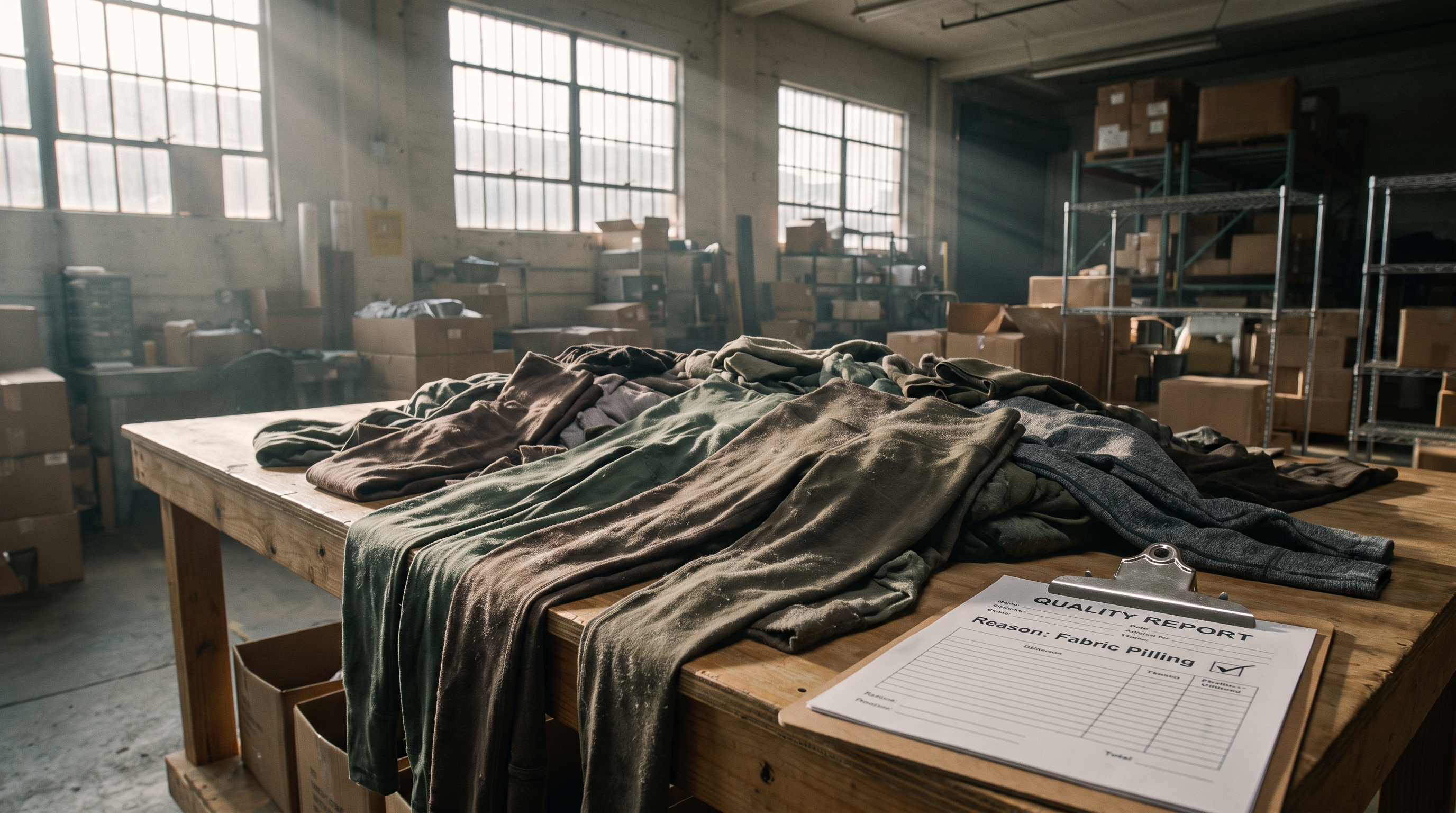
I have stood in the returns room at 6 a.m. on a Monday, watching the carts come in.
You can tell a lot about a fabric spec by what comes back. Fit issues get re-tagged and moved to the outlet channel. Damage claims get photographed and filed. But pilling complaints. Those get counted, logged, and sent upstairs.
What the marketing page says
The marketing page says the fabric is soft, breathable, and made from natural fibers. It says the garment is designed to move with you. It does not mention the pilling grade. It does not mention the Martindale cycles. It does not mention that the spec was changed after the last season because 3.2 percent of units came back with visible pills after one wash.
The customer sees "natural fiber activewear." The sourcing desk sees a spec sheet with a pilling acceptance threshold that determines whether the fabric gets approved.
What actually happens on the line
Here is how the feedback loop works.
The returns team logs every reason code. "Item defective, pilling" is its own category. Once a week, the quality manager pulls a report. If pilling complaints for a SKU exceed 2 to 3 percent of units shipped, that number goes to the sourcing team.
The sourcing team does not rewrite the marketing copy. They rewrite the spec sheet.
The spec sheet for the next order might say: ISO 12945-2, Martindale method, acceptance grade 4 at 5,000 cycles. The previous spec said grade 3. That one grade difference means the mill has to change something. Longer staple yarn. Tighter twist. A nylon blend instead of 100 percent natural fiber. An anti-pilling finish in the dye bath.
The fabric that ships next season looks the same on the hangtag. It is not the same fabric.
What does ISO 12945-2 actually measure?
ISO 12945-2 is the Martindale method for pilling resistance. A circular sample gets rubbed against a standard abrasive fabric under controlled pressure in a Lissajous pattern. After a set number of cycles, usually 2,000 or 5,000 for activewear, the sample gets graded visually against reference photographs.
The grades run from 5 (no change) to 1 (severe pilling). For mass-market activewear, acceptance is typically grade 3 or higher at the final cycle. For premium brands, acceptance is grade 4 or higher.
When a brand tightens the spec from grade 3 to grade 4, that costs money. The mill has to source different yarn, adjust the knitting tension, or add a finishing step. The cost increase is usually 8 to 15 percent per meter. The brand absorbs it or passes it to the customer.
The returns room set that spec. Not the design team. Not the marketing team. The returns room.
Why natural fibers pill more
Natural fibers pill because of their structure. Short staple fibers work loose from the yarn during abrasion. Friction rolls them into balls. The balls anchor to the fabric surface.
Merino wool is the classic example. Fine merino fibers are soft because they are thin. Thin fibers are also weaker and more likely to break free during wear. A 100 percent merino baselayer in 17.5 micron wool will pill faster than a merino-nylon blend at 80/20.
"Durability is the Achilles heel of merino, particularly for lightweight varieties," as one industry guide put it. Reviewers consistently report getting only a couple of seasons out of pure merino baselayers.
Cotton pills too, especially in softer constructions. Ring-spun cotton with a long staple length pills less than open-end spun cotton with short fibers. But longer staple cotton costs more. So the spec decision comes down to: how much pilling are customers willing to tolerate, and how much are we willing to pay to prevent it?
Regenerated cellulose fibers like viscose, modal, and lyocell also pill. Bamboo-derived viscose, often marketed as a sustainable natural fiber, behaves like cotton in this regard. Short staple fibers, prone to pilling with wear.
The trade-off, named honestly
Here is the trade-off that never makes it to the marketing page.
You can have a 100 percent natural fiber fabric that pills. Or you can have a blended fabric that does not pill as fast.
The blend usually means nylon. Nylon fibers are stronger and longer than natural fibers. They anchor the shorter fibers and reduce surface breakage. A 10 to 20 percent nylon content makes a measurable difference in pilling resistance.
But nylon is a synthetic. It is a plastic. If your brand story is "plastic-free activewear" or "natural fiber performance," adding nylon to the blend creates a problem. The fabric performs better. The claim gets weaker.
Some brands solve this by not mentioning the nylon on the marketing page. They list the primary fiber and let the full composition live on the care label. Technically compliant. Not exactly transparent.
Other brands accept higher return rates and keep the blend pure. They know that 3 percent of customers will be unhappy. They price accordingly.
The honest math is this: pilling complaints cost money. Anti-pilling specs cost money. You pay one way or the other.
What a brand founder can do about it
If you are sourcing natural fiber activewear and you want to minimize pilling complaints without compromising your material story, here is what I would do.
First, specify longer staple fibers in your tech pack. Ring-spun cotton with a staple length above 28mm pills less than shorter staple alternatives. For merino, specify a minimum staple length and a maximum fiber diameter. These specs cost more upfront. They save money on the back end.
Second, specify a pilling acceptance grade. Do not leave it open. Write "ISO 12945-2, Martindale method, grade 4 minimum at 5,000 cycles" into your purchase order. If your supplier cannot hit that grade with your chosen fiber, they will tell you. Then you can have an honest conversation about blends or finishes.
Third, ask for pre-shipment pilling test results. Not a generic certificate from the mill's qualification process. A test report from the specific lot you are buying. The lot-to-lot variation in pilling performance is real. A mill can hit grade 4 in qualification and ship grade 2.5 in production if the yarn source changes.
Fourth, build your return reason data into your reorder process. If pilling complaints exceed your threshold, tighten the spec on the next order. Do not wait for a full season. The returns room is giving you real-time feedback on your fabric performance.
What I would want to see in a supplier's lab report
If I were reviewing a supplier's submission for a natural fiber activewear fabric, I would ask for the following:
- ISO 12945-2 pilling test report, Martindale method, showing the grade at 2,000 cycles and 5,000 cycles.
- Fiber composition certificate, including any nylon or synthetic content that might be present as a core yarn or anti-pilling additive.
- Staple length and fiber diameter data for the primary fiber. For merino, mean fiber diameter (in microns) and coefficient of variation. For cotton, staple length (in mm) and uniformity index.
- Wash durability testing. The pilling grade after 5 wash cycles (per ISO 6330) compared to the unwashed sample. Some fabrics pill more after washing due to fiber release from the finishing process.
- Any anti-pilling finish applied. If the mill is using a surface treatment to improve pilling resistance, I want to know what it is and how durable it is through wash cycles.
"Quality complaints include seams coming apart, zippers failing, and fabric pilling after one wash," according to industry analysis. These defect claims should feed into supplier quality reviews.
The test report tells you what the fabric does. The production lot tells you what you actually shipped. They are not always the same.
The returns room sets the spec
Here is the part that rarely gets discussed publicly.
The returns room has more influence over fabric specifications than the design team. A designer can request a fabric. A sourcing manager can approve it. But the returns room decides whether it worked.
Activewear return rates run 25 to 40 percent online. Fit issues account for most of that. But quality defects, including pilling, run second. When pilling complaints hit a threshold, the spec changes.
I have seen brands switch from 100 percent merino to 80/20 merino-nylon after a single season of returns. I have seen brands add an anti-pilling finish mid-production to stop the bleeding on a bestseller. I have seen brands quietly change fiber suppliers between colors on the same style because one supplier's yarn was pilling and the other's was not.
None of this makes it to the marketing page. The customer sees "natural fiber activewear" in both cases. The returns room knows the difference.
The honest answer
The honest answer is that pilling is physics, and physics does not care about marketing.
Natural fibers have shorter staple lengths than synthetics. Short fibers work loose. Loose fibers pill. You can delay it with better yarn, tighter construction, and finishing treatments. You cannot eliminate it.
The brands that win are the ones that spec honestly, test lot by lot, and use their returns data to drive continuous improvement. They know their pilling threshold. They know their acceptance grade. They know what trade-offs they are making and why.
OHZEHN-TEX(TM) exists to help brands make these trade-offs with better data, not better spin.
The returns room is already telling you what your customers think of your fabric. The question is whether you are listening.
Sources
https://gowarpspeed.com/industries/apparel-fashion/activewear https://darongtester.com/fabric-pilling-complaints/ https://www.claimlane.com/resources/blog/average-ecommerce-return-rates https://www.shipnetwork.com/post/return-rates-by-industry https://darlon-garment.com/my-insiders-guide-to-activewear-product-development-in-2026/ https://www.ohsurewear.com/blog/Quality-Control-Standards-Used-by-a-Professional-Custom-Activewear-Manufacturer_b20909 https://xiaotex.com/en/blog/loungewear-fabric-science-modal-cotton-guide https://hdmerino.com/does-merino-wool-pill/ https://merinoprotect.com/blogs/outdoor/how-long-does-merino-wool-last https://www.switchbacktravel.com/info/merino-wool-is-it-worth-it https://www.testextextile.com/martindale-method-of-abrasion-pilling-testing-iso-12945-22020/ https://knitwear.io/iso-12945-2-martindale-pilling-checklist/ https://begoodtex.com/blog/iso-12945-textile-pilling-and-fuzzing-test-standards/ https://blog.qima.com/textile/quality-assurance-and-control-in-the-apparel-industry https://www.fabrikn.com/blog/buyer-tips-reviewing-apparel-manufacturer-defect-rates-returns/ https://thingtesting.com/brands/alo/reviews https://sourcingjournal.com/topics/lifestyle-monitor/activewear-apparel-market-growth-cotton-154225