You are deciding whether to launch a plastic-free activewear line in the next 18 to 24 months. The category is real. The consumer question is shifting from "why should I care about plastic in my leggings" to "prove it." Here is what your customer will be asking by 2028, what your COGS looks like, and where the regulatory floor is moving.
What does plastic-free activewear look like in 24 months?
The sustainable clothing market was valued at USD 8.6 billion in 2025 and is projected to grow at a CAGR of 15.7 percent through 2035, driven by rising consumer awareness and ethical consumption. Within that market, plastic-free activewear is moving from a fragmented feature set to a recognizable category.
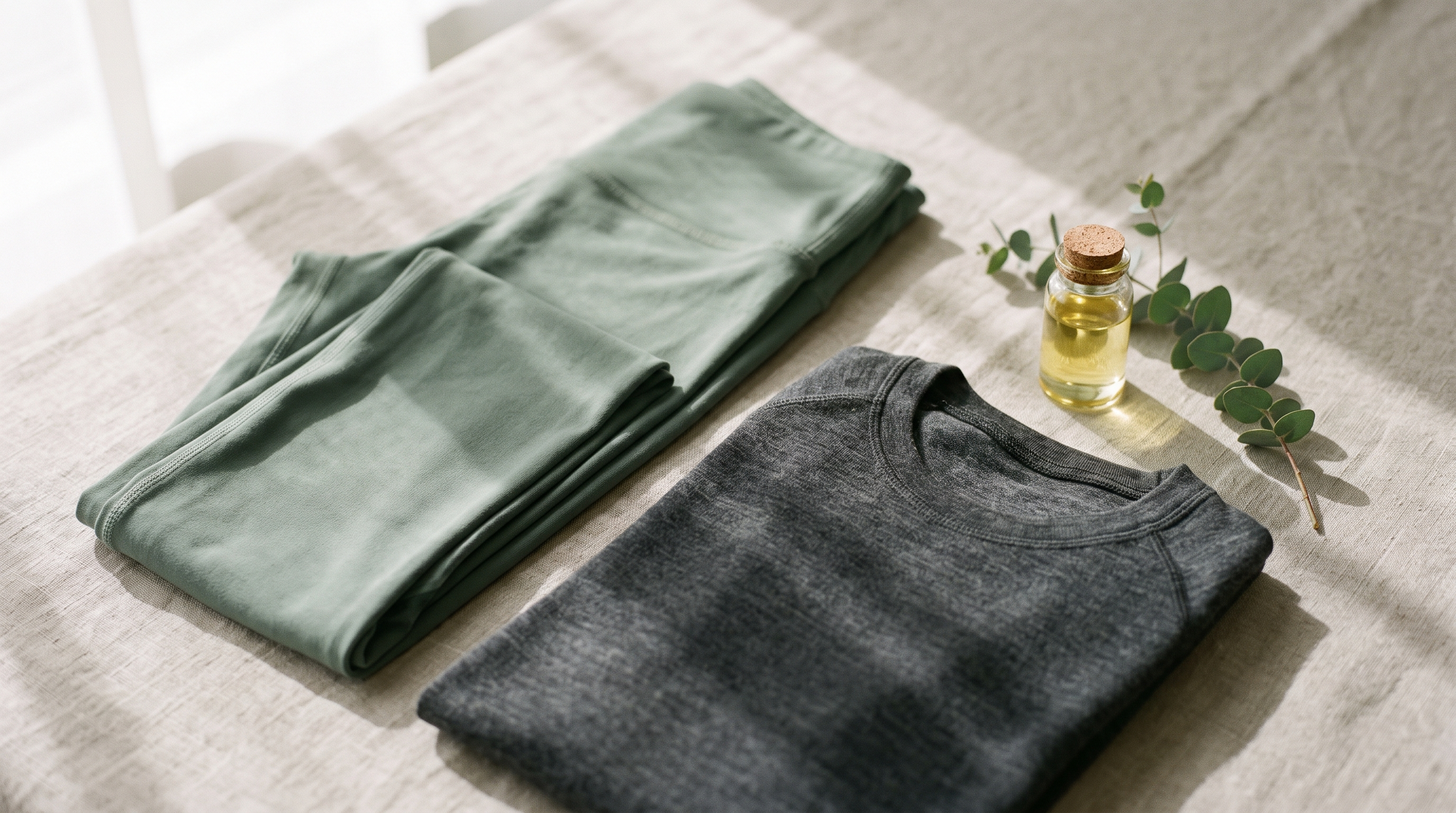
Genuinely plastic-free activewear comes from a short list of brands building garments out of natural fibers: organic cotton, merino wool, alpaca, or wood-pulp TENCEL instead of polyester, nylon, or recycled plastic. The standouts in 2026 include brands like Wayve, Nero, Tripulse, and Icebreaker.
The category is consolidating around three fiber families:
- TENCEL Lyocell and Modal: Lyocell, a biodegradable fiber known for its high tensile strength, moisture management, and softness, accounted for over 50 percent of the global Tencel fiber market share in 2026 due to rising demand in sustainable apparel.
- Merino wool blends: Consumer demand for sustainable, high-performance natural fibers is driving merino's growth. Merino wool has gained a reputation for its soft, breathable, moisture-wicking properties and now plays a major role in luxury apparel, activewear, and home textiles.
- Organic cotton: Familiar hand-feel, GOTS certification, and a very low chemical-risk profile, though it absorbs rather than wicks moisture.
True plastic-free activewear contains no polyester, no nylon, and no petroleum-based fibers. Most brands use TENCEL Lyocell, TENCEL Modal, organic cotton, or merino wool. Some also use hemp or bamboo-derived fibers. The stretch component is where it gets complicated. Nearly all activewear requires some elastane for mobility and fit, and elastane is technically synthetic. The question is how much, what kind, and whether it has been tested for harmful substances.
By 2028, the category will split into two tiers:
- Proof-led brands that publish third-party lab reports, disclose elastane percentage, and cite OEKO-TEX or GOTS certification on every SKU.
- Claim-led brands that use the word "natural" or "eco" without linking to test data.
Your customer will know the difference. TikTok creators are already framing the conversation as "slowly building out my non-tox activewear collection and saying goodbye to Lulu." The ask is shifting from aspiration to verification.
What will your customer be asking by 2028?
Three questions will dominate product-page scrutiny:
- What is the actual fiber content? Not "made with sustainable materials." The percentage, the fiber name, and whether the elastane is conventional or biodegradable.
- Is it PFAS-free? Creators are connecting the dots: "conventional activewear sits right against our largest organ while we sweat, absorbing forever chemicals, BPA, phthalates, and more."
- Does it shed microplastics? A 2025 lab study found that recycled polyester sheds even more microplastics than virgin polyester. Your customer has read the headline.
"Nobody wants microplastics going into their intimate areas whilst they're working out and sweating."
That quote is from a TikTok that has already circulated to the target demographic. The framing is visceral and specific. Your product page needs to answer it directly.
What does the cost math look like?
Here is where the category gets real. Switching from petroleum nylon to bio-based nylon or natural fiber blends is not a margin-neutral move.
Bio-based nylon (PA11 from castor oil)
PA11 carries a 20 to 30 percent cost premium over petroleum-based polyamides. Nylon 11 pricing is structurally higher due to its feedstock dependency on castor oil. PA11 requires a specialized monomer synthesis path that lacks the massive economies of scale found in Nylon 6 or Nylon 12 production.
Bio-based nylon manufacturing involves complex extraction and polymerization processes that require substantial water and energy input. Compared to petroleum-based nylon, production costs were higher in 2025 and 2026, limiting adoption among cost-sensitive manufacturers.
Sample math:
If your current legging COGS is $11 using conventional nylon 6,6, and you switch to a bio-based PA11 blend:
- Fabric cost increase: approximately 22 to 28 percent
- New landed COGS: approximately $13.40 to $14.10
- At a $78 ASP with 68 percent gross margin today, your margin drops to approximately 63 to 64 percent
That is recoverable if your customer pays a $10 to $15 premium for the positioning. If she does not, you are absorbing the delta.
TENCEL Lyocell or Modal
The global Tencel fiber products market valuation exceeded USD 4.5 billion in 2026. Modal is growing at a CAGR of approximately 6.8 percent, with expanding adoption in intimate wear and activewear.
Tencel is generally more price-stable than merino, but still carries a premium over polyester. Expect a 15 to 20 percent fabric-cost increase versus recycled poly.
Merino wool
Merino fibers can absorb up to 30 percent of their own weight in moisture without feeling wet. The performance is real, but so is the price volatility. Volatile wool prices push mills to balance composition without sacrificing feel. Most activewear brands are moving to merino blends rather than 100 percent merino to manage cost and pilling.
Where is the regulatory floor moving?
This is the section that changes your 2027 line plan.
United States: the state patchwork accelerates
As of mid-2026, at least 18 states have enacted class-based PFAS restrictions on consumer products.
California AB 1817 bans intentionally added PFAS in textiles, effective January 2025. Outdoor apparel for severe wet conditions must carry a "Made with PFAS chemicals" disclosure label. The total organic fluorine threshold drops from 100 ppm to 50 ppm in January 2027.
New York S.1322/A.994 prohibits apparel with intentionally added PFAS, effective January 1, 2025. Maine's sales ban on textile articles containing intentionally added PFAS took effect January 1, 2026.
Washington's reporting requirements for apparel with intentionally added PFAS took effect January 2026. First reports are due January 2027. Apparel and accessories may not contain intentionally added PFAS after January 1, 2027.
Vermont restricted PFAS in artificial turf, clothing, children's products, menstrual and incontinence products, personal care products, and textiles in 2026.
PFAS compliance for textiles is no longer a California-only problem. It is a multi-state litigation risk that turns on testing, documentation, and supply chain control.
Europe: PFHxA restriction lands in October 2026
The EU PFHxA restriction phases in on a staggered timeline: October 10, 2026 for clothing and accessories, footwear, food-contact paper and cardboard, consumer mixtures, and cosmetics. October 10, 2027 for other textiles for the general public. The thresholds are 25 ppb for PFHxA and its salts, or 1,000 ppb for PFHxA-related substances.
ECHA's Risk Assessment Committee adopted its opinion on the broad PFAS restriction proposal on March 3, 2026. ECHA's Socio-Economic Analysis Committee agreed its draft opinion on March 11, 2026, with a 60-day public consultation running from March 26 to May 25, 2026.
Further restrictions affecting textiles, footwear, and comparable products are expected to apply from October 2026 onwards, with broader bans foreseen from October 2027, subject to exemptions for medical devices, protective equipment, and other critical uses.
France: already in force
Since January 1, 2026, the manufacture, import, export, and placing on the market of certain consumer products containing PFAS has been prohibited in France. The products concerned include cosmetics, ski waxes, clothing textiles, and footwear.
What this means for your landed cost
If you sell into California, New York, the EU, and France, you are now managing four overlapping compliance regimes. Brands importing into the US or EU face overlapping rules, lab bills starting at $150 per SKU, and fines that scale with every shipment.
The compliance cost is not optional. It is a line item.
What to do this quarter
- Audit your current fiber content at the SKU level. Not the marketing claim. The actual mill certificate. If your legging says "recycled polyester" but your mill cannot produce a chain-of-custody document, you have a problem.
- Request total organic fluorine test data from your finishing supplier. If they cannot provide it, you do not know whether your DWR chemistry is PFAS-free. Compliance demonstration is required for fluorine content above 50 mg F/kg.
- Price out a pilot run in TENCEL or merino blend. Do not commit to a full line until you know your actual landed cost and your customer's willingness to pay. Run a 200-unit test, track sell-through, and watch returns for fit and pilling complaints.
- Map your state-by-state exposure. If you ship to California, New York, Maine, Vermont, and Washington, you already have five overlapping PFAS rules in effect or phasing in by 2027. Build a compliance calendar.
What to do in the next 12 months
- Decide whether you are proof-led or claim-led. The middle ground is disappearing. If you publish lab data, you build trust. If you do not, you are competing on price against brands that do.
- Lock in your fiber supplier for 2028. The bio-based nylon market is projected to grow from USD 1.69 billion in 2026 to USD 7.77 billion by 2034 at a CAGR of 20.80 percent. Capacity is expanding, but so is demand. If you wait until Q4 2027, you will be competing for allocation.
- Build material proof into your product page architecture. Not a sustainability landing page buried in your footer. The fiber content, the test report, and the certification should be visible on the PDP, above the fold, next to the size chart. This is the format that OHZEHN-TEX(TM) is designed for: proof as a product attribute, not a marketing afterthought.
- Prepare for the EU PFHxA deadline. If you sell into Europe, your October 2026 shipments must already be compliant. That means your Q1 2026 production run needed to use reformulated finishes. If you missed that window, you are now remediating inventory.
For a deeper breakdown of what plastic-free means at the fiber level, see the plastic-free activewear guide.
The category is real. The question is whether your material story is.
The sustainable apparel market was valued at USD 10.04 billion in 2025 and is projected to reach USD 37.07 billion by 2035, registering a CAGR of 14.0 percent. Plastic-free activewear is a defined slice of that market, and it is consolidating around brands that can prove what they claim.
The cost math is not trivial. The regulatory floor is not static. But the consumer question is clear: prove it.
Sources
https://www.bluesign.com/pfas-in-clothing https://www.morganlewis.com/pubs/2026/01/state-regulation-of-pfas-in-consumer-products-continues-to-gain-momentum-in-2026 https://www.saferstates.org/resource/2026-analysis-of-state-policy-addressing-toxic-chemicals-and-plastics/laws-going-into-effect-in-2026/ https://www.buchalter.com/blogs/how-state-by-state-product-bans-are-fueling-demand-letters-across-textiles-apparel-and-cosmetics/ https://sbifinishing.com/pfas-free-stain-protection-options/ https://www.oneaimapparel.com/blog/pfas-apparel-compliance-guide/ https://www.fortunebusinessinsights.com/bio-based-nylon-market-113757 https://www.giiresearch.com/report/fbs1916451-bio-based-nylon-market-size-share-growth-global.html https://wayvewear.com/blogs/read-our-blog/best-plastic-free-activewear-brands https://everyrep.com/best-non-toxic-activewear-brands/ https://www.tiktok.com/@sbkliving/video/7634612953538383135 https://www.tiktok.com/discover/non-toxic-activewear https://tocco.earth/article/which-eu-pfas-ban-applies-to-your-brand https://www.pinsentmasons.com/out-law/guides/pfas-regulation-eu https://www.safic-alcan.com/en-fr/industry-articles/reach-2026-restricted-substances/ https://www.gminsights.com/industry-analysis/sustainable-clothing-market https://www.snsinsider.com/reports/sustainable-apparel-market-3920 https://textileus.com/nylon-11/ https://www.verifiedmarketreports.com/product/tencel-fiber-products-market/ https://www.expertmarketresearch.com/reports/merino-wool-market https://www.regentech-fashion.com/blogs/fabric-trends/merino-wool-blends-premium-activewear-2026