I have stood in finishing rooms where the tech pack said "PFAS-free" and the marketing brief said "stain-resistant." Those two claims do not live on the same planet. Here is what actually happens when a brand switches from C6 DWR to C0, and why the PFAS-free leggings hitting your production line may not behave the way your customer expects.
What the marketing page says
The product page will say the leggings are fluorine-free, water-repellent, and safe. It will mention OEKO-TEX or bluesign certification. It will call out sustainability, maybe show a leaf icon. The implication: you are getting all the performance of the old chemistry without the health or environmental risk.
PFAS-free clothing has come a long way, thanks to major advances in textile technology. Today, you can find plenty of options that do not sacrifice durability or style. While early alternatives sometimes fell short on performance, continued innovation has closed that gap. That is what the positioning says. The line lead's job is to ship. The chemist's job is to hit the spec. When those two conflict, the test report tells you where the gap actually is.
What is actually happening on the finishing line?
C0 DWR is the industry shorthand for a fluorine-free, non-fluorinated water-repellent finish. C0 DWR is a PFAS-free, non-fluorinated water-repellent finish. Instead of relying on fluorinated chemistry like C6, C0 uses hydrocarbon-based chemistry to help water bead and roll off a fabric's surface. This allows water repellency without the environmental concerns and regulatory pressures associated with PFAS-containing finishes.
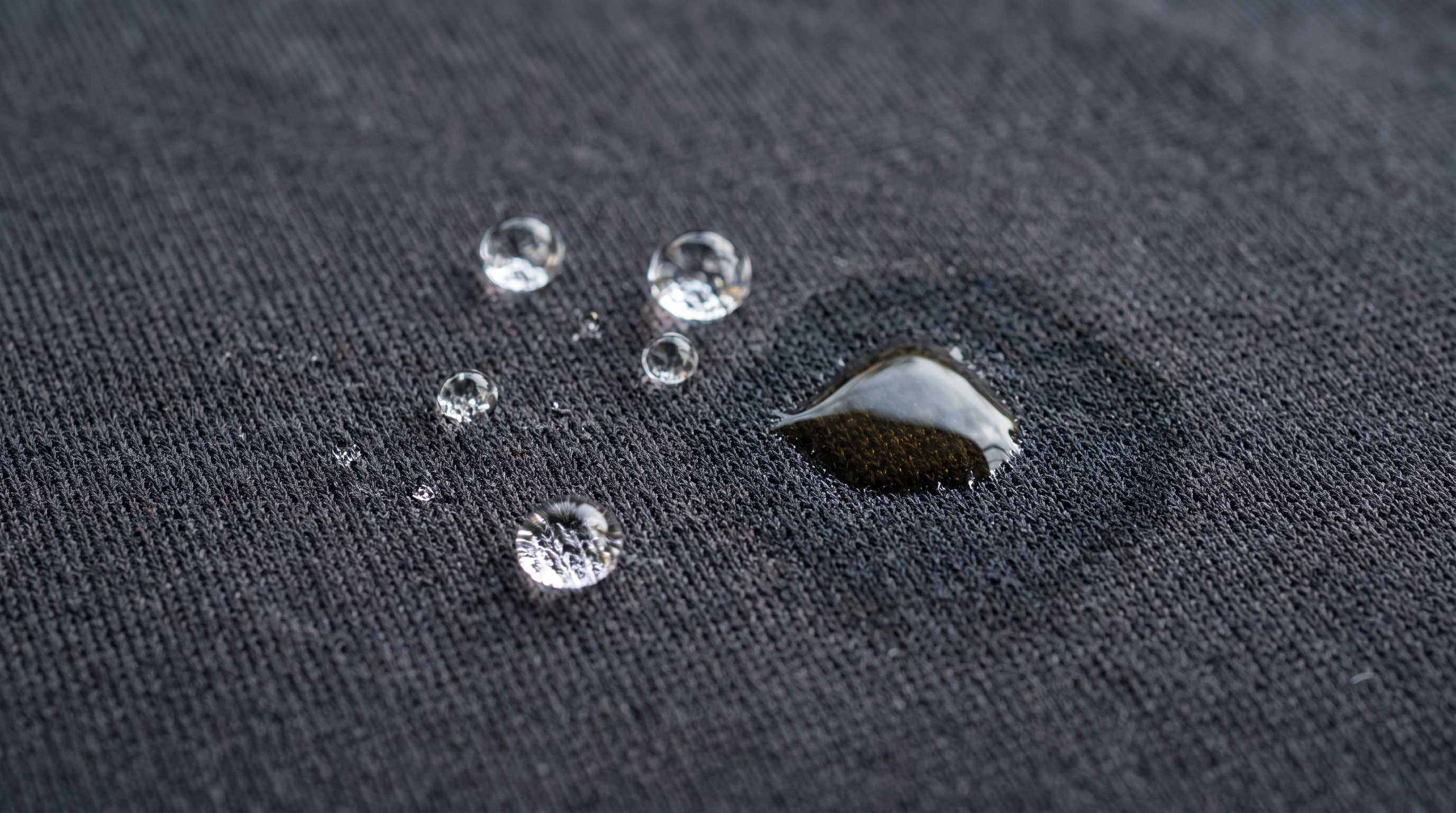
On the spray test, C0 performs. The water beads. The fabric passes initial inspection. Fluorine-free DWR chemistries match short-chain PFAS water repellency on AATCC 22 spray ratings up to 80 out of 100, though oil repellency stays weaker. That 80/100 is decent. It is close enough that a brand can claim water repellency in good faith.
But here is the problem: water is not the only thing your customer's leggings will touch.
Why does C0 fail the oil repellency test?
The chemistry is simple if you know where to look. Common oils have surface tensions of only 18-33 mN/m; for a surface to repel oil as well, its critical surface tension must fall below even that, down to a few mN/m. A close-packed array of -CF3 groups delivers the lowest known solid surface tension at ~6 mN/m, whereas -CH3 groups bottom out at only 22-24 mN/m. So while hydrocarbon and silicone chemistries comfortably defeat water (72 mN/m), oil repellency is in practice a zone reachable only with fluorine. That single fact explains why a PFAS-free fabric stays weak against oils, sunscreen and skin oils.
This is not a supplier cutting corners. This is physics. The carbon-fluorine bond creates a surface energy so low that even olive oil beads up. Hydrocarbon-based C0 finishes cannot get there. PFAS-free oil repellency is one of the holy grails of current textile finishing, because unlike water repellency, oil wets textile surfaces much easier. There are many academic groups and chemical manufacturers working on solving this issue and there might be an available commercial solution on the market as soon as in the year 2026, based on hyperbranched polysiloxanes.
Until that solution lands and proves out on your fabric weight, your PFAS-free leggings will stain more easily and wet out faster when body oil, sunscreen, or sweat accumulates on the surface.
What does body oil actually do to the finish?
A build-up of dirt and other surface contaminants such as body oil, salt, sunscreen and sweat can reduce the effectiveness of the textile's durable water-repellent treatment, affecting performance and breathability. Dirt also allows water molecules to be drawn into the face fabric, saturating or 'wetting out' the fabric and leading to increased levels of condensation on the inside of the garment. Oils can have a degrading effect on the fabrics and treatments while salt and debris can act to abrade membranes and fibres over time.
This is not theoretical. Anyone who has worked quality on an activewear line has seen it: leggings come back from the returns room because the customer says they "stopped repelling sweat" after a few wears. The fabric looks fine. The DWR polymer is still there. But body oil and sunscreen have contaminated the surface, masking the finish and letting water soak through.
DWR durability is not a fixed property; it is a function of how aggressively the surface chemistry is abraded, washed, or contaminated in use. Four mechanisms drive degradation: Friction from straps, pack belts, brush, and skin contact physically wears the polymer film off the fiber surface. Areas of high abrasion lose DWR performance measurably faster than low-contact zones. Detergent residues from home laundering, particularly anionic surfactants, leave behind hydrophilic residue on the fiber surface that defeats DWR beading. Critically, this often makes an undamaged DWR finish appear to fail after washing: the polymer is still present, but the surface is masked by contamination.
With C6, the finish has some oil repellency baked in. It pushes back against the contamination longer. With C0, the contamination wins faster.
How do you measure the gap in the lab?
The test you need is AATCC 118: Oil Repellency, Hydrocarbon Resistance. This test method detects the presence of a fluorochemical finish, or other compounds capable of imparting a low energy surface, on all types of fabrics, by evaluating the fabric's resistance to wetting by a selected series of liquid hydrocarbons of different surface tensions.
The procedure is straightforward. Beginning with the lowest numbered test liquid, one drop is placed on each of three locations at least 5 mm apart. The drops are observed for 30 seconds. If, at the end of this period, two of the three drops are still spherical in shape with no wicking around the drops, three drops of the next highest numbered liquid are placed on adjacent sites and similarly observed. The procedure is continued until one of the test liquids results in two of the three drops failing to remain spherical to hemispherical, or wetting or wicking occurs. The oil repellency rating of the fabric is the highest numbered test liquid for which two of the three drops remained spherical to hemispherical, with no wicking for 30 seconds.
Grade 0 is the lowest oil repellency, while grade 8 is the highest oil repellency.
C6-treated fabrics typically score 4 to 6. C0-treated fabrics score 0 to 2. That is the gap. And that gap is where your customer's sunscreen lives.
What are brands actually doing about this?
C0 DWR is a water-repellent treatment made without PFAS that provides water resistance on par with C6 DWR. While its initial performance is comparable, the absence of oil repellency makes it more vulnerable to degradation over time, as accumulated body oils and dirt can diminish its effectiveness with repeated use. Although C0 DWR has a lower environmental impact than PFAS-based treatments, a key challenge remains, particularly for technical products, as it may accelerate fabric wear and functional decline, ultimately reducing the product's lifespan.
Some brands are honest about this. Yamatomichi, for example, chose to move their 5-Pocket series to C0 DWR because "the lack of oil repellency does not affect its intended performance" for that product. That is the right call: know your use case, spec accordingly.
Fluorine-free DWRs may require more frequent reactivation, usually via heat such as a tumble dry or iron, to maintain performance. Additionally where fluorine-free treatments fall short is oil and stain resistance.
Other brands are moving forward without updating the care instructions or the marketing. That is where the returns room gets busy.
Why is this happening now?
The regulatory floor moved. As of 2026, several U.S. states (including California, New York, Maine, Vermont, and Connecticut) and European countries (France and Denmark) have enacted bans or restrictions on PFAS in consumer textiles.
The levels ranged from 10 to 284 parts per million. For context, California's new law banning PFAS in apparel draws the line at 100 ppm. Some tested leggings were well above that threshold.
Brands have to move off fluorinated chemistry. The choice is not whether to switch to C0. The choice is whether to switch with honest specs or pretend the performance is identical.
What does the testing actually catch in PFAS-free activewear?
Mamavation sent 32 pairs of activewear, mostly workout leggings and yoga pants, to an EPA-certified lab to test for organic fluorine, which is an indicator of PFAS. Each pair of activewear was tested for organic fluorine in the crotch area. The crotch area is the most common area to find detectable organic fluorine, which is a marker for PFAS, including inside the crotch of LulaRoe leggings, which was found at 284 parts per million. 25% of the workout leggings, yoga pants, and leisure leggings sent to the lab came back with detectable levels of organic fluorine.
The testing catches fluorine. It does not tell you whether the finish will survive ten hot yoga sessions with sunscreen and body oil on the customer's skin. That is where AATCC 118 matters.
What should a brand founder actually do about this?
First, stop asking your supplier for "PFAS-free DWR" as if that is a single checkbox. Ask for three data points:
- AATCC 22 spray rating (water repellency), initial and after 10 home washes
- AATCC 118 oil repellency grade, initial
- Spray rating after oil contamination test (if your supplier's lab runs it)
If your supplier cannot produce AATCC 118 data, they are shipping you a finish they have not fully characterized. That is fine if you are selling untreated leggings. It is not fine if your marketing says "repels sweat and stains."
Second, update your care instructions. Fluorine-free DWRs may require more frequent reactivation, usually via heat such as a tumble dry or iron, to maintain performance. If your C0-treated leggings need a tumble dry after every three wears to restore beading, say so. The customer will thank you later.
Third, know your use case. C6 offers moderate oil repellency, while C0 provides limited or no oil protection. If your product regularly comes into contact with oils, lotions, or heavy abrasion, this is an important consideration. Yoga leggings that touch sunscreen, body lotion, and sweat all day are a different spec than a hiking pant that mostly sees rain.
For a deeper look at what "PFAS-free" and "plastic-free" actually require across your full line, see the plastic-free activewear guide.
What should I want to see in a supplier's lab report?
Here is what I would ask for, lot by lot:
Water repellency
- AATCC 22 spray rating, initial: target 80+
- AATCC 22 spray rating after 5 home washes (AATCC 135 wash method): target 70+
Oil repellency
- AATCC 118 grade, initial: expect 0-2 for C0 finishes
- If the grade is 0, ask: does your marketing promise stain resistance? If yes, rewrite the marketing.
Durability under contamination
- Ask if the supplier has run a simulated body-oil contamination test. Most have not. The ones who have will tell you how fast the spray rating drops.
Certification scope
- Certifications like OEKO-TEX Standard 100 and the Global Organic Textile Standard (GOTS) indicate that a product has been tested for harmful substances, including PFAS. But these are finished-product tests. They do not tell you whether the DWR will last. Proactive chemical management, starting at the input stage rather than relying solely on end-product testing, is essential to reduce impact and stay ahead of tightening global standards.
If you are building a line that needs both PFAS-free compliance and meaningful stain or oil performance, you are in the waiting room. The hyperbranched polysiloxane solutions are coming. They are not here at scale. In the meantime, the honest spec says: water repellency yes, oil repellency no. OHZEHN-TEX(TM) exists in part because this kind of clarity is what brands actually need.
The honest answer is that C0 DWR is a real improvement for the planet and a real tradeoff for the garment. Your job is to tell the customer the truth before the returns room tells you.
Sources
https://www.mmitextiles.com/blog/switching-to-c0-dwr-what-you-need-to-know/ https://www.fersantekstil.com/en/knowledge/durable-water-repellent-pfas-free.html https://www.yamatomichi.com/en/news/323461 https://www.bluesign.com/pfas-in-clothing https://learn.pfasfreelife.com/research/pfas-in-workout-clothes-what-your-activewear-isnt-telling-you https://mamavation.com/product-investigations/non-toxic-activewear-guide-pfas-workout-leggings-yoga-pants.html https://www.thegoodtrade.com/features/pfas-free-clothing/ https://theomm.com/faq/product-care-instructions/ https://www.honryfleece.com/dwr-on-fleece-explained-what-b2b-buyers-must-know-in-2026/ https://specialtyfabricsreview.com/2023/07/01/pfas-regulations-prompt-innovation/ https://wearfoehn.com/blogs/journal/the-future-of-dwr-why-pfas-free-water-repellency-matters https://www.oneaimapparel.com/blog/pfas-apparel-compliance-guide/ https://law.resource.org/pub/us/cfr/ibr/001/aatcc.tm.118.1997.pdf https://ohzehn-tex.com/plastic-free-activewear/