I have stood in the returns room at 7:30 in the morning, watching the intake team sort defect codes into buckets. The categories are predictable: ran small, ran large, color off, fabric feel, function failure, quality defect. Six buckets cover 90 percent of what comes back.
The bucket that changes the fabric spec is "fabric feel." And within fabric feel, the word that appears most often is "pilling."
What does the marketing page say about natural fiber activewear?
The marketing page says natural fiber activewear is soft, breathable, biodegradable at end of life, and free from microplastic shedding. The marketing page says organic cotton is GOTS certified. The marketing page says merino wool is naturally odor-resistant.
The marketing page does not say: pilling complaints run higher on natural fibers than on filament synthetics. The marketing page does not say: fine merino is more susceptible to abrasion than coarser fibers. The marketing page does not say: when the returns room starts logging pilling at 8 percent of units on a SKU, the spec rewrites itself.
Why does natural fiber activewear pill more than polyester?
The answer is fiber length and fiber tenacity.
Synthetic fibers like polyester and nylon are continuous filaments with no staple ends to migrate. Natural fibers are different. They are staple fibers, meaning they have finite lengths. Cotton staple runs 25 to 35 millimeters for standard varieties, longer for Supima. Merino wool staple depends on the micron count and the breed.
According to Bellissima's technical comparison, "Merino fibers, precisely because they are fine, are more susceptible to abrasion than coarser fibers." High-friction areas like the inner thigh of leggings and the underarm of a sports bra wear faster in merino than in synthetic or TENCEL-blended fabrics. Research from the Wool Research Organisation of New Zealand has documented accelerated pilling and fiber breakage in fine merino under sustained abrasion conditions.
This is not a defect in the fabric. This is what staple fibers do. The short ends migrate to the surface under friction, tangle together, and form pills.
What does the Martindale pilling test actually measure?
The two standards you will see most often are ASTM D4970 and ISO 12945-2. Both use the Martindale tester.
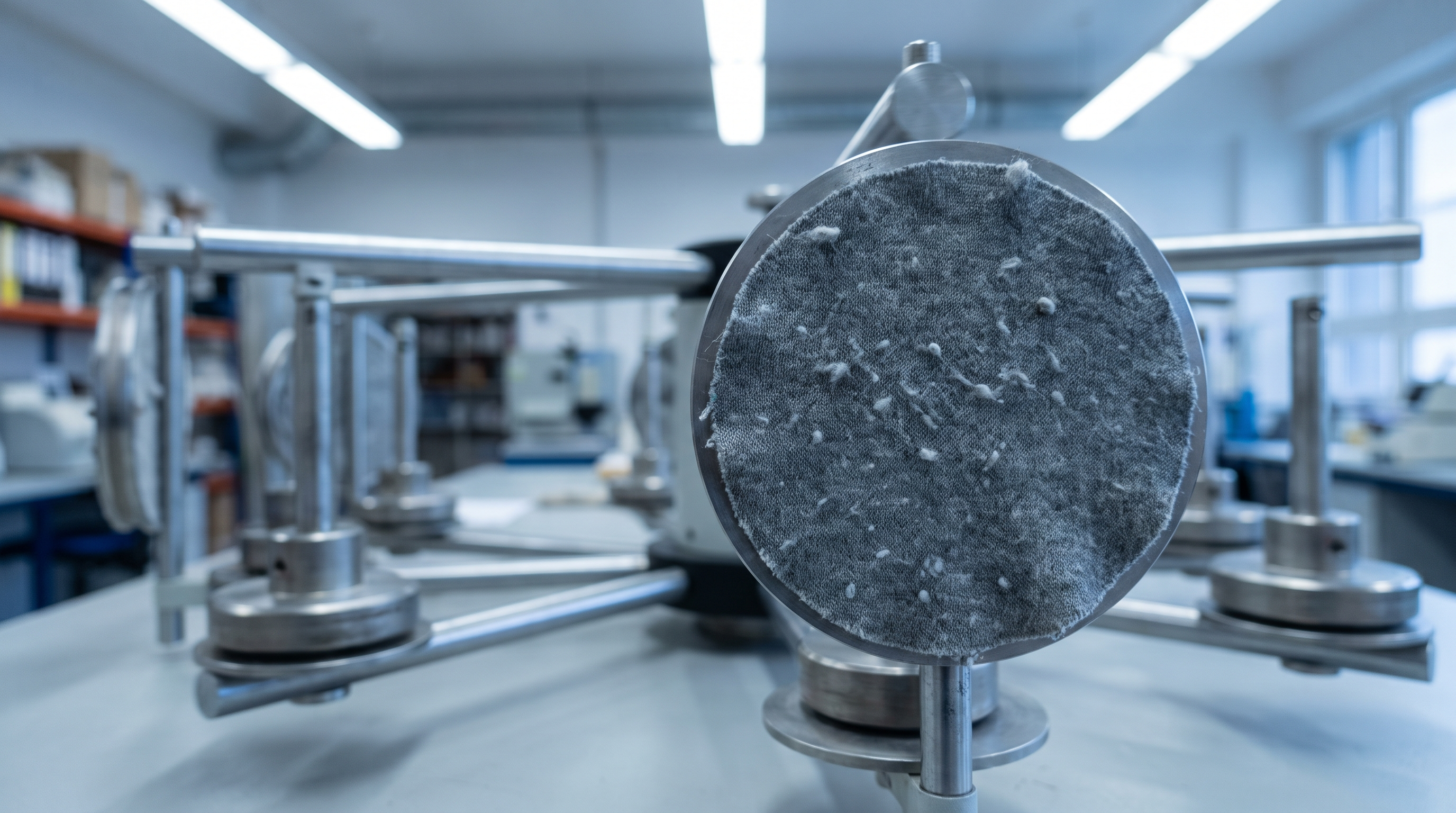
ISO 12945-2 specifies a method for the determination of the resistance to pilling, fuzzing, and matting of textile fabrics using a modified Martindale method. The tester moves circular specimens against the same fabric or a wool abradant cloth under defined pressure, forming a Lissajous figure motion trajectory. After reaching the specified number of cycles, the pilling grade of the sample is assessed.
The grading scale runs from 5 to 1. Grade 5 means zero pilling. Grade 4 means slight surface fuzzing or a few isolated pills. Grade 3 means moderate pilling, clearly visible. Grade 2 and Grade 1 mean the fabric is failing.
As BeGoodTex's testing guide notes, "A Grade 5 rating means the fabric will never pill" is a misconception. It only indicates that no visible change occurred within the specific laboratory cycle limit.
The cycle count matters as much as the grade. A fabric that passes Grade 4 at 2,000 cycles might fail at 5,000. The spec sheet needs to state both the grade and the cycle count.
What happens when pilling complaints stack up in the returns room?
Here is what I have seen. A brand launches a natural fiber legging with a fabric that tested at Grade 3.5 on 3,000 Martindale cycles. The hand feel at retail is beautiful. Soft, buttery, exactly what the customer expects from a $95 organic cotton or merino product.
Three months later, the returns data shows pilling complaints running at 9 percent on that SKU. According to Warp Speed's activewear fulfillment data, "Six buckets handle 90 percent of activewear returns: ran small, ran large, color mismatch, fabric feel, function (compression too tight, pocket placement), and quality defect." Pilling falls into fabric feel.
The returns team codes it as "fabric feel" because the customer describes the product as looking "worn out" or "fuzzy" after a few washes. The merchandising team escalates. The technical team pulls retained samples from the original shipment. They run the pilling test again, this time at 5,000 cycles. The fabric degrades to Grade 2.5. That is the gap between shelf presentation and wash durability.
The spec rewrites itself. The next production order reads: "Must pass ISO 12945-2 at Grade 4 minimum, 5,000 cycles."
What changes on the fabric to hit the new spec?
To move from Grade 3 to Grade 4, something has to give. The options are:
Yarn twist
According to Shanghai Garment's fabric guide, "High-twist yarns consequently produce harder, sometimes crisper fabrics that offer excellent durability and pilling resistance. Alternatively, low-twist yarns, often employed for ultra-soft hand feels, permit easy fiber escape."
Number Analytics research confirms that "high twist yarns generally produce stronger, more resistant fabrics due to their compact structure, which reduces the likelihood of fibers breaking or pilling."
The trade-off: higher twist means firmer hand feel. The buttery softness that sold the product at retail disappears.
Knit density
Denser fabric construction means fewer gaps for fiber ends to escape through. A 250 GSM interlock knit has more structural resistance to surface fiber migration than a 180 GSM single jersey.
The trade-off: denser fabric is heavier fabric. The lightweight feel that natural fiber activewear markets as a benefit gets compromised.
Fiber blend
As Bellissima notes, "Pure merino wool has natural elasticity, but it does not match the recovery of spandex-blended fabrics under high-stretch, high-repetition movement." Most merino activewear addresses this by blending in synthetic fibers, typically nylon or spandex, which reintroduces the synthetic material concern through a different route.
The trade-off: the "100 percent natural fiber" claim becomes "85 percent natural fiber with 15 percent elastane." The marketing page needs to change.
Fiber selection
Shanghai Garment explains: "Long-staple cotton varieties, including Supima and Egyptian cotton, possess fibers substantially longer than conventional cotton. These elongated fibers transform into finer, stronger, and smoother yarns during spinning."
The trade-off: long-staple cotton costs more than standard cotton. The COGS math changes.
Why does the softness-durability trade-off matter for brand founders?
"This desirable softness therefore comes with the trade-off of increased pilling propensity, requiring careful consideration during product development."
That line from Shanghai Garment captures the tension every natural fiber activewear brand faces.
The returns room conversation changes three things:
1. The acceptable grade threshold. If pilling complaints run above 5 percent on a SKU, the next spec tightens from "Grade 3 acceptable" to "Grade 4 minimum."
2. The cycle count. Testing at 2,000 cycles tells you what the fabric looks like after light wear. Testing at 5,000 or 7,000 cycles tells you what it looks like after the customer has washed it 15 to 20 times. The returns room tells you which number matters.
3. The softness-durability balance. According to Warp Speed's data, "Returns add another 60 to 80 percent on top of outbound fulfillment cost because of inbound shipping, intake labor, and disposition cost on B-grade or defect units."
If pilling drives 2 or 3 percent of that return rate, the math changes. A tighter spec costs more per yard. But the alternative is watching margin disappear into the returns room.
What does the health trade-off look like?
Natural fiber activewear is a legitimate category. The health concerns around synthetic activewear are documented.
According to FiberCheck's 2026 analysis, "Sweat acts as a chemical solvent. Research shows that sweat dissolves chemical residues from fabric and drives them into direct contact with skin." A 2025 study published in Environmental Science & Technology found that sweat can increase chemical absorption from textiles significantly compared to dry fabric contact.
Boldwill's technical overview notes that "dermally absorbed EDCs enter the systemic circulation directly. This creates a unique exposure profile for athletes where the very act of training might accelerate the absorption of the chemicals found in their technical apparel."
Customers who want plastic-free activewear are not wrong to want it. But the pilling trade-off is real too.
What would I want to see in a supplier's lab report?
If you are sourcing natural fiber activewear, here is the pilling data I would ask for:
- ISO 12945-2 or ASTM D4970 test report, lot by lot. Not a generic mill certificate. The actual test report for the lot you are buying.
- Cycle count at test. If the report shows Grade 4 at 2,000 cycles, ask what the grade is at 5,000.
- Post-wash testing. Washing typically loosens the fiber structure, leading to a decrease in the pilling grade.
- Yarn twist specification. Ask for turns per inch. If the supplier cannot tell you, they are not controlling the variable that matters most for pilling.
- Staple length. For cotton, ask whether it is ring-spun from combed long-staple fiber or open-end spun from shorter staple.
As Darong Tester's technical guide explains, "High twist yarn are compacted and limit the outward migration of the fibers, but excessive twists makes the fabric stiffer and affect drape." The spec needs to find the balance.
What does the trade-off look like for a brand founder?
The line lead's job is to hit the ship date. The chemist's job is to hit the spec. When those two conflict, what gets cut is testing rigor. The returns room catches it three months later.
The honest answer is that natural fiber activewear cannot match the pilling resistance of filament polyester without compromising something. The question is what you are willing to compromise.
OHZEHN-TEX(TM) exists to put that testing data into the hands of brand founders before the production order ships, not after the returns stack up.
"Pilling isn't an unavoidable garment destiny, it's a predictable outcome determined by fiber selection, yarn quality, and construction methods."
That is the sentence I would want every natural fiber activewear founder to read before they sign off on the next lot.
Sources
https://livebellissima.com/blogs/news/merino-wool-vs-tencel https://www.iso.org/obp/ui/#iso:std:iso:12945:-2:en https://begoodtex.com/blog/iso-12945-textile-pilling-and-fuzzing-test-standards/ https://gowarpspeed.com/industries/apparel-fashion/activewear https://shanghaigarment.com/what-are-the-best-fabrics-for-reducing-pilling-in-clothing/ https://www.numberanalytics.com/blog/ultimate-guide-yarn-twist-textiles-materials https://fibercheck.app/blog/are-gym-clothes-toxic-pfas-bpa-chemicals-activewear/ https://www.boldwill.com/pages/endocrine-disruptors-in-sportswear https://darongtester.com/fabric-pilling/ https://ohzehn-tex.com/plastic-free-activewear/