
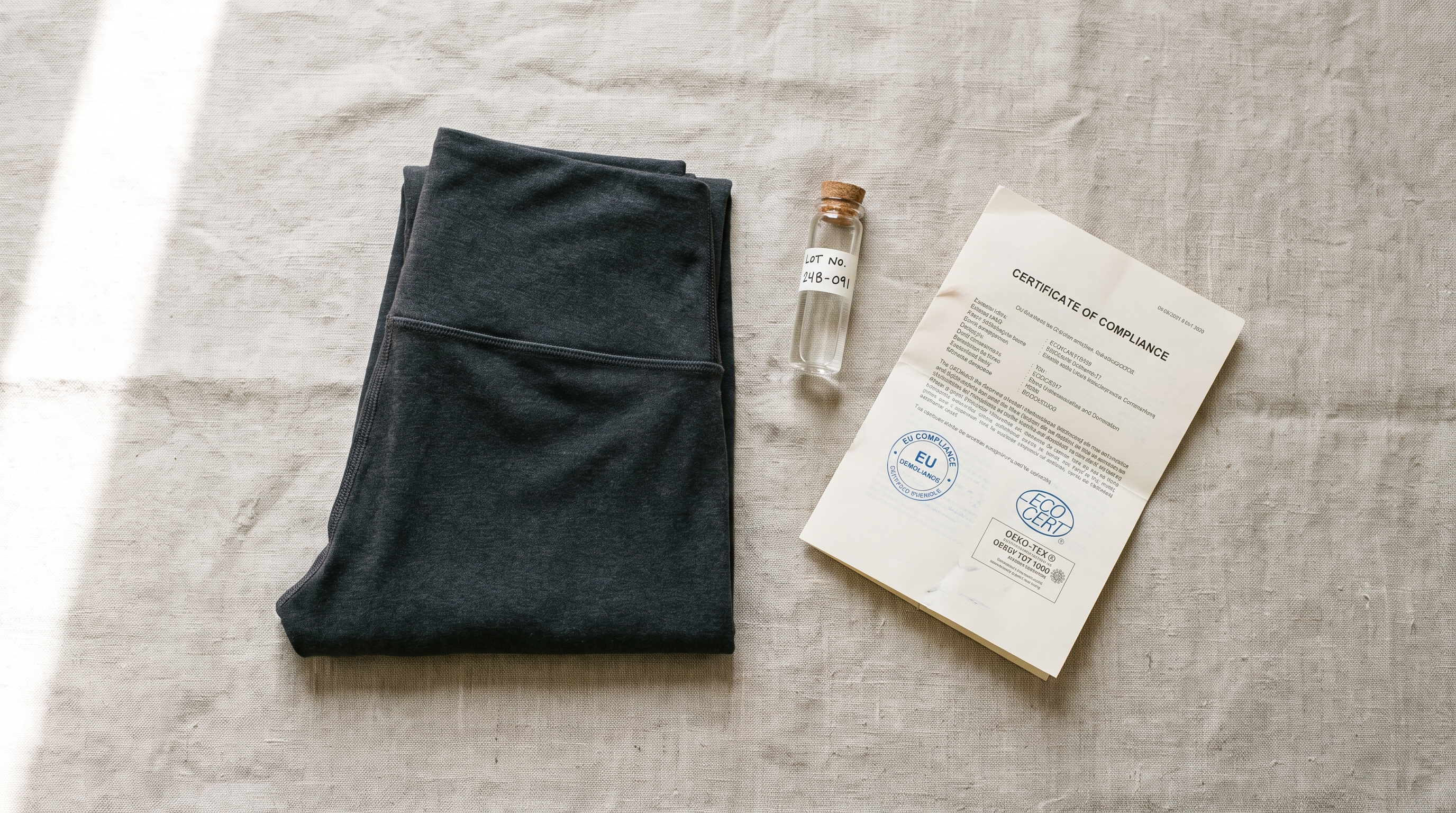
You are about to spec your 2027 line. Your fabric choices will lock in landed cost, compliance exposure, and marketing story for the next 18 months. The regulatory floor under PFAS is moving faster than most founders realize. Here is what you need to know before your next PO.
The category in 24 months
The activewear market is bifurcating. One track is the established synthetic performance category. It remains dominant in unit volume but faces accelerating regulatory and reputational headwinds. The other track is the plastic-free activewear category. still small, but pulling attention from founders, consumers, and answer engines.
The consumer base for activewear made of natural materials like cotton and wool is growing, as more people on the political right join progressives in worrying about the health effects of polyester and other synthetics. This convergence is rare. It suggests durable demand, not a trend cycle.
The math on PFAS-free clothing is straightforward. In 2026 alone, new PFAS restrictions took effect across multiple U.S. states and European countries, with additional deadlines approaching throughout the year. If your supply chain cannot document PFAS-free status at the lot level, you cannot ship to California, New York, Maine, or Vermont without exposure.
By mid-2028, the floor rises again. In 2032, three states, Maine, Minnesota, and New Mexico, will ban all products sold or distributed in their states from containing intentionally added PFAS, unless the product meets an exemption. That is not distant. It is within your current product lifecycle.
What your customer is going to ask
In Q1 2025, very few consumers asked about PFAS in leggings. By Q3 2026, the question is common. TikTok creators are framing the issue clearly. "We've normalized working out, 'being healthy,' and wanting to look cute… while ignoring what those clothes are actually made of. And it shouldn't be a trade-off. Feeling good in your body shouldn't come at the cost of exposing it to unnecessary toxins."
The specific questions your customer will ask:
- Is this PFAS-free?
- Is this plastic-free?
- Do you test every lot?
- What certifications back the claim?
If your PDP cannot answer those questions with documentation, the customer moves to a brand that can. Non-toxic activewear brands that feel like Lululemon and Alo without the risk of PFAS and microplastics being absorbed into your skin during workouts is the search intent you are competing for.
The cost math
The cost delta depends on what you are switching from and what you are switching to. Here are the baseline numbers as of Q2 2026.
Petroleum-based nylon (PA6)
During the first quarter of 2026, the PA6 (nylon 6) prices in the USA reached 3031 USD/MT in March. That is approximately $3.03 per kg at the resin level.
Bio-based nylon (PA11)
Virgin PA11 lands at INR 6,800 to 7,500 per kilogram in India. At current exchange rates (roughly 83 INR to 1 USD), that translates to approximately $81 to $90 USD per kg for virgin powder. However, this is for industrial SLS powder, not textile-grade fiber. For fiber applications, PA11 carries a 20–30% cost premium over petroleum nylon, putting textile-grade bio-based nylon in the $3.90 to $4.50 per kg range when comparing like-for-like fiber.
What this means for your COGS
Assume your current legging uses 200g of nylon fabric. At $3.00/kg for petroleum nylon, your fiber cost is approximately $0.60 per unit. At $4.20/kg for bio-based nylon, that becomes $0.84 per unit. The delta is $0.24 per unit at the fiber level.
After knitting, dyeing, finishing, cut-and-sew, and landed cost, the total COGS delta is typically 8–15% higher for a bio-based nylon garment versus a petroleum nylon garment at today's scale. If your current COGS is $12.00, expect the bio-based equivalent to land at $12.96 to $13.80.
The scale curve is favorable. As production technologies improve and costs gradually decline, bio-based nylon is expected to become a mainstream alternative to conventional petroleum-based polymers across multiple industries.
The PFAS-free finish cost
If you are switching from a fluorinated DWR to a C0 (PFAS-free) DWR, expect the finish cost to be roughly equivalent at scale. The transition cost is in reformulation, not in the chemistry itself. Budget $5,000 to $15,000 for reformulation testing across your core SKUs.
Where the regulatory floor is moving
United States
California AB 1817 bans intentionally added PFAS in textiles, effective January 2025. Outdoor apparel for severe wet conditions must carry a "Made with PFAS chemicals" disclosure label. The total organic fluorine threshold drops from 100 ppm to 50 ppm in January 2027.
New York S.1322/A.994 prohibits apparel with intentionally added PFAS, effective January 2025.
Vermont (Act 54) prohibits manufacturers from making clothing and other consumer products with intentionally added PFAS, effective January 2026.
In Maine, a broad ban on unnecessary uses of PFAS is taking effect across products such as clothing, cleaning products, cookware, dental floss, children's products, food packaging, menstrual products, personal care products, ski wax, and textiles.
Minnesota's law has garnered national attention because it applies to any product sold or distributed in Minnesota containing intentionally added PFAS, with very few exemptions. The deadline to submit initial reports is July 1, 2026.
The pattern: The trend accelerates in 2027, when eight states will have new restrictions go into effect for dozens of products.
European Union
The new Registration, Evaluation, Authorisation, and Restriction of Chemicals (REACH) Regulation restrictions on the use of perfluorohexanoic acid (PFHxA) and PFHxA-related substances will apply from 10 October 2026.
The measure covers the use of these substances in textiles, leather, furs, and hides in clothing, footwear, and related accessories for the general public.
If you switched from PFOA to PFHxA-based chemistry in the last few years, and many companies did, that "compliant" replacement is itself getting banned. This is the risk many brands have not mapped.
ECHA's Risk Assessment Committee (RAC) adopted its opinion on the restriction proposal on 3 March 2026, completing a comprehensive evaluation of PFAS hazards, emissions, and risks. The universal PFAS restriction under REACH covers more than 10,000 substances. The direction is clear.
France
Under this regulation, the manufacture, import, export, and marketing of products containing PFAS are prohibited as of 1 January 2026. France moved ahead of the EU-wide timeline.
Denmark
The Danish government has introduced a national ban on PFAS in clothing, shoes, and waterproofing agents.
Practical implication
Brands and manufacturers operating across multiple markets now face overlapping requirements with different timelines, thresholds, and exemption structures. If you sell in California, New York, France, and Germany, your lowest common denominator is no intentionally added PFAS. That is your spec.
What to do this quarter
- Audit your current finishes. Request total organic fluorine (TOF) testing on your core SKUs. The threshold you need to beat is 50 ppm (California, effective January 2027). Many brands assume their suppliers have handled this. They have not.
- Map your supply chain to state-by-state requirements. Due to the complexity of product supply chains and the prevalence of imported products or components, it is critical for companies to develop internal due diligence programs and arrangements with suppliers to mitigate potential regulatory and litigation liability.
- Request certificates of compliance from your Tier 1 and Tier 2 suppliers. Several states require certificates of compliance or disclosure labeling. Procurement teams should expect to request, and fabric suppliers should expect to provide, written substantiation that finishes are PFAS-free.
- Price bio-based nylon fiber for your Fall 2027 line. Get actual quotes. The gap between petroleum nylon and bio-based nylon is narrowing. Compared to petroleum-based nylon, production costs were higher in 2025 and 2026, limiting adoption among cost-sensitive manufacturers. Scale is changing the math.
What to do in the next 12 months
- Lock in a PFAS-free finish supplier with documented lot-level testing. Your marketing claims must be traceable to test reports, not just supplier declarations.
- Develop at least one SKU line in bio-based nylon. This is your proof-of-concept for the 2028 cost curve. "Nylon is one of the key areas because we see not much investment is going into finding solves on nylon. So, we want to take that leadership role here on nylon," as Lululemon's VP of raw material innovation noted. The majors are moving. You should have a parallel workstream.
- Build your material story for due diligence. If you are positioning for acquisition or institutional capital, your compliance documentation will be audited. Clean supply chain records, lot-level test data, and certificates of compliance are table stakes. The absence of these is a negotiating haircut.
- Update your PDPs with verifiable claims. The phrase "non-toxic activewear" is not a certification. It is a marketing category that requires proof. PFAS-free clothing is a regulatory statement that requires documentation. Ensure your product pages can withstand scrutiny from both regulators and answer engines.
The brands that will own the PFAS-free clothing category in 2028 are the ones locking in supply chain documentation this quarter. OHZEHN-TEX works with brands building that proof layer. The floor is moving. Your spec should move with it.
Sources
https://www.bluesign.com/pfas-in-clothing https://www.morganlewis.com/pubs/2026/01/state-regulation-of-pfas-in-consumer-products-continues-to-gain-momentum-in-2026 https://www.saferstates.org/resource/2026-analysis-of-state-policy-addressing-toxic-chemicals-and-plastics/laws-going-into-effect-in-2026/ https://www.hunton.com/the-nickel-report/what-to-watch-for-in-2026-a-new-wave-of-pfas-product-restrictions-and-reporting-requirements-go-into-effect-with-many-more-expected-in-2027-and-beyond https://sbifinishing.com/pfas-free-stain-protection-options/ https://www.manufacturingdive.com/news/pfas-forever-chemicals-state-laws-regulations-enacted-2026/808733/ https://www.giiresearch.com/report/fbs1916451-bio-based-nylon-market-size-share-growth-global.html https://www.forbes.com/sites/oliviapinnock/2025/03/19/can-lululemon-solve-the-sustainable-nylon-problem/ https://www.tiktok.com/discover/working-out-in-plastic https://www.tiktok.com/discover/non-toxic-activewear https://www.businessoffashion.com/articles/retail/the-tiktok-savvy-activewear-brands-stealing-market-share/ https://www.osborneclarke.com/insights/regulatory-compliance-and-sustainability-clothing-and-textiles-2026 https://www.safic-alcan.com/en-fr/industry-articles/reach-2026-restricted-substances/ https://www.eurofins.com/consumer-product-testing/media-centre/news/chemicals-monthly-bulletin-january-2026/ https://tocco.earth/article/which-eu-pfas-ban-applies-to-your-brand https://www.ul.com/news/eu-sets-pfas-restrictions-consumer-products https://www.imarcgroup.com/pa6-nylon-6-pricing-report https://www.autoabode.com/blog/pa12-vs-pa11-sls-material-guide-india https://textileus.com/nylon-11/