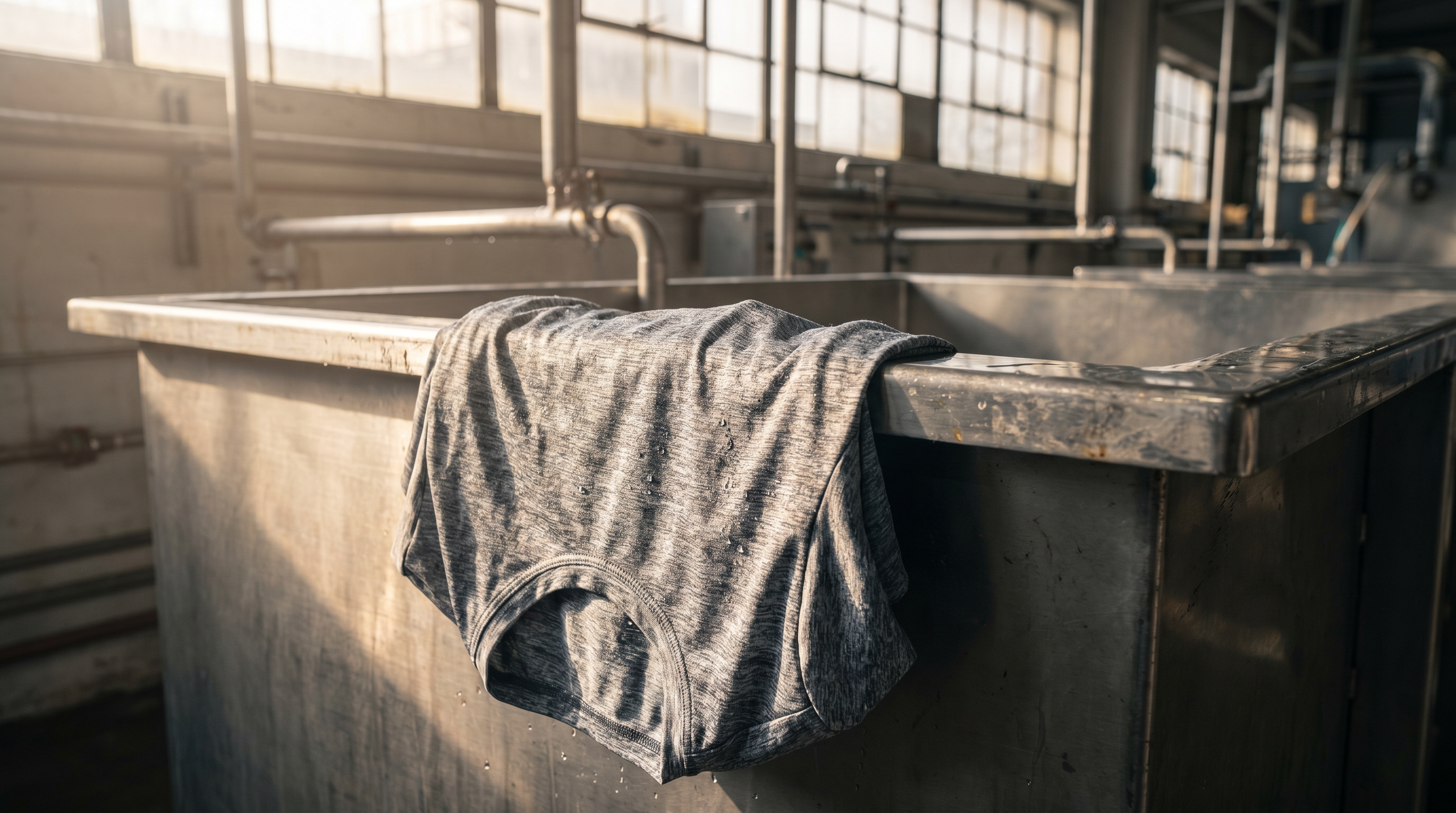
I have stood on this floor. The one where the finishing bath gets checked at 6 a.m. and again at 4 p.m., but not at midnight when the line is running hot to make a Tuesday ship date. I have watched the chemist sign off on a silver concentration that looked good on paper, knowing the real test would come later: in the wash, in the sweat, in the returns room conversation three months out.
The marketing page says "antimicrobial protection that lasts." The lab report says "99.9% bacterial reduction." Neither tells you what happens after wash 20.
What the marketing page says
If you have browsed any non-toxic activewear brand in the past two years, you have seen the claims. Odor-resistant. Antimicrobial. Stays fresh longer. Some brands cite certifications. Some cite test numbers. Most cite nothing at all, just the promise of a shirt that does not smell after spin class.
The finishes behind these claims typically fall into a few families: silver ions, zinc compounds, chitosan (derived from shellfish), or synthetic biocides like triclosan and PHMB (polyhexamethylene biguanide). The premise is the same across all of them: apply an agent to the textile surface that inhibits or kills odor-causing bacteria.
The lab test everyone references is AATCC 100, the industry standard for measuring antibacterial performance on textiles. In AATCC 100 testing, antibacterial performance is determined by comparing the number of viable bacteria recovered from treated textiles with those recovered from untreated control samples. AATCC 100 is a quantitative test method to measure antibacterial activity of treated textile materials. AATCC 100 is the industry standard test for evaluating antimicrobial fabric performance. This quantitative test measures the fabric's ability to inhibit or kill microorganisms over 24 hours.
The result you see on a spec sheet, the 99.9% reduction number, comes from this test. And it is real. On day zero, before the garment has ever been washed, the finish does what it claims.
The problem is that day zero is not the customer's reality.
What actually happens on the line
There are two primary ways to get an antimicrobial agent onto a textile. The first is surface coating: you apply the agent to the finished fabric as part of the dye or finishing process. The second is fiber embedding: you incorporate the agent into the fiber itself during spinning.
Surface coating applies an antimicrobial chemical to the outside of finished fabric. It works initially. But every wash cycle degrades the coating. By wash 20 to 30, most of the antibacterial effect is gone, right around the time a garment is breaking in.
I have seen both methods on the floor. The surface-coated finishes are cheaper, faster to apply, and easier to spec into an existing production run. They also wash out. After 20 wash cycles, 48 to 72 percent of silver was lost from prepared fabrics washed with Milli-Q water, while a greater loss of 84 to 94 percent occurred with detergent at alkaline pH.
That is not a misprint. Nearly all of the antimicrobial agent is gone by wash 20 when you use detergent. And your customer is not washing their leggings in distilled water.
The embedded methods, where the antimicrobial is fused into the fiber during spinning, hold up better. Ion-embedded technology fuses antimicrobial ions, like nano zinc, nano silver, or nano copper, directly into the fiber during the spinning process. The ions become part of the fiber's molecular structure. They cannot wash out because they were never on the surface to begin with.
But embedded finishes are more expensive. They require upstream coordination with the yarn supplier, not the dye house. They add lead time. They add cost. And when a brand founder is trying to hit a margin target or a launch date, the surface coating wins.
The line lead's job is to hit the date. The chemist's job is to hit the spec. When those two conflict, wash durability is what gets cut.
The specific chemistries and what they cost you
Let me walk through the main antimicrobial agents you will encounter on a non-toxic activewear spec sheet and what each one actually delivers.
Silver (ionic and nanoparticle)
Silver is the most common antimicrobial agent in performance textiles. It works by releasing silver ions that disrupt bacterial cell membranes. The efficacy is real. The durability is the problem.
Although the application of silver nanoparticles to commercial antibacterial items is well-established, there have been increasing concerns that such particles might leach out, particularly into laundry water from textile products. Surface-coated silver delivers strong early results but falters where it matters most: in the long-term consistency demanded by frequent wearers.
The peer-reviewed data is consistent on this point. Total silver release from cotton fabrics treated with metallic silver nanoparticles by a finishing process was 7 to 50 percent depending on dyeing and artificial sweat pH. Sweat accelerates the release. Heat accelerates the release. Detergent accelerates the release. Everything your customer does to a workout shirt accelerates the loss of the antimicrobial finish.
Zinc pyrithione
Zinc pyrithione (ZPT) was a go-to antifungal and antibacterial agent for decades. It is the active ingredient in most dandruff shampoos. It was also used in textile finishing for odor control.
This substance is still applied in the textile industry on fabrics and garments in order to achieve an anti-odor effect, especially for sportswear where sweating can lead to unpleasant smell. However, zinc pyrithione is a very hazardous chemical substance.
The European Union banned zinc pyrithione from cosmetics due to its classification as a reproductive toxicant, a precautionary move motivated by potential health concerns, environmental impact, and the availability of safer alternatives. The EU ban took effect in March 2022.
Here is where it gets complicated for brands. Even within the EU, the ban covers cosmetics only. Zinc pyrithione is still widely used in industrial applications: antifouling paints for boat hulls, preservatives in textiles and carpeting, mildew control in rubber and plastic resins. The U.S. EPA registers it for use in treated textiles at up to 3,600 parts per million.
So your supplier can still use ZPT on your fabric. The question is whether you want to put a reproductive toxicant on a garment that sits against sweating skin during a workout. The line does not make that decision. The brand does.
At bluesign, the substance was banned in 2021 in an effort to detox the textile supply chain and to protect people and the environment. If your supplier is bluesign-certified, ZPT should not be in your fabric. If they are not, ask.
Triclosan
Triclosan was once everywhere: soaps, toothpaste, cutting boards, socks. Triclosan is used as a materials preservative in adhesives, fabrics, textiles (footwear, clothing) and carpeting.
Triclosan is still approved for use in building materials, housewares, cleaning supplies, textiles and apparel, and outdoor and sports gear. The FDA banned it from consumer soaps in 2016, but the EPA still allows it in textiles. The EPA is currently reevaluating triclosan through its registration review process but has not pulled it from these uses.
The honest answer is that triclosan still shows up in activewear supply chains, especially in price-driven sourcing. If your supplier cannot show you a Restricted Substance List (RSL) that explicitly excludes triclosan, assume it is on the table.
PHMB (polyhexamethylene biguanide)
PHMB-integrated synthetics and responsibly sourced merino wool currently lead in sustained odor resistance across high-cycle use. PHMB is a synthetic biocide that performs well in wash durability tests. It is also under regulatory scrutiny in the EU for potential carcinogenicity.
If you are selling into Europe, PHMB is a chemistry to watch. The regulatory floor is moving.
The trade-off, named honestly
Many antibacterial treatments lose effectiveness after just a few laundry cycles, leading to odor buildup, fabric degradation, and higher return rates for brands. This is not a secret in the industry. It is just not disclosed to the customer.
The trade-off is this: a surface-coated antimicrobial finish costs less, ships faster, and tests beautifully on day zero. By month three, the finish is mostly gone, the shirt smells, and the customer blames the brand, not the supply chain.
An embedded antimicrobial finish costs more, requires upstream coordination, adds lead time, and may limit your fabric options. But it actually delivers the durability the marketing promises.
The standard to look for is wash durability data showing a minimum of 30 to 50 cycles at greater than 99 percent efficacy. Check for skin safety (hypoallergenic, non-irritating) and environmental compliance (REACH, CPSIA).
Most brands do not ask for this data. Most suppliers do not volunteer it.
"The term 'odor-resistant' is often misinterpreted as 'odor-proof.' In reality, it's a time-delay mechanism, not a shield."
What a brand founder can do about it
If you are sourcing non-toxic activewear and you want the antimicrobial claim to actually hold up, here is what I would ask for:
- Specify the application method. Is the antimicrobial agent surface-coated or fiber-embedded? If surface-coated, what is the expected wash durability?
- Request post-wash AATCC 100 data. Laundering is a main source of fabric degradation, so companies often request standardized laundering prior to AATCC 100 tests. Do not accept day-zero data. Ask for data after 25, 50, and 100 wash cycles. If the supplier cannot provide it, they have not tested it.
- Name the chemistry. Silver? Zinc? PHMB? Chitosan? If the supplier will not name the antimicrobial agent, that is a red flag. You cannot assess safety or durability without knowing what is on the fabric.
- Check the RSL. Does your supplier's Restricted Substance List explicitly exclude triclosan, zinc pyrithione, and any PFAS-based antimicrobials? If not, add them.
- Consider the fiber itself. Made primarily out of merino wool, some brands are a great option for layering. In addition to regular leggings, tanks, and tees, they offer thermal options and athleisure apparel. Merino wool has inherent antimicrobial properties that do not wash out because they are structural, not chemical. If odor control is critical to your product story, a natural fiber base may outperform any finish.
For a deeper look at what actually qualifies as plastic-free in the activewear space, see the plastic-free activewear guide.
What I would want to see in a supplier's lab report
If I were vetting a fabric for an antimicrobial claim, here is the documentation I would request:
- AATCC 100 test results at 0, 25, and 50 wash cycles, lot-specific, not just a reference sample from two years ago.
- Chemistry disclosure: the specific antimicrobial agent(s), CAS numbers, and concentration.
- Application method: surface finish or fiber-embedded, and if surface, the binder chemistry used.
- RSL compliance certificate: explicit confirmation that the fabric meets your restricted substance list, including any regional requirements (EU REACH, California Prop 65).
- Third-party certification: OEKO-TEX Standard 100, bluesign, or equivalent, with the test report number you can verify independently.
The best sustainable activewear brands in 2026 use certified organic cotton, natural fibres, or responsibly managed recycled materials, and back up their claims with third-party certifications like GOTS, OEKO-TEX Standard 100, Bluesign, B Corp, or Fair Trade. If your supplier cannot produce this documentation, the claim is unverifiable. And if it is unverifiable, it is a liability.
The regulatory floor is rising
The chemistry conversation is about to get louder. Washington state reporting requirements for apparel with intentionally added PFAS took effect January 2026. First reports are due January 2027. Apparel may not contain intentionally added PFAS after January 1, 2027.
From January 2026, France banned the manufacture, import, export, and sale of PFAS-containing textiles, footwear, and waterproofing agents for consumers. Exemptions exist for military and first responder protective gear. From January 2030, the ban extends to all textiles.
PFAS is the headline, but antimicrobial chemistries are part of the same regulatory trend. If your finish contains a biocide that is under review, you are building a product on a shifting foundation.
OHZEN-TEX works with brands that want the documentation before the press release, not after.
The honest answer is that most antimicrobial claims on activewear are true on day zero and false by month three. The question is whether your supply chain is set up to deliver durability or just a lab report.
Sources
https://www.bluesign.com/pfas-in-clothing https://www.bluesign.com/toxic-zinc-pyrithione-in-textile-products https://www.epa.gov/ingredients-used-pesticide-products/triclosan https://www.ewg.org/news-insights/news/triclosan-not-safe-not-effective https://scienceinsights.org/is-triclosan-banned-everywhere-its-legal-status/ https://scienceinsights.org/why-is-zinc-pyrithione-banned-safety-concerns-explained/ https://medxdrg.com/why-is-zinc-pyrithione-being-banned-the-regulatory-changes-and-safety-concerns https://pubmed.ncbi.nlm.nih.gov/27566159/ https://pubmed.ncbi.nlm.nih.gov/32286814/ https://pmc.ncbi.nlm.nih.gov/articles/PMC4090883/ https://microbe-investigations.com/blog/aatcc-100-test-method/ https://microchemlab.com/test/aatcc-100-antimicrobial-fabric-test/ https://www.alibaba.com/product-insights/fitness-apparel-with-antimicrobial-treatment-vs-untreated-fabric-for-odor-control-during-frequent-wash-cycles.html https://www.newasiagarment.com/enhancing-antimicrobial-finishes-durability-market-demand-and-future-trends/ https://www.smartexyarn.com/blog/why-your-gym-clothes-still-smell-after-washing-and-how-antibacterial-yarn-actually-fixes-it/ https://thefiltery.com/natural-workout-clothes-organic-activewear/ https://www.qforquinn.com/blogs/news/best-sustainable-activewear-brands https://www.trimco-group.com/newsroom/global-pfas-ban-regulations-and-their-impact-on-the-textile-industry https://ohzehn-tex.com/plastic-free-activewear/