You are 18 to 24 months from a decision point. The category your customer will call "polyester-free workout clothes" is forming now. Whether you position into it, adjacent to it, or ignore it entirely will affect your gross margin, your brand defensibility, and your exit multiple. Here is what the next 24 months look like.
The category in 24 months
The consumer base is broadening faster than most founders expect. The consumer base for activewear made of natural materials like cotton and wool is growing, as more people on the political right join progressives in worrying about the health effects of polyester and other synthetics. This is not a coastal niche anymore. It is a bipartisan consumer concern driven by health anxiety, not sustainability positioning.
Cotton emerges as the dominant material, accounting for an estimated 45.2% share of the global activewear market in 2026, driven by its superior comfort, breathability, and natural appeal. That number signals the shift is already underway. The question is whether "polyester-free" becomes a discrete category with its own shelf space and search volume, or whether it remains a feature claim inside the broader "sustainable" bucket.
More than 58% of consumers now favor multifunctional apparel suitable for both exercise and everyday wear, while around 41% actively seek sustainable and eco-friendly activewear options. The 41% figure is directionally correct but understates the intensity. Your actual customer, the one who pays full price and does not wait for a sale, skews higher.
Today's consumers, particularly Millennials and Gen Z, are not just purchasing a product; they are buying into a brand's ethos and values. Surveys indicate that over 65% of consumers globally now consider sustainability a key factor in their apparel purchasing decisions.
The evidence points toward category formation. When regulation creates a compliance floor, and consumer search creates a distinct query cluster, and retailers create a distinct merchandising category, you have a category. All three conditions are converging.
What your customer is going to ask
Your customer is not going to ask whether your leggings are "sustainable." That word is too vague to mean anything at shelf.
The activewear industry has a plastic problem. Walk into any gym and you'll see walls of polyester and nylon, synthetic materials that shed microplastics with every wash and contain chemical additives that can disrupt hormones.
Natural fibres, lyocell (TENCEL™), organic cotton, hemp, require significantly less chemical processing than synthetics, don't shed microplastics in the wash, and biodegrade at end of life. Recycled polyester is a common sustainability claim. It is better than virgin polyester from a carbon perspective, but it still sheds synthetic microfibres every wash cycle and doesn't biodegrade.
Your customer is going to ask: "Is this plastic?" And if you cannot say no, you lose her.
Polyester, nylon, and spandex are full of endocrine-disrupting compounds like phthalates, BPA derivatives, and PFAS that love to hitch a ride into your body via sweat and open pores. A 2023 study from the University of Birmingham found that sweat can actually leach harmful additives from synthetic fibres, making them more bioavailable for our skin to absorb. This research is now circulating in mainstream wellness media, and your customer has seen it.
The questions she will ask by Q4 2027:
- "Is this polyester-free?"
- "What is the microplastic shedding on this fabric?"
- "Is this PFAS-free?"
- "What certifications does this have?"
If your product page cannot answer those questions with proof, not positioning, you are competing on price.
The cost math
Here is what the switch looks like at a $32 wholesale unit.
Current state: Polyester-spandex blend
Polyester is a durable, synthetic fabric that wicks moisture, is easy to care for, and is budget-friendly ($3–$25/yard).
- Fabric cost (greige): $3.80 per unit
- CMT (cut, make, trim): $4.20 per unit
- Finishes (DWR, antimicrobial): $0.90 per unit
- Packaging, freight, duty: $2.10 per unit
- Total landed COGS: approximately $11.00
- Wholesale: $32.00
- Gross margin: approximately 65.6%
Transition state: TENCEL-organic cotton blend (8% elastane)
TENCEL is made from wood pulp, it's breathable, absorbs moisture 50% better than cotton, resists odors naturally, and is biodegradable. Perfect for athletes in hot climates or those with sensitive skin, but requires gentle care and costs more ($10–$35/yard).
- Fabric cost (greige): $5.40 to $6.20 per unit
- CMT: $4.50 per unit (slightly higher due to fabric handling)
- Finishes (plant-based antimicrobial, no DWR): $0.70 per unit
- Packaging, freight, duty: $2.30 per unit
- Total landed COGS: approximately $13.20 to $13.70
- Wholesale: $32.00 (unchanged)
- Gross margin: approximately 57.2% to 58.8%
You lose 7 to 8 points of gross margin at the same wholesale price.
Premium positioning state: TENCEL-organic cotton blend, certified
- Same COGS: approximately $13.50
- Wholesale: $38.00 (19% price lift)
- Gross margin: approximately 64.5%
The math only works if you can command a price premium. The premium only holds if you can prove the claim. Proof requires certification, lot testing, and supply chain documentation.
Market analysis indicates that a significant portion of consumers, particularly in the 18-34 age demographic, are now willing to pay a premium for products from sustainable brands. This confluence of environmental and wellness trends creates a powerful driver for the adoption of activewear made from recycled polyester, organic cotton, and other eco-friendly materials.
Where the regulatory floor is moving
The PFAS regulatory wave is the forcing function. It does not directly ban polyester. But it bans the finishes that make polyester perform.
United States
Beginning January 1, 2026, new PFAS prohibitions and reporting requirements take effect in Colorado, Connecticut, Maine, Minnesota, Vermont, and Washington. The requirements target a wide range of consumer products and industries, with meaningful implications for companies across the product supply chain.
California AB 1817 bans the manufacture and sale of textile articles containing intentionally added PFAS. It establishes Total Organic Fluorine (TOF) thresholds: 100 ppm starting January 1, 2025, dropping to 50 ppm by January 1, 2027.
Effective January 1, 2027, the allowable PFAS limit drops to 50 ppm TOF, cutting the permissible concentration in half. By January 1, 2028, even the temporary exemption for outdoor apparel designed for severe wet conditions will expire, bringing those products under the same 50 ppm ceiling.
Apparel and accessories made from leather, natural textiles, synthetic textiles, or technical textiles may not contain intentionally added PFAS after January 1, 2027. Additional states, including New Mexico and Pennsylvania, are advancing PFAS legislation that may take effect in 2027 and beyond.
The trajectory is clear. By 2028, selling apparel with intentionally added PFAS in California, New York, Maine, Minnesota, Vermont, Washington, Colorado, and Connecticut will require either a disclosure label or product reformulation.
Europe
France Law No. 2025-188 with Decree no 2025-1376: Bans the manufacture, import, export, and sale of PFAS-containing textiles, footwear, and waterproofing agents for consumer use, effective January 2026. The ban extends to all textiles by January 2030.
Denmark Executive Order BEK no. 464 (2 May 2025) prohibits import and sale to consumers of clothing, footwear and certain impregnation agents containing PFAS at total fluorine ≥ 50 mg F/kg, effective 1 July 2026 (sell-through permitted until 1 January 2027).
Europe is advancing PFAS regulation through both EU-wide measures and national legislation. EU REACH Annex XVII, Entry 79: Restrictions on PFHxA and related substances take effect in April 2026, adding to existing bans on C9-C14 PFCAs.
End of 2026: Final RAC and SEAC opinions delivered to the European Commission. 2027: European Commission drafts legislation to amend REACH Annex XVII.
The net effect
If you are selling into California, New York, France, Denmark, and the EU broadly, your DWR finish is already a compliance liability. If your DWR is PFAS-based, you need to reformulate or disclose. If you reformulate, you lose oil repellency. If you lose oil repellency, your polyester fabric stains more easily. If your polyester fabric stains more easily, your customer asks why she should not just buy natural fiber instead.
The regulatory floor is making polyester harder to sell without finishes. The finishes are being banned. The customer is noticing.
What to do this quarter
- Audit your current fabric library for PFAS content. Request total organic fluorine testing from your mill. If the result is above 50 ppm, you have a reformulation decision to make before January 2027.
- Map your SKU-level exposure to California, New York, and France. If more than 30% of your revenue comes from these markets, you are already in the compliance window.
- Price test a natural fiber capsule. Run a limited drop of TENCEL or organic cotton pieces at a 15-20% price premium. Measure sell-through rate and return rate against your polyester baseline. This gives you margin data before you commit to a full line transition.
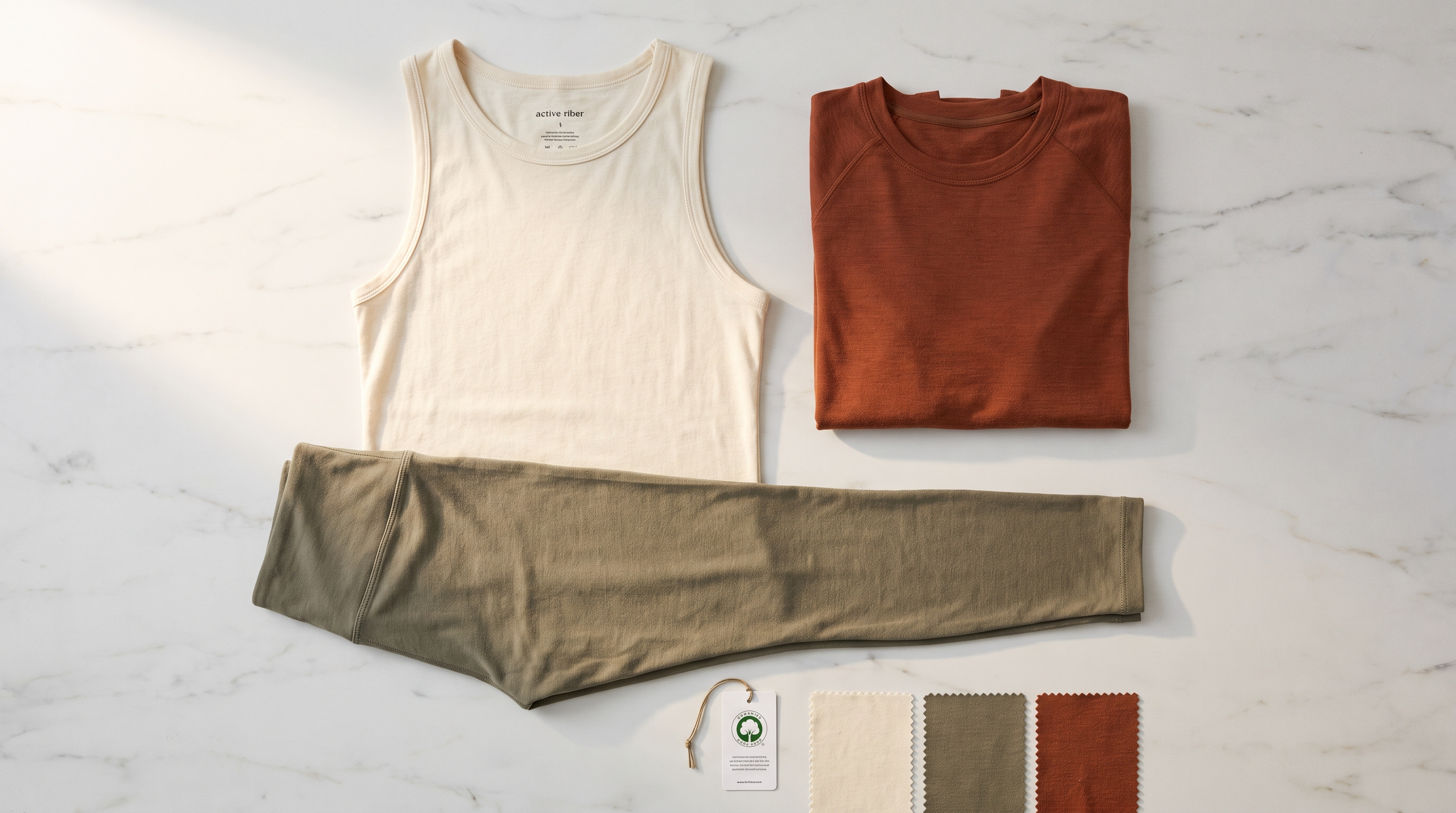
- Build your certification stack. Trusted sustainable activewear brands provide certifications like: GOTS (Global Organic Textile Standard): Ensures the use of organic fibers and eco-friendly processing. OEKO-TEX (chemical safety): Confirms fabrics are free from harmful substances. Fair Trade (ethical labor): Supports fair wages and safe working conditions. Get at least two of these on your natural fiber SKUs before you launch.
What to do in the next 12 months
- Develop a sourcing relationship with a natural fiber mill that can deliver at your volume. The capacity for performance-grade TENCEL and organic cotton blends is not infinite. In March 2024, Lenzing AG expanded its TENCEL™ lyocell fiber production in Southeast Asia through a new facility to address surging demand for sustainable options. The brands that lock in capacity now will have supply when the category tips.
- Rebuild your product page architecture around proof. The winning product page in 2028 has: fiber content, certification logos with links, microplastic shedding data (or "not applicable: natural fiber"), and PFAS testing results. If you cannot populate those fields, you are competing on vibes.
- Prepare for the California 50 ppm threshold. January 2027 is 18 months away. Your Fall 2027 production is being speced now. If your Fall 2027 line ships to California with PFAS above 50 ppm, you are out of compliance on day one.
- Model the gross margin impact of a full line transition. The math above is per-unit. At scale, the transition affects your working capital cycle, your returns rate (natural fibers perform differently), and your CMT relationships. Run the full P&L scenario before you commit.
For a full breakdown of what "plastic-free" actually means at the fiber level and how to audit a supply chain against it, see the plastic-free activewear guide.
"Consumers are not just requesting sustainability anymore. They are demanding it. Brands that fail to adopt eco-friendly materials risk losing environmentally-conscious shoppers, now over 60% of the market."
The category is forming. The regulatory floor is rising. The customer's questions are changing. The brands that build the proof infrastructure now, including verification systems like OHZEHN-TEX™, will own the premium tier when polyester-free workout clothes becomes a search term with real volume.
Sources
https://www.businessoffashion.com/articles/sustainability/wool-natural-fibre-activewear-nero-mover-huha-mate-the-label/ https://www.coherentmarketinsights.com/industry-reports/active-wear-market https://www.globalgrowthinsights.com/market-reports/activewear-market-107792 https://www.grandresearchstore.com/consumer-goods-and-services/global-sustainable-activewear-forecast-market https://wayvewear.com/blogs/read-our-blog/best-natural-activewear-brands-2026 https://www.aprisportswear.com/blogs/guides-articles/the-best-sustainable-activewear-brands-in-2026-a-no-greenwash-guide https://bottlecup.com/blogs/news/the-best-natural-plastic-free-activewear-brands https://wooter.com/articles/tencel-vs-polyester-best-for-sportswear/ https://www.morganlewis.com/pubs/2026/01/state-regulation-of-pfas-in-consumer-products-continues-to-gain-momentum-in-2026 https://sustainabilityservices.eurofins.com/news/california-pfas-regulations-a-compliance-checklist-for-consumer-products/ https://www.certivo.com/blog-details/california-ab-1817-pfas-textiles-ban-compliance-requirements-manufacturers https://www.bluesign.com/pfas-in-clothing https://sustainabilityservices.eurofins.com/news/2025-pfas-regulations-in-europe/ https://tocco.earth/article/which-eu-pfas-ban-applies-to-your-brand https://www.intelmarketresearch.com/clothing-fibers-market-43872 https://theapparelfactory.com/blog/high-quality-activewear/