I have stood on floors where the antimicrobial bath goes on at 2 AM, and I have signed off on test reports that say things the customer service queue contradicts six months later.
The non-toxic activewear category is growing fast, and antimicrobial finishes are everywhere. Silver. Zinc pyrithione. Triclosan derivatives. The claim on the hangtag says odor control. The lab report says 99% bacterial reduction. The brand story says you can wear it three times between washes.
Here is what I have seen happen between the spec sheet and the return pile.
What the marketing page says
Pick any major activewear brand. The product description will say something like this:
"Our antimicrobial technology prevents the growth of odor-causing bacteria, keeping your gear fresh wear after wear."
Lululemon's Silverescent technology, powered by X-STATIC, claims to "prevent the growth of odour-causing bacteria" with silver ions bonded to the fiber surface. The brand's own technology page states this is "a core component for many products within our sweat category."
Other brands use zinc pyrithione, marketed as Microban Z PTech or similar trade names. Some still use triclosan-based finishes, though regulatory pressure has pushed many mills away from that chemistry.
The marketing premise is simple: the finish kills bacteria on contact, bacteria cannot metabolize your sweat into odor, your shirt stays fresh.
The lab data often backs this up. AATCC 100, the industry standard quantitative test for antibacterial textiles, measures bacterial reduction on treated fabric versus untreated control. A good antimicrobial finish will show 99% or greater reduction against Staphylococcus aureus and Klebsiella pneumoniae after 24 hours of contact.
The problem is what happens after that test.
What actually happens on the line
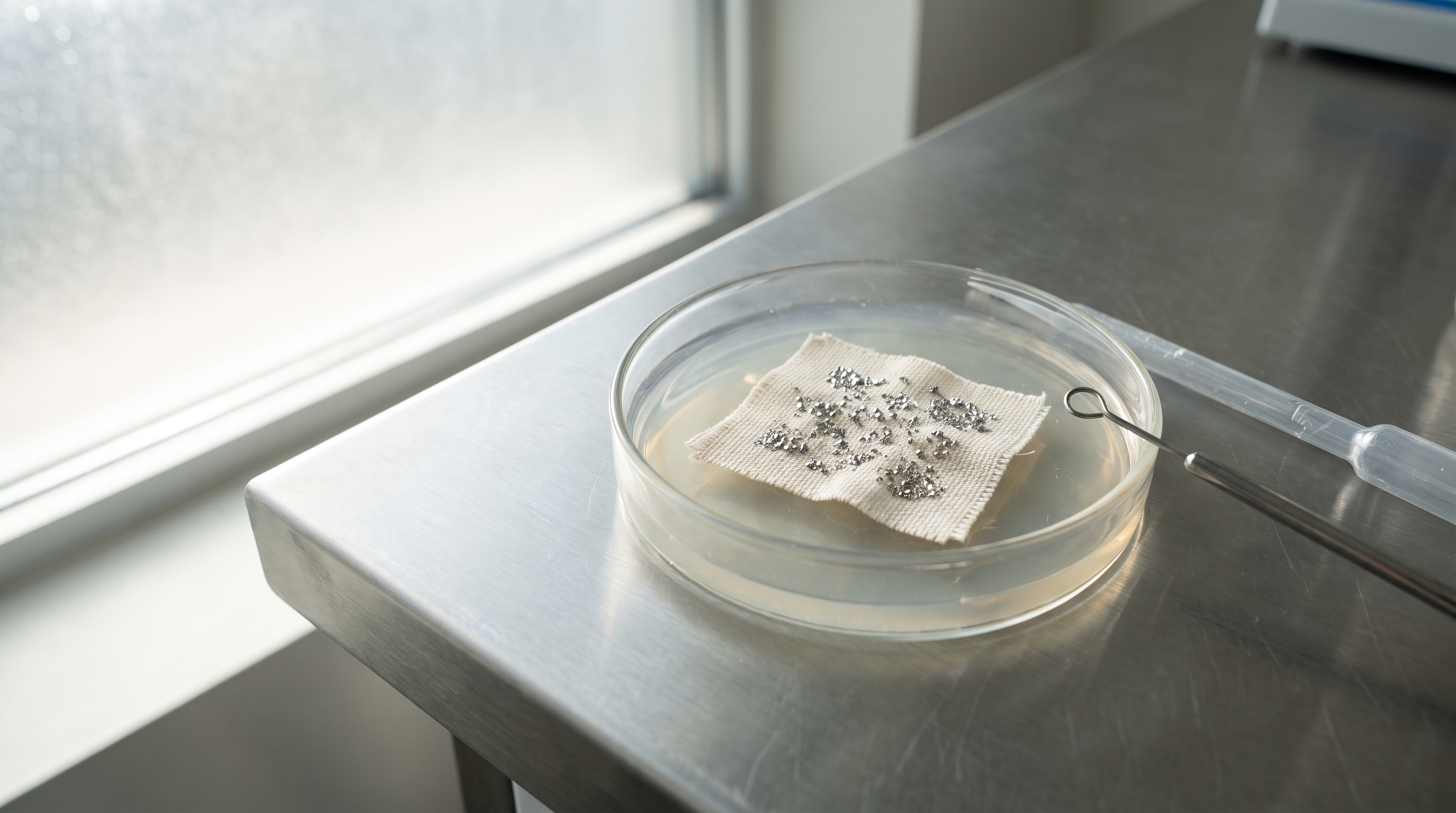
AATCC 100 is a static test. It measures bacterial reduction on a fabric swatch in a petri dish under controlled lab conditions. It does not simulate what happens when that fabric is worn, sweated into, washed in hard water with detergent, tumble dried at high heat, and repeated 20 or 30 or 50 times.
When brands want to validate durability claims, they request AATCC 61 or AATCC 135 laundering cycles before running AATCC 100 again. This is where the story changes.
A 2016 study published in Environmental Science and Pollution Research found that after 20 wash cycles, 48 to 72 percent of silver was lost from prepared fabrics washed with plain water. When detergent was added at alkaline pH, that loss increased to 84 to 94 percent.
Patent literature tells the same story. USPTO testing data on triclosan-impregnated polyester showed "100% contact inhibition" against S. aureus before washing, but "no zone of inhibition and 0% contact inhibition" after just five regular washing cycles.
A 2015 peer-reviewed study comparing triclosan, silver, and chitosan finishes on cotton found that "cyclic laundering showed statistically significant effect on activity of finishes up to five cycles but it was almost reduced to half for chitosan."
The finish chemistry matters. Ionic treatments, which include most silver and zinc applications, bond electrostatically to fiber surfaces. Each wash cycle, each detergent interaction, each mechanical abrasion in the drum pulls ions away from the fabric. The antimicrobial load declines. The spec sheet does not update itself.
The trade-off, named honestly
Here is the honest math that most brand founders never see:
- Application method determines durability. Finishes that are topically applied or pad-dry finished wash out fastest. Finishes that are spun into the fiber during extrusion, what the industry calls "fiber-level integration," last longer. Lululemon's Silverescent uses X-STATIC yarn where silver is bonded to the fiber surface before knitting. This is more durable than a post-knit bath. But even bonded silver releases ions over time.
- The "50 wash" claim is often accelerated testing, not real-world laundering. AATCC 61-2A is a common accelerated protocol: 45 minutes at 120°F with steel balls to simulate abrasion. Five cycles of this protocol is said to simulate 25 home washes. But accelerated testing does not capture the cumulative effect of fabric softeners, bleach residue in shared machines, or the high-heat dryer cycle your customer uses every time. Real-world durability is almost always worse than accelerated lab durability.
- The test bacteria are not the bacteria causing your customer's odor. AATCC 100 tests against S. aureus and K. pneumoniae because they are standardized lab strains. But body odor comes from a complex microbiome including Corynebacterium and Staphylococcus hominis, which metabolize sweat lipids into volatile organic acids. A fabric can pass AATCC 100 and still develop funk in the armpit after three hot yoga sessions.
- What washes out goes somewhere. Swiss research published in Chemistry World confirmed that silver nanoparticles release most heavily during the first wash, entering wastewater systems. Silver ions are toxic to aquatic organisms and can accumulate in the food chain. A 2018 paper in The Conversation noted that "about one-fourth of nanomaterial-based consumer products currently marketed in the United States contain nanosilver," and "studies show that the amount of silver leached in the wash solution depends on many factors, including interactions between detergent and other chemicals."
This is the part of the spec sheet that nobody wants to talk about at the product review meeting.
What a brand founder can do about it
If you are building a non-toxic activewear line and you want to make antimicrobial claims, here is my advice from the floor:
Understand the difference between "antimicrobial" and "odor resistant"
Antimicrobial means the finish inhibits bacterial growth on the fabric surface. Odor resistant can mean that, or it can mean the fiber structure itself resists odor accumulation. Merino wool, for example, has natural odor resistance due to its lanolin content and fiber morphology, not a topical finish. TENCEL lyocell resists odor because of its hydrophilic fiber structure and smooth surface that does not trap bacteria the way polyester's hydrophobic surface does.
If you are positioning as non-toxic, the cleaner story is a fiber that resists odor inherently, rather than a synthetic fiber with a finish that washes off and enters the water table.
Demand lot-by-lot post-wash testing
Any supplier can hand you an AATCC 100 report from a reference sample tested at time zero. That report tells you nothing about what the fabric does after your customer's 15th wash.
Ask for post-wash efficacy data at 10, 25, and 50 home laundering cycles, tested on production lots, not reference samples. If your supplier cannot provide this, they are selling you a story, not a spec.
Be specific about application method
Topical finishes applied during dyeing or finishing wash out faster than finishes spun into the fiber at the polymer stage. If your supplier says "silver-infused," ask: Is the silver ionic or metallic? Is it applied as a post-treatment or integrated at the fiber level? What is the estimated silver content after 25 washes?
The difference between a topical spray and a fiber-level integration is the difference between a claim that lasts six months and a claim that holds up to a class action.
Consider whether the claim is worth the regulatory exposure
In the United States, antimicrobial claims on textiles fall under EPA jurisdiction through FIFRA, the Federal Insecticide, Fungicide, and Rodenticide Act. The EPA requires registration for textiles making public health claims about antimicrobial activity. Even the phrase "antimicrobial" on a hangtag can trigger regulatory review if it implies protection against pathogens.
One compliance attorney I spoke to put it this way: "The mere mention of a textile's antimicrobial or antiviral properties may be sufficient to trigger EPA jurisdiction under FIFRA."
If your marketing team wants to say "stays fresh," that is a different claim than "kills 99% of bacteria." Know which category you are in before the hangtag goes to print.
What I would want to see in a supplier's lab report
If I were sourcing antimicrobial fabric for a non-toxic activewear line today, I would ask for:
- AATCC 100 data at T=0, T=10 washes, T=25 washes, T=50 washes. Not accelerated equivalents. Actual home laundering per AATCC 135.
- Silver or zinc content (ppm) measured at each wash interval. If the active ingredient is leaving the fabric, I want to know the depletion curve.
- Test organisms that include Corynebacterium or S. hominis, not just the standard S. aureus panel. If the claim is about body odor, the test should use body odor bacteria.
- OEKO-TEX 100 or bluesign certification on the finished fabric, confirming the antimicrobial chemistry passes restricted substance limits.
- A clear statement of application method: pad-dry topical, pad-dry-cure crosslinked, or fiber-level polymer integration.
The brands doing this well, and there are some, treat the antimicrobial finish as a performance spec with a depreciation curve, not a permanent feature. They test against that curve and set customer expectations accordingly.
OHZEN-TEX works with suppliers who publish post-wash efficacy data because the alternative is a marketing claim that falls apart in the returns queue.
What the floor knows
Antimicrobial finishes work. The chemistry is real. Silver ions kill bacteria. Zinc pyrithione inhibits microbial growth. The peer-reviewed literature is clear on mechanism.
But finishes are not fibers. What is applied can be removed. And the testing protocols that generate the "99% reduction" claim do not capture the full lifecycle of a garment worn hard, washed often, and expected to perform for years.
If you are building a plastic-free activewear line, the plastic-free activewear guide covers the fiber selection question in depth. On the antimicrobial side, the honest answer is simpler: know what you are buying, know how long it lasts, and do not promise your customer something the lab report cannot support past wash 15.
The line lead's job is to hit the date. The chemist's job is to hit the spec. But your job, as the brand founder, is to make sure the spec still holds when the customer opens the package six months from now.
Sources
https://www.lululemon.com.au/en-au/c/community/fabric-and-technology/silverescent%C2%AE%C2%A0 https://www.eu.lululemon.com/en-lu/c/community/about-us/our-fabric-and-technology https://link.springer.com/article/10.1186/s40691-015-0040-y https://link.springer.com/article/10.1007/s11356-016-7486-3 https://image-ppubs.uspto.gov/dirsearch-public/print/downloadPdf/6299651 https://www.situbiosciences.com/product/aatcc-tm-100-antimicrobial-fabric-test/ https://microbe-investigations.com/textile-services/textile-antibacterial/aatcc-100/ https://www.eurofins.com/textile-leather/articles/testing-standards-of-antimicrobial-treatment-for-textile-products/ https://www.chemistryworld.com/news/silver-nanoparticles-lost-in-the-first-wash/9600.article https://theconversation.com/silver-nanoparticles-in-clothing-wash-out-and-may-threaten-human-health-and-the-environment-90309 https://www.bdlaw.com/publications/fifra-compliance-five-tips-for-antimicrobial-apparel-manufacturers-and-distributors/ https://www.epa.gov/pesticides/epa-releases-final-guidance-and-methods-control-public-health-pathogens-soft-surface https://www.aprisportswear.com/blogs/guides-articles/the-best-workout-clothes-that-dont-smell-a-complete-buyers-guide-2026 https://www.athleticbrands.org/odor-control-activewear-technology/