
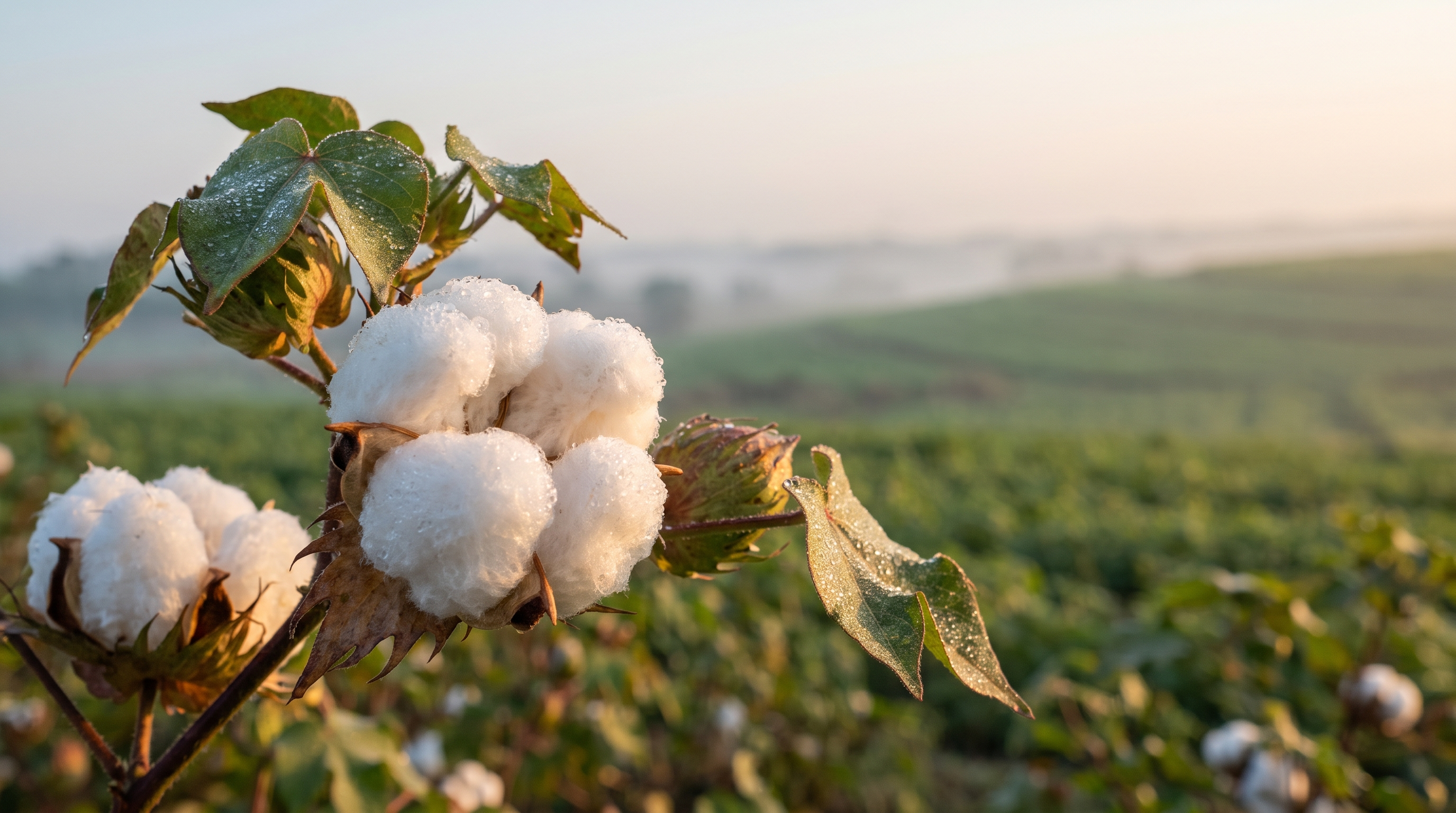
The popular framing says cotton is a thirsty crop. It takes 2,700 liters of water to make a single t-shirt. The fashion industry is draining the planet. If you care about the environment, choose polyester.
This framing is not entirely wrong. It is incomplete in ways that change the sourcing calculus for natural fiber activewear.
What the popular framing says
The 2,700 liter figure comes from the World Wildlife Fund and has been repeated by National Geographic, TED, and dozens of sustainability publications. A typical version: producing one cotton t-shirt uses enough water for a person to drink for 2.5 years. Cotton farming alone consumes 60% of that water. The Aral Sea dried up because of cotton. Therefore, cotton is inherently unsustainable.
This narrative has shaped consumer perception for over a decade. It has also shaped brand positioning. Many activewear companies have leaned into polyester precisely because the water footprint numbers for synthetic fibers appear dramatically lower.
What the data actually says
The International Cotton Advisory Committee (ICAC) published a comprehensive study in 2025 analyzing water footprint data from 271 cotton-growing locations across 38 countries over the 2020-2024 period. The findings:
The global average water footprint for cotton is 8,920 litres per kilogram of lint, of which 6,576 litres/kg (73.4%) are sourced from rainfall and only 2,344 litres/kg come from irrigation.
That distinction matters. The water footprint methodology counts three categories:
- Green water: rainfall that falls on fields and is consumed through evapotranspiration
- Blue water: surface water and groundwater withdrawn for irrigation
- Grey water: freshwater required to dilute pollutants to acceptable standards
The data reveal that 75% of the water used for cotton comes from rainfall, a resource completely beyond human control.
Rainfall is cyclical. It returns to the atmosphere through plant transpiration and soil infiltration. Since rainfall is cyclical and returns to the environment through plant evapotranspiration or soil infiltration, the ICAC study contradicts the notion of cotton being a "thirsty" crop that uses excessive amounts of water.
The relevant environmental pressure is not total water footprint. It is blue water footprint: the extraction of surface water and groundwater that depletes finite reserves.
The regional variation problem
Global averages obscure what actually matters for sourcing decisions. Brazil's water footprint is 3,436 litres per kilogram of cotton lint, of which 3,372 litres come from rainwater and only 64 litres come from irrigation.
Compare that to the numbers from heavily irrigated regions:
The blue virtual water content and thus the impact per unit of cotton production are highest in Turkmenistan, Uzbekistan, Egypt, and Pakistan, followed by Syria, Turkey, Argentina and India.
Irrigated cotton is mainly located in dry regions: Egypt, Uzbekistan, and Pakistan. The province Xinjiang of China is entirely irrigated, whereas in Pakistan and the North of India a major portion of the crop water requirements of cotton are met by supplementary irrigation.
The numbers tell a clear story. Chapagain et al. (2006) revealed that the water footprint in the United States was 2,249 m³ per ton, whereas in Argentina it reached 7,700 m³ per ton, and in India, it stood at 8,662 m³ per ton.
That is a 4x difference in total water footprint between sourcing from the US versus India. The blue water difference is even more pronounced.
"In the United States, cotton farmers in the southeast use 234 liters of irrigated water per kilogram of cotton on average compared to farmers in the west, which use 3,272 liters of irrigated water per kilogram," says the report.
Within a single country, the irrigation footprint varies by a factor of 14.
Where the popular framing is right
The Aral Sea disaster is real. The Aral Sea is the most famous example of the effects of water abstractions for irrigation. In the period 1960–2000, the Aral Sea in Central Asia lost approximately 60% of its area and 80% of its volume as a result of the annual abstractions of water from the Amu Darya and the Syr Darya–the rivers which feed the Aral Sea–to grow cotton in the desert.
The problem was not cotton. The problem was growing cotton in a desert using flood irrigation from rivers that fed an inland sea. The mechanism matters.
The Indus River in Pakistan and the Nile in Egypt are prime examples of river systems heavily taxed by the demands of cotton cultivation.
In Pakistan already 31% of all irrigation water is drawn from ground water and in China the extensive freshwater use has caused falling water tables.
Cotton grown in water-stressed regions using inefficient irrigation does deplete finite water resources. The popular framing is right about the mechanism in specific contexts. It is wrong to generalize that mechanism to all cotton.
Where the popular framing is wrong, and the mechanism for why
The framing treats all water as equivalent. It is not.
In the United States, about 64% of the cotton crop is grown without irrigation, relying solely on natural rainfall.
In general, across India, 70 – 80% of cotton farms are rainfed, with only 20 – 30% using irrigation.
Studies by Mekonnen and Hoekstra (2010) and Safaya et al. (2016) estimated the global water footprint of cotton at 233 billion cubic meters per year, closely aligning with this study's estimate of 210.2 billion cubic meters per year (2020–2024), with 75.0% from rainwater and 25.0% from irrigation.
The ICAC data further clarifies the actual irrigation burden:
The commonly cited figure that cotton accounts for 2.6% of global water use (Hoekstra & Chapagain, 2008) is proportionate to its land use, as cotton occupies 2.21% of global arable land (1,397 million hectares) and closely aligns with this study's finding that consumptive irrigation water used by cotton accounts for 1.59% and applied irrigation water use accounts for 1.91% of the total water withdrawn for agriculture.
Cotton consumes 1.59% of global agricultural irrigation water while occupying 2.21% of arable land. That ratio is not evidence of exceptional thirst. It is roughly proportionate to cotton's land footprint.
About 21.42 million tonnes of lint, which is equivalent to 87.0% of the total global cotton was produced by using only 644 litres irrigation water per Kg lint.
The median case is not the extreme case. Most cotton production happens at irrigation rates far below the figures in the popular narrative.
The second error in the popular framing is conflating water use with water scarcity. A liter of rainwater falling on a field in Brazil has a different environmental impact than a liter pumped from a depleting aquifer in Pakistan. The ecological cost is measured by the blue water footprint, representing the volume of surface or groundwater consumed and not returned to the source basin.
Water scarcity indices matter. A conventionally grown, rain-fed cotton crop may have a smaller blue water footprint than an organically grown, irrigated one. The organic label does not guarantee lower water impact. The sourcing region and irrigation method determine the actual environmental burden.
What this means for a product founder
If you are sourcing natural fiber activewear and want to make defensible claims about water impact, the generic "cotton uses 2,700 liters per shirt" framing is both misleading and strategically weak. Here is what to specify instead:
1. Source from rainfed regions.
Brazil, the US Southeast, and parts of West Africa produce cotton with minimal irrigation footprint. Brazil's water footprint is 3,436 litres per kilogram of cotton lint, of which 3,372 litres come from rainwater and only 64 litres come from irrigation. That 64 liters of irrigation water per kilogram is not 2,700 liters. It is 98% lower than the global average irrigation component.
2. Ask suppliers for blue water data, not total water footprint.
Total water footprint includes rainfall, which is not a depletable resource in the same sense as aquifer water. Cotton's consumptive use of irrigation water accounts for only 1.59% of the total irrigation water used by all arable crops, contradicting the "thirsty crop" narrative. The blue water footprint is the number that matters for resource depletion claims.
3. Specify irrigation method.
While irrigation inefficiencies persist, especially with flood irrigation systems, drip systems are deployed in only 19% of irrigated cotton fields. Drip irrigation reduces water waste dramatically compared to flood irrigation. If your supplier uses drip irrigation, that is a meaningful specification.
4. Compare honestly.
Polyester requires approximately 17 liters of water per kilogram of fiber production. Cotton requires 7,000-29,000 liters per kilogram depending on region and method. But polyester's water footprint is concentrated in the manufacturing phase and often involves chemical-laden wastewater. Cotton's footprint is dominated by rainfall in the agricultural phase. Cotton growing requires, however, huge amounts of water and, in many cases, cotton is cultivated in regions where the amount of rain is not sufficient and irrigation is needed. The reported irrigation amounts vary from 7 m³/kg to 29 m³/kg compared to the approximately 17 l/kg of water consumption in polyester fibre production.
The comparison is not apples to apples. Green water in agriculture and process water in petrochemical manufacturing have different environmental implications.
5. Build the spec sheet.
For brands positioning around the plastic-free activewear guide, the water footprint question will come up in due diligence, in retailer scorecards, and in consumer-facing claims. The defensible position is not "cotton is fine" or "cotton is bad." It is: "We source cotton from X region with Y irrigation method, resulting in Z blue water footprint per kilogram." That specificity is what separates marketing from material science.
OHZEHN-TEX tracks blue water footprint by lot for partner brands because the global average is not the same as the number on your specific supply chain.
"The study shows the need to shift the focus of the debate on cotton water usage away from rainwater and onto the prioritization of how to optimize water used in irrigation.", Keshav R Kranthi, Chief Scientist, ICAC
The cotton water debate has been shaped by advocacy statistics that conflate rainfall with aquifer depletion. The data does not support the blanket claim that cotton is environmentally inferior to synthetic alternatives on water impact. It supports a more nuanced claim: that sourcing decisions, regional variation, and irrigation methods determine actual environmental burden.
The relevant number is not 2,700 liters per t-shirt. It is the blue water footprint of the specific cotton in your supply chain, compared to the local water scarcity index of the region where it was grown.
Sources
https://cottonbrazil.com/icac-releases-cotton-water-footprint-analysis-and-updates-water-consumption-estimates/ https://www.icac.org/wp-content/uploads/2025/04/WATER-PAPER-Summary-note.pdf https://icac.org/wp-content/uploads/2025/07/Recorder-June-2025-V1.pdf https://www.researchgate.net/publication/228377230_The_Water_Footprint_of_Cotton_Consumption https://www.sciencedirect.com/science/article/abs/pii/S0921800905005574 https://www.waterfootprint.org/resources/Report18.pdf https://www.selvane.co/blogs/knowledge/the-water-footprint-of-cotton-irrigation-rain-fed-and-regenerative-approaches https://waterfootprint.org/resources/Assessm_water_footprint_cotton_India.pdf https://www.ncbi.nlm.nih.gov/pmc/articles/PMC8093473/ https://product.sustainability-directory.com/area/water-usage-in-cotton-production/resource/4/ https://www.greenqueen.com.hk/cotton-fashion-misinformation/ https://texfash.com/special/cotton-s-water-myth-busted-new-global-study-exposes-flawed-thirsty-crop-claims https://www.proyectaryproducir.com.ar/public_html/Seminarios_Posgrado/Material_de_referencia/LCA%20for%20Cotton%20and%20Polyester-cotton%20fabrics.pdf