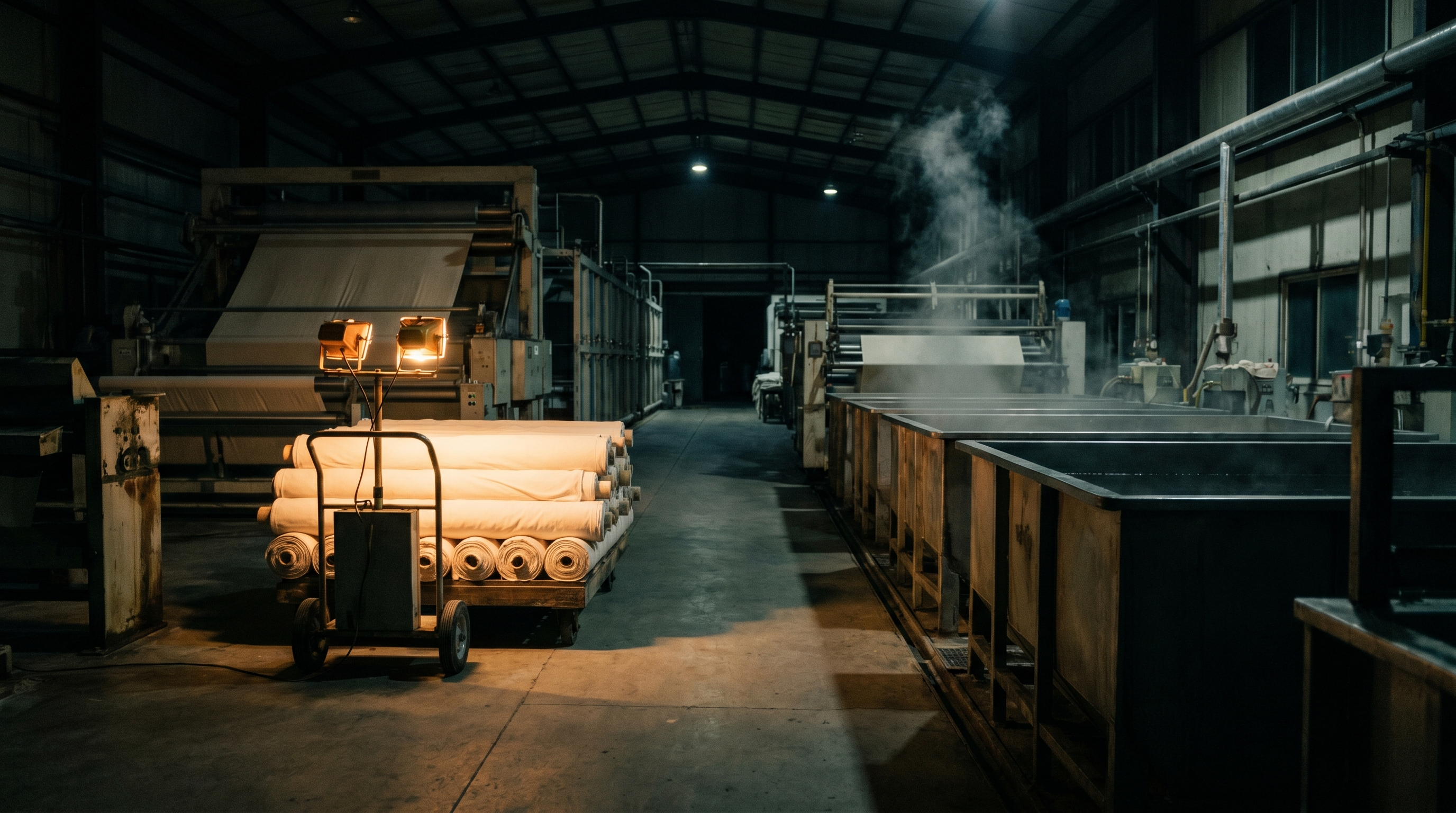
I have stood on a finishing floor at 11:47 p.m., watching a line lead make a call that never shows up in your lab report.
The conversation usually goes like this: the freight cut-off is in nine hours, the container is already booked, and the fabric still has two finishing baths left. The softener bath adds hand feel. The pH neutralization bath makes sure the fabric arrives at a skin-safe acidity level and doesn't degrade the next finish in sequence. Both take time. Both cost chemistry. And when the ship date is non-negotiable, one of them often disappears.
If you are building a brand around non-toxic activewear, you deserve to know what actually happens between your tech pack and the roll of fabric that lands at your cut-and-sew facility.
What the marketing page says
Most activewear brands talk about their fabric story in terms of fiber content. Organic cotton. TENCEL Lyocell. Merino wool. These are the headline materials, and they matter. But fiber content is only half the story.
The other half is finishing: the sequence of chemical and mechanical treatments that turn greige cloth into something you can actually sell. Finishing determines hand feel, dimensional stability, moisture management, color fastness, and in some cases, skin safety.
When a brand says its product is OEKO-TEX Standard 100 certified, that certification tests the finished product for over 1,000 harmful substances and confirms they fall within safe limits. That is valuable. But the certification does not test whether the finishing process was completed correctly, whether any steps were skipped, or whether the fabric will hold its claimed performance after washing.
What actually happens on the line
Textile finishing is a sequence, and the sequence matters.
A typical finishing run for a knit activewear fabric might include desizing, scouring, bleaching (if the fabric is white or pale), dyeing, a pH neutralization bath, a softener bath, and a final heat-set on the stenter frame. Each step has a purpose. Remove one, and you change the fabric's behavior in ways that may not show up until the garment is on a customer's body.
The softener bath is often the first to go when time runs short. Softeners are finishing agents that improve hand feel by lubricating the fiber, allowing it to slide more easily within the fabric structure. As one textile finishing resource puts it, "the softening agents applied are lubricating agents, which facilitate the fiber sliding within the fabric structure, thus granting easier deformation and creasing of the fabric." They also affect sewability, static, and drape.
But softeners are typically applied in the final stage of the treatment because they wash out relatively quickly. Skip the softener bath, and your fabric arrives at the cut-and-sew facility with a harsher hand. The seamstress notices. The needle drags. The customer notices too, eventually, but by then the return is already processed.
The pH bath is more consequential for skin safety. After dyeing and bleaching, fabric can sit at a pH level that is either too alkaline or too acidic for prolonged skin contact. The neutralization step brings the fabric back into a safe range. OEKO-TEX Standard 100 specifies a pH range of 4.0 to 7.5 for Class II textiles (direct skin contact for adults), with tighter ranges for baby products. If the pH bath is shortened or skipped, the fabric may still pass a spot check at the mill but drift out of range by the time it reaches your customer.
The honest answer is that production pressure creates shortcuts. The line lead's job is to hit the date. The chemist's job is to hit the spec. When those two conflict, the step that takes the most time and costs the most chemistry is the step that gets trimmed.
The trade-off, named honestly
There are three versions of this story, and they all happen.
Version one: the softener gets cut. The fabric arrives with a harsher hand than the approved sample. Your cut-and-sew facility may or may not flag it. If they do, you face a choice: accept the lot or miss your launch date. Most brands accept the lot.
Version two: the pH bath gets shortened. The fabric arrives at a pH level that is technically within spec but at the edge. Over time, or after one aggressive home wash, it drifts out of range. The customer complains about skin irritation. You blame the detergent. The fabric was the problem.
Version three: the moisture-wicking finish gets diluted. Moisture-wicking performance on synthetic fabrics comes from hydrophilic finishes applied during finishing. Polyester is inherently hydrophobic, meaning it does not absorb moisture. The wicking you feel on a polyester shirt comes from a surface treatment that spreads liquid across the fiber so it can evaporate. That finish can wash out. If the finishing bath is diluted to save chemistry, the wicking performance may pass initial testing but degrade after three to five home washes.
AATCC Test Method 195 measures liquid moisture management properties, and it is the industry standard for comparing wicking performance. But most brands do not test every lot, and the test is typically run on virgin fabric, not fabric that has been washed twenty times.
"Surface treatment, Hydrophilic finishes enhance wicking but may wash out after 20-50 cycles."
That quote is from a B2B sourcing guide for moisture-wicking fabric. It names the problem plainly. The finish is not permanent. If your supplier diluted the bath to hit the ship date, you may never know until the returns start.
What a brand founder can do about it
You cannot be on every finishing floor at midnight. But you can change what you ask for.
1. Require post-wash test data, not just virgin fabric data.
If your fabric spec includes a moisture-wicking claim, ask your supplier to provide AATCC 195 test results on fabric that has been laundered five times using a standard wash protocol (AATCC 135 or equivalent). If the supplier refuses or says it is not standard practice, you have learned something important about the supplier.
2. Specify pH range in your purchase order, not just your tech pack.
A tech pack is a request. A purchase order is a contract. If you care about skin safety, put the pH range in the PO and state that lots outside the range will be rejected. The supplier will either comply or tell you it cannot, and that conversation is worth having before you pay for the lot.
3. Understand what OEKO-TEX Standard 100 does and does not cover.
OEKO-TEX Standard 100 is a valuable certification. It tests for harmful substances at levels that go beyond most legal requirements. But as one analysis notes, "Standard 100 does not test whether a textile sheds microplastic fibres during washing or wearing. A certified polyester shirt can still release microplastics into waterways." The certification also does not test for durability, finish wash-fastness, or supply chain traceability. It certifies that the finished product is safe for skin contact at the time of testing. It does not certify that the finishing process was executed correctly or that the performance claims will hold after washing.
4. Build relationships with mills, not just trading companies.
When you work through a trading company, you are several steps removed from the finishing floor. The trading company may not know which steps were skipped because the trading company was not there. If you want visibility into what actually happens to your fabric, you need a relationship with the mill itself, or a sourcing partner who maintains that relationship on your behalf.
The difference between a good fabric and a bad fabric is often not the fiber. It is the finishing. And the difference between correct finishing and compromised finishing is often a conversation at 11:47 p.m. that you never hear about.
What I would want to see in a supplier's lab report
If I were reviewing a supplier's documentation for a non-toxic activewear fabric, here is what I would ask for:
- OEKO-TEX Standard 100 certificate with a valid certificate number that I can verify on the OEKO-TEX website. The certificate should specify the product class (Class II for adult activewear worn against the skin) and the testing institute.
- pH test result on the finished fabric, with the test method specified (typically ISO 3071 or AATCC 81). The result should fall within the 4.0 to 7.5 range for Class II textiles.
- Moisture management test result if the fabric is claimed to be moisture-wicking. AATCC 195 is the industry standard. Ask for the grade (Grade 3 or higher is acceptable for activewear; Grade 4-5 is excellent) and whether the test was performed on virgin fabric or fabric after laundering.
- Colorfastness to washing (AATCC 61 or ISO 105-C06). A rating of 4 or higher on the gray scale indicates acceptable durability.
- Dimensional stability after washing (AATCC 135 or ISO 5077). Shrinkage above 3-5% will throw off your size grading and create fit issues that show up as returns.
- Formaldehyde content if the fabric is cotton or a cotton blend that might have been treated with a wrinkle-resistant finish. OEKO-TEX Standard 100 allows up to 75 mg/kg for Class II textiles. GOTS allows zero. Know what you are buying.
If a supplier cannot provide these documents, or provides documents that do not match the specific lot you are purchasing, that is information. It tells you how much control the supplier has over its own finishing process.
The honest answer
Most activewear fabric is finished correctly. Most suppliers hit the spec. But the exceptions are real, and they are more common when ship dates are tight, when the buyer is small, and when the relationship is transactional.
The brands that avoid these problems are the ones that ask specific questions, put requirements in writing, and are willing to reject lots that do not meet spec. That takes time and money and sometimes costs you a launch date. But it also means your customer gets the fabric you promised, not the fabric the line lead decided to ship at midnight.
OHZEN-TEX works with suppliers who document every finishing step and provide lot-level test data, because the material story has to hold up under scrutiny, not just on the marketing page.
If you want to understand how to build a fabric spec that survives the finishing floor, the plastic-free activewear guide is a place to start.
The fabric you approve in sampling is not always the fabric you receive in bulk. The question is whether you have the documentation to know the difference.
Sources
https://www.textiletoday.com.bd/role-of-softeners-in-textile-wet-processing https://www.sciencedirect.com/topics/chemistry/softener https://www.boquinstrument.com/a-news-monitoring-ph-in-the-textile-industry-improving-dyeing-and-finishing-processes.html https://atlas-scientific.com/blog/importance-of-ph-in-the-textile-industry/ https://greenguidehub.com/what-does-oeko-tex-certified-mean/ https://www.oeko-tex.com/en/news/infocenter/oeko-tex-new-regulations-2026/ https://www.xundatextile.com/blog/moisture-wicking-fabric-b2b-guide https://www.aatcc.org/moisturemanagement25/ https://www.makemine.com/blog/performance-fabric-sourcing https://www.qforquinn.com/blogs/news/what-is-oeko-tex-certified https://www.bluesign.com/pfas-in-clothing