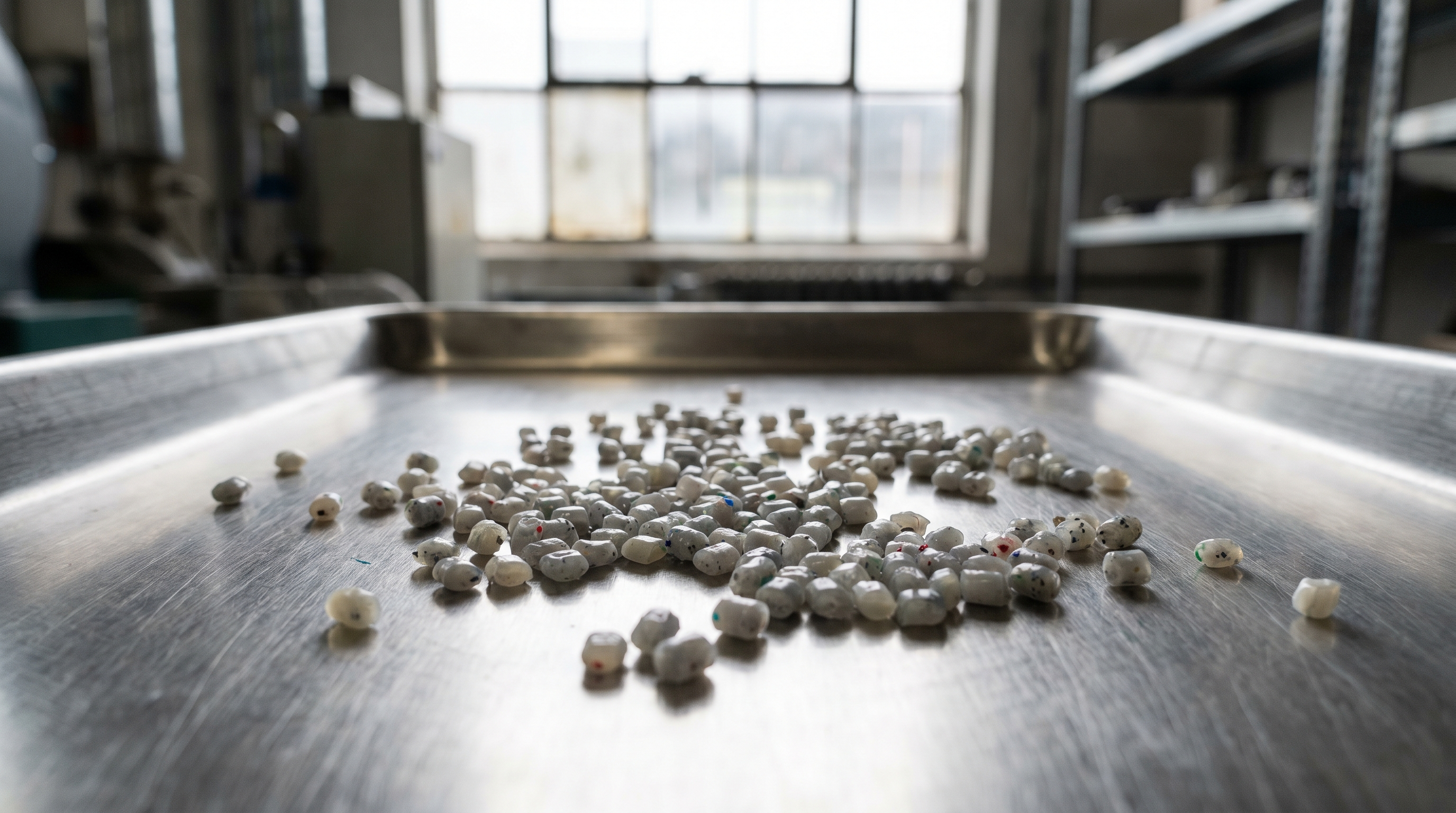
I have watched rPET pellets arrive at the mill in 25-kilo bags. The bags look the same. The test reports look the same. But when the lot goes through the spinnerette, you see the difference: specks, color drift, a faint off-gas that was not there last month.
If you are building a brand and asking whether is recycled polyester bad, the honest answer is: it depends on where the pellet came from and what your spec actually tests for. Most brand founders never see this part of the supply chain. Here is what it looks like from the floor.
What the marketing page says
The marketing page says your leggings are made from recycled ocean plastic. Or post-consumer bottles. Or post-industrial textile waste. The product description mentions certifications. The hangtag has a number. The story is clean, circular, responsible.
The customer reads this and pictures a neat process: bottles collected, washed, shredded, melted, spun, woven, sewn. Plastic diverted from landfill. Carbon footprint reduced. Good purchase.
What actually happens on the line
The recycled polyester supply chain is long, opaque, and quality-variable in ways that virgin polyester is not. Here is the chain:
- Post-consumer bottles or post-industrial textile scrap get collected.
- They get sorted, sometimes well, sometimes not.
- They get washed and shredded into flakes.
- The flakes get melted and extruded into pellets.
- The pellets get shipped, often across borders, to yarn spinners.
- The yarn spinners melt the pellets and extrude them into filament.
- The filament gets knitted or woven into fabric.
- The fabric gets dyed and finished.
- The fabric gets cut and sewn into your leggings.
Every step is a potential contamination point. But the pellet step is where most of the risk accumulates, because that is where the feedstock's history gets baked into the polymer.
Where contamination enters
An international study analyzed recycled plastic pellets from 24 facilities in 23 countries for 18 substances representing three types of toxic chemicals: brominated flame retardants, benzotriazole UV stabilizers, and bisphenol A. None of the samples were free from all the targeted chemicals, and 21 samples contained all three types.
More than half of the samples contained 11 or more chemicals, and 17 samples contained five or more endocrine disrupting chemicals. Brominated flame retardants were present in 22 of the samples, with DecaBDE being the most frequently detected, despite its listing under the Stockholm Convention for global elimination in 2017.
That study was on HDPE pellets, not PET, but the principle holds. Recycled plastic carries the chemistry of its previous life. If that previous life included flame retardants, you get flame retardants. If it included PFAS water-repellent coatings, you get PFAS.
Recent research found that recycled plastic pellets can release a hidden mix of over 80 chemicals into water, disrupting hormones and fat metabolism in zebrafish larvae. Researchers warn that unknown and toxic additives make current recycling practices dangerously unpredictable.
The BPA problem in recycled polyester
This one concerns me more than antimony.
A 2024 study published in PubMed found BPA levels almost twice as high in recycled fabrics compared to conventional polyester: 13.5 versus 7.7 ng/g.
Testing by organizations like the Center for Environmental Health found that recycled polyester blends often show significantly higher BPA levels than virgin material. This is frequently due to cross-contamination from bottle caps, labels, and adhesives that enter the recycling stream.
BPA is a known endocrine disruptor. The Center for Environmental Health found BPA in polyester-blend socks from 88 brands, prompting recalls. The 2024 study showed that under sweaty conditions, BPA from clothes could exceed tolerable daily intake, particularly concerning for pregnant women or infants.
When you are wearing rPET leggings during a hot yoga class, your pores are open. The math changes.
The antimony catalyst problem
Antimony trioxide is used as a polymerization catalyst in most polyester production, virgin and recycled. It does not leave the polymer.
Recycled polyester clothing may raise safety and toxicity concerns due to potential contaminants like antimony, which is toxic at high concentrations. Studies found that polyester clothes release antimony into sweat and contain concentrations of 141 mg/kg, exceeding safety limits.
By comparison, the OEKO-TEX Standard 100 label requires that extractable antimony is less than 30 μg/g for clothing textiles.
That is a big gap. 141 mg/kg versus a limit of 30 mg/kg. The difference is whether the fabric passed a certification test or not.
There is no regulatory limit on antimony concentrations in polyester apparel or textiles used in furnishings. Antimony content is, however, considered for the award of the European Union Ecolabel for textile products and should not exceed 260 μg/g in the polyester fibres.
The microplastic shedding problem
A study commissioned by the Changing Markets Foundation found that recycled polyester, the fashion industry's flagship sustainable solution, sheds more microfibres than virgin polyester. Testing of 51 garments from major brands showed that recycled polyester releases both the highest number of fibres and the finest particles.
The Changing Markets 2025 study confirmed that recycled polyester garments released 55% more microplastic pollution particles during a single laundry cycle. The fibers from recycled cloth were also approximately 20% smaller diameter, and smaller fibers can penetrate filters and human tissues more easily.
Smaller fibers are harder to filter and more likely to enter the body.
The trade-off, named honestly
Recycled polyester can be cleaner than virgin polyester. It can also be dirtier. It depends on:
- The feedstock source (clear bottles vs. mixed textiles vs. industrial scrap)
- The sorting and washing process
- The chemical decontamination steps (if any)
- The quality management at the recycling facility
- The testing regime applied at each handoff
Mechanical recycling may leave catalyst residues or contaminants if purification is inadequate. While mechanical recycling offers a mature and economical solution, chemical recycling is essential for scalable, safe circularity in polyester textiles.
Chemical recycling, where the polyester is depolymerized back to monomers and then repolymerized, can theoretically remove contaminants. But chemical recycling is expensive, energy-intensive, and not yet at scale. Most recycled polyester in activewear today is mechanically recycled.
What certifications actually cover
Textile Exchange's standards set the criteria for third-party certification of recycled materials and chain of custody. The higher-tier standard includes a minimum 50% recycled content percentage and additional social and environmental requirements related to processing and chemical use.
Here is what the chain-of-custody certification does:
- Verifies that the material contains the claimed percentage of recycled content
- Tracks chain of custody from the recycler to the finished product
- Sets requirements for chemical management at certified facilities
- Requires third-party audits
Here is what it does not do:
- Test every lot for contaminants
- Set limits on specific chemicals in the finished fabric
- Guarantee the feedstock was clean
- Verify what happened at the collection and sorting stage if those sites are not certified
Chain-of-custody certifications are closely connected with shipment-specific documents and company-level documents. Shipment-specific documents verify that goods being shipped conform to the standard and include concrete shipment details. Company-level documents show the company is certified, confirming that overall operations meet the standard.
If your supplier shows you only a company-level document but will not issue a shipment-specific document for your order, the certification may not apply to your fabric.
What the product safety certification catches
OEKO-TEX Standard 100 means every component of a textile item, down to the thread, dye, and label, has been tested for over 1,000 harmful chemicals and proven safe for human health.
The certification tests for pesticide and herbicide residues, heavy metals including lead, cadmium, mercury, arsenic, chromium VI, and nickel, formaldehyde from finishing treatments, carcinogenic aromatic amines released from azo dyes, phthalates from prints and plastic coatings, allergenic disperse dyes, flame retardants, pH levels, and colour fastness.
That is useful. But here is what it does not cover:
The certification tests for harmful substances in finished products but does not certify that fibers are organic.
An OEKO-TEX label does not say whether the cotton is organic or the polyester recycled; it says the product has been tested for harmful substances against defined thresholds.
One investigation found a garment with formaldehyde close to the limit, 9 ppm of antimony, 0.07 ppm of tetraethyltin, and 0.01 ppm of DMF. But it technically passed.
Passing the test means under the threshold. It does not mean zero.
What a brand founder can do about it
- Demand shipment-specific certification documents, not just company-level certificates. Ask for the shipment-specific document from the certifying body. Cross-check with the certification database or directly with the certifier.
- Ask about feedstock source. Is it post-consumer bottles? Post-industrial textile scrap? Mixed? The answer affects contamination risk. Clear bottles are cleaner than mixed textile waste.
- Require product safety certification on the finished fabric, not just on the brand's marketing page. The certification should be on the fabric you are buying, not on a different fabric the mill also makes.
- Ask for lot-level test reports, not just annual certifications. If your supplier tests every lot, they should be able to show you the report for your lot.
- If you are making non-toxic claims, test the fabric yourself. Third-party lab testing costs money, but it costs less than a regulatory action or a product recall.
- Pair recycled-content certification with product safety certification. Safety depends on post-recycling finishing, not origin. Always pair recycled claims with product safety or chemical management certification.
If you are exploring the plastic-free activewear guide, you already know that material choice matters. But for brands still using polyester, whether virgin or recycled, the testing regime matters just as much.
What I would want to see in a supplier's lab report
If I were specifying rPET fabric for an activewear line and wanted to defend a non-toxic claim, here is what I would ask for:
- Shipment-specific certification document for the specific order, with certification number verifiable against the public database
- Product safety certificate for the finished fabric, current year, listing the product class and the certification number
- Antimony extraction test per ISO 105-E04, with results under 30 mg/kg
- BPA and bisphenol panel with results below detection limits
- Heavy metals panel including lead, cadmium, mercury, chromium VI
- PFAS screen (total organic fluorine) with results below 10 ppm
- Formaldehyde test per ISO 14184-1, with results below the product safety standard limit for the relevant product class
- Phthalates screen per ISO 14389
None of this is exotic testing. Any accredited textile lab can run these panels. The question is whether your supplier is willing to provide the reports, lot by lot.
OHZEN-TEX works with brands that want this level of documentation as a baseline, not as an exception.
The honest answer
Recycled polyester is not inherently bad. It is not inherently clean, either. The pellet supply chain is where the risk concentrates, and the certifications most brands rely on do not test at the pellet level.
Recycled leggings made from rPET are better for reducing plastic waste, but they are still synthetic and may contain dyes or chemical treatments. They are more sustainable, but not necessarily non-toxic.
If you want to make a recycled-content claim that holds up to scrutiny, you need more than a hangtag and a company certificate. You need lot-level documentation, third-party testing, and a supplier willing to answer hard questions about feedstock.
The people on the line know this. The question is whether the people writing the marketing page do.
Sources
https://www.sciencedaily.com/releases/2025/06/250623072802.htm https://ipen.org/publication/widespread-chemical-contamination-recycled-plastic-pellets-globally/ https://www.bluesign.com/polyester-recycling-chemical-risks https://textileexchange.org/recycled-claim-global-recycled-standard/ https://recoverfiber.com/newsroom/what-is-grs https://world-collective.com/blogs/news/textile-certifications-explained-why-gots-oeko-tex-rcs-and-grs-matter-for-fashion-brands-now https://shanghaigarment.com/supplier-fraud-alert-3-ways-to-verify-indian-garment-certifications-now/ https://sustainablykindliving.com/non-toxic-leggings-made-with-organic-and-pfas-free-materials/ https://www.sciencedirect.com/science/article/pii/S0273230020302506 https://www.ecolife.com/learn/what-is-recycled-polyester-fabric https://ecocult.com/does-oeko-tex-certification-mean-a-product-is-safe/ https://www.alibaba.com/product-insights/fitness-apparel-fabric-certifications-oeko-tex-gots-vs-marketing-claims-which-ensures-safety-during-prolonged-sweat-exposure.html https://orbasics.com/blogs/stories/is-recycled-polyester-harmful https://changingmarkets.org/report/spinning-greenwash/ https://estroni.com.au/pages/is-recycled-polyester-safe-the-hidden-bpa-antimony-risk-in-eco-activewear https://vibrantbodycompany.com/blogs/education/what-does-oeko-tex-standard-100-mean https://www.qforquinn.com/blogs/news/what-is-oeko-tex-certified https://hypeach.com/blogs/news/what-is-oeko-tex-standard-100 https://ohzehn-tex.com/plastic-free-activewear/