You are building a non-toxic activewear brand in 2026. Your customer no longer trusts the word "sustainable." They have seen too many conscious collections from fast fashion brands. They have scrolled past too many earth-tone campaigns that end at 82% polyester on the product page. The marketing category you thought you were entering is dying. What replaces it is not another positioning angle. It is proof.
This post is about what that shift means for your product roadmap, your supply chain investment, and your next 12 months of capital allocation.
The category in 24 months
The non-toxic activewear category is splitting into two tiers. The first tier is brands with verifiable third-party data attached to the product. The second tier is everyone else.
For too long, sustainability has been sold as a moral upgrade, a bolt-on feature customers were expected to reward with loyalty and price premiums. In practice, they did not. Virtue does not trigger purchases. Performance does. That observation from IMD researchers captures what your customer already feels but cannot articulate. The language of sustainability has become noise.
For 2026, values like ethical sourcing and sustainable packaging are table stakes, baseline expectations brands must fulfill to compete, but they will not win the game. Consumers are seeking lived alignment where performance earns trust. NielsenIQ's consumer outlook is explicit: functional quality is now the primary trust driver. Sustainability claims, social impact, and diversity statements have shifted toward "nice to have" status.
The implication for your brand: you cannot market your way to the premium tier. You have to test your way there.
What your customer is going to ask
Gen Z has quietly made fiber content a status symbol. For the first time in fashion's history, material transparency is influencing desirability as much as silhouette or brand name. This shift is not coming from fashion editors. It is coming from changing rooms, TikTok stitches, resale listings, and the comments section.
The behavior pattern is specific. Gen Z shoppers are starting to flip to the care label before checking the price, scrutinizing fiber breakdown the way millennials read skincare ingredients. They film hauls rating pieces by material quality, not just aesthetics. They call out brands whose outfits are "80% microplastic."
Your customer is going to ask questions you are not ready for:
- What is the OEKO-TEX batch number for this production run?
- Can I verify the certification on a public registry?
- What is the PFAS test result, not the claim, the result?
- Who did the testing and when?
Ask your current activewear brand for their OEKO-TEX batch number. Most cannot provide one because they have never submitted to testing. That is the competitive gap you are either exploiting or vulnerable to.
The cost math
Proof costs more than positioning. Here is what that looks like at scale.
Scenario: 10,000-unit production run of leggings
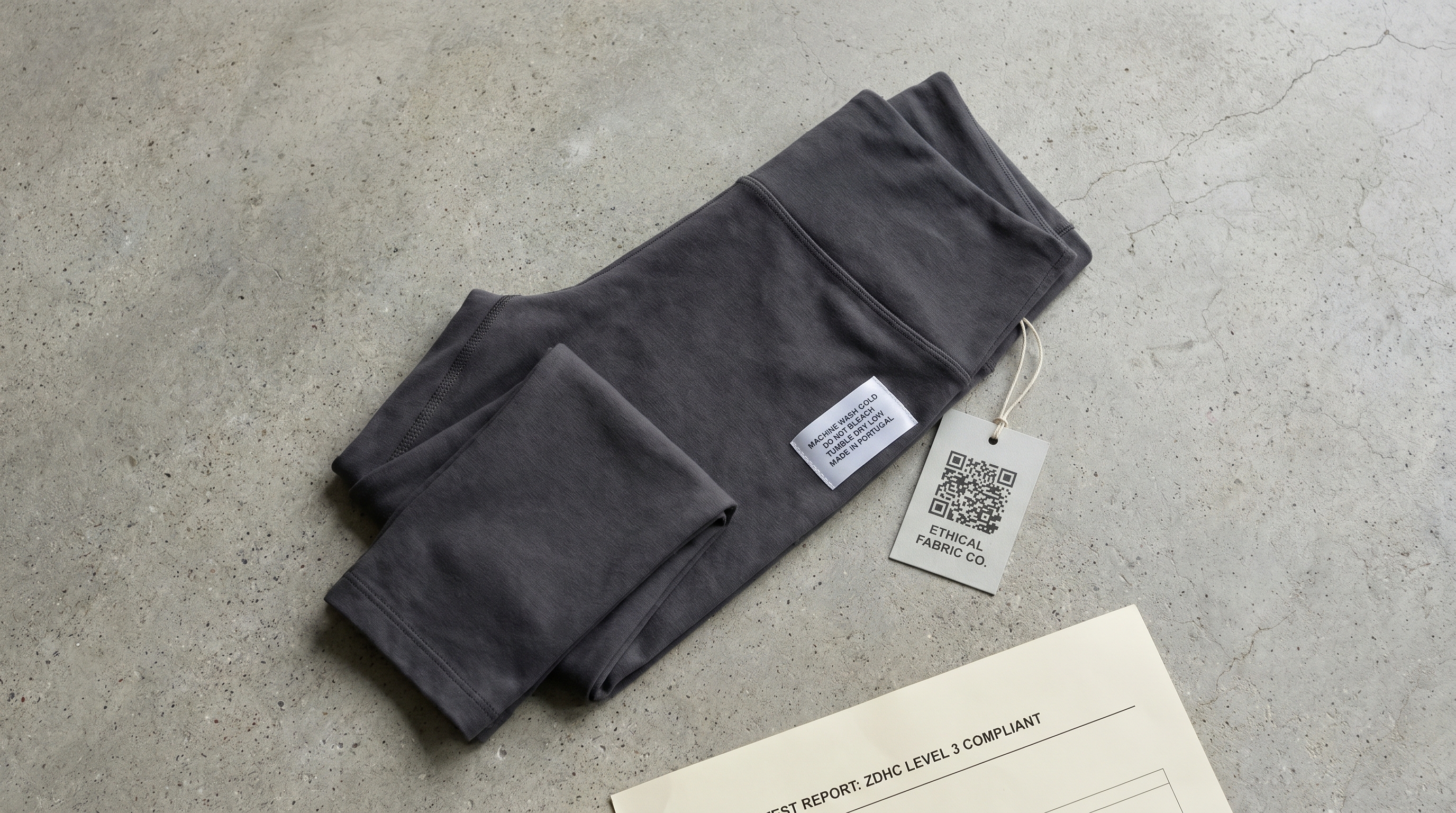
| Line item | Claims-only approach | Proof-based approach | |-----------|---------------------|---------------------| | Base fabric COGS | $8.50 | $8.50 | | OEKO-TEX Standard 100 batch testing | $0 | $0.35–$0.50 per SKU | | PFAS third-party lab test per lot | $0 | $0.15–$0.25 per SKU | | Finished product testing (BPA, phthalates, formaldehyde) | $0 | $0.20–$0.30 per SKU | | Documentation and registry maintenance | $0 | $0.05–$0.10 per SKU | | Testing overhead per unit | $0 | $0.75–$1.15 |
If your current COGS is $11, your proof-based COGS is approximately $11.75 to $12.15. At an ASP of $98, that moves your gross margin from 88.8% to 87.6%. The margin compression is real, but it is single-digit basis points, not structural.
This costs significantly more than the industry standard, but it is the only way to guarantee what the customer is wearing is actually safe.
The math changes if you skip batch testing and rely on fiber-level certifications. Your marketing still says "OEKO-TEX materials," but your finished product has not been verified. Rather than relying solely on fiber-level certifications, testing finished products for BPA, PFAS, and hormone disruptors is a more rigorous approach that accounts for contamination introduced during manufacturing.
The cost difference between "materials certified" and "product certified" is where your competitor will lose the trust race.
Where the regulatory floor is moving
The regulatory environment is about to remove the optionality from this decision.
United States: state patchwork accelerating
As of 2026, several U.S. states, including California, New York, Maine, Vermont, and Connecticut, have enacted PFAS restrictions in textiles. In Washington, apparel may not contain intentionally added PFAS after January 1, 2027. Additional states, including New Mexico and Pennsylvania, are advancing PFAS legislation that may take effect in 2027 and beyond.
The EU is moving toward a near-total PFAS ban under REACH 2.0, while state-level bans in the U.S. are creating a fragmented patchwork that affects product access to markets.
European Union: France and Denmark leading
In France, a ban on the manufacture, import, sale, and offering for free of PFAS-containing textiles, clothing, and footwear took effect on January 1, 2026. In Denmark, it is prohibited to import or sell clothing and footwear containing PFAS for private consumer use from July 1, 2026.
Penalties in France include fines up to €15,000 and €1,500 per day. Non-compliant products can be pulled from the market.
The Digital Product Passport
From 2027, every textile in the EU must carry a Digital Product Passport. It links each product to digital data, from materials to sustainability, making transparency the new standard.
While final requirements are still being defined, EU studies indicate early DPPs will focus on material composition, manufacturing processes, core environmental indicators, chemical compliance, traceability, and durability.
For brands, this marks a structural shift. Sustainability is no longer a voluntary marketing claim. It is becoming embedded into enforceable product-level regulation.
The regulatory floor is not just moving. It is converging on the same requirement: verifiable, product-level data. If you are already testing every lot and maintaining batch documentation, you are building the infrastructure the law will require. If you are not, you are building compliance debt.
What to do this quarter
- Audit your current certification stack. Are your certifications at the fiber level, the fabric level, or the finished-product level? The gap between "we use OEKO-TEX certified materials" and "our products are OEKO-TEX certified" is the gap your customer will find.
- Get one SKU through full third-party testing. Do not test your entire line. Pick your highest-volume SKU, run it through OEKO-TEX Standard 100, a targeted PFAS panel, and a BPA/phthalate screen. Document the process. Understand the timeline and cost. This is your baseline.
- Build the registry link. OEKO-TEX certification is independently audited, publicly trackable, and has specific performance requirements. You can verify claims on the OEKO-TEX registry using batch numbers. If your customer cannot verify your certification in 30 seconds, you do not have proof. You have marketing.
- Rewrite one PDP. Take your tested SKU and rewrite the product page. Lead with the test result, not the claim. Link to the public registry. Show the batch number. This is the template for your entire catalog.
What to do in the next 12 months
- Move to batch-level testing. Do not apply certification once and rest on that claim. Each new production run should be tested. If a single batch fails, do not use it. This is expensive. It is also the only defensible position when a customer, a regulator, or an acquirer asks for receipts.
- Build your DPP infrastructure now. Depending on supply chain complexity, IT maturity, and supplier readiness, full DPP implementation can take 18 to 36 months. If you wait for the delegated act to be finalized in 2027, you are 18 months behind brands that started in 2025.
- Price the proof into your ASP. The cost math above assumes you absorb testing costs in your margin. The alternative: price it in. A $2 price increase on a $98 legging is invisible to the customer who already filters for non-toxic activewear. It is material to your unit economics at scale.
- Use the pillar page as your anchor. If you are building content around this category, link your claims to the plastic-free activewear guide and make sure every material claim on your site traces back to a verifiable source.
- Prepare for the trust audit. In 2026, the Edelman Brand Trust Barometer recorded that 86% of global consumers now refuse to purchase from a brand they do not trust, with the sharpest rise among Gen Z shoppers aged 18 to 27, where the figure reached 91%. Your next investor, your next retail partner, your next acquisition suitor will ask: can you prove what you claim? The answer cannot be a PDF no one reads.
Platforms like OHZEHN-TEX™ exist precisely because the gap between claim and proof is where brands either build defensibility or lose it. The next 24 months will sort the category.
"Sustainability is not a trend. It is a change in operations."
That line, from a commenter responding to a TikTok exposé of fast-fashion greenwashing, captures the consumer verdict. If a brand has a sustainable "collection," they are not sustainable. They are greenwashing. Sustainability is not a trend. It is a change in operations.
Your customer already knows this. The question is whether your supply chain does.
Sources
https://www.bluesign.com/pfas-in-clothing https://sustainabilityservices.eurofins.com/news/pfas-regulations-overview-2026-for-consumer-products/ https://www.trimco-group.com/newsroom/global-pfas-ban-regulations-and-their-impact-on-the-textile-industry https://www.certivo.com/blog-details/global-pfas-regulations-the-2025-2026-compliance-master-guide-for-manufacturers https://www.imd.org/ibyimd/industry/sustainability/sustainability-trends-businesses-must-watch-in-2026/ https://instituteofdigitalfashion.substack.com/p/is-buying-polyester-embarrassing https://www.thecooldown.com/green-business/tiktok-greenwashing-fast-fashion-h-m-boohoo-shein/ https://luthresearch.com/glossary/what-is-sustainability-fatigue-and-how-do-brands-overcome-it/ https://www.amraandelma.com/consumer-trust-in-advertising-statistics/ https://nielseniq.com/global/en/insights/report/2025/consumer-outlook-guide-to-2026/ https://www.inriver.com/resources/do-consumers-care-about-sustainability/ https://www.carbonfact.com/blog/policy/digital-product-passport-fashion https://deutsche-recycling.com/blog/the-digital-product-passport-for-textiles-explained/ https://tracextech.com/eu-textile-strategy-dpp-compliance/ https://www.dekographics.com/dpp/ https://wearbonta.com/blogs/news/oeko-tex-certified-vs-conventional-activewear-why-we-lead-in-non-toxic-performance https://everyrep.com/best-non-toxic-activewear-brands/