The popular framing is that biodegradable polyester solves the end-of-life problem for performance wear. You buy the leggings, you wear them out, you toss them in your backyard compost bin, and they return to the earth. That framing is incorrect. The gap between what "biodegradable" means on a lab certification and what it means in a consumer's actual disposal environment is measured in decades.
What the popular framing says
Brands marketing biodegradable polyester textiles, including PLA (polylactic acid), PBAT, and various aliphatic polyester blends, lean on a simple story: these materials are designed to break down, unlike conventional PET polyester. The marketing language on product pages suggests you can close the loop: wear the garment, compost it, done.
Social media amplifies this. TikTok creators point out that companies use buzzwords like "biodegradable," "eco-friendly," and "green" without backing up those claims, and offer actionable advice encouraging viewers to look for third-party certifications. The conversation often frames the issue as greenwashing by bad actors, implying that the "good" biodegradable products work as promised.
The problem is more structural than that. Even the certified products, even the ones with legitimate third-party credentials, require conditions most consumers cannot access.
What the data actually says
The relevant certification standard in Europe is EN 13432. The material must biodegrade into carbon dioxide, water, and biomass, with at least 90% of the organic carbon converting to CO₂ within 180 days under industrial composting conditions. After 12 weeks, no visible fragments larger than 2 mm should remain in the compost.
The mechanism matters here. Industrial composting is not your backyard pile with kitchen scraps. The EN 13432 standard specifies requirements for packaging recovery through composting and biodegradation, setting out strict criteria for the compostability of packaging materials and products, including their biodegradability, disintegration, and absence of negative effects on composting processes or resulting compost quality.
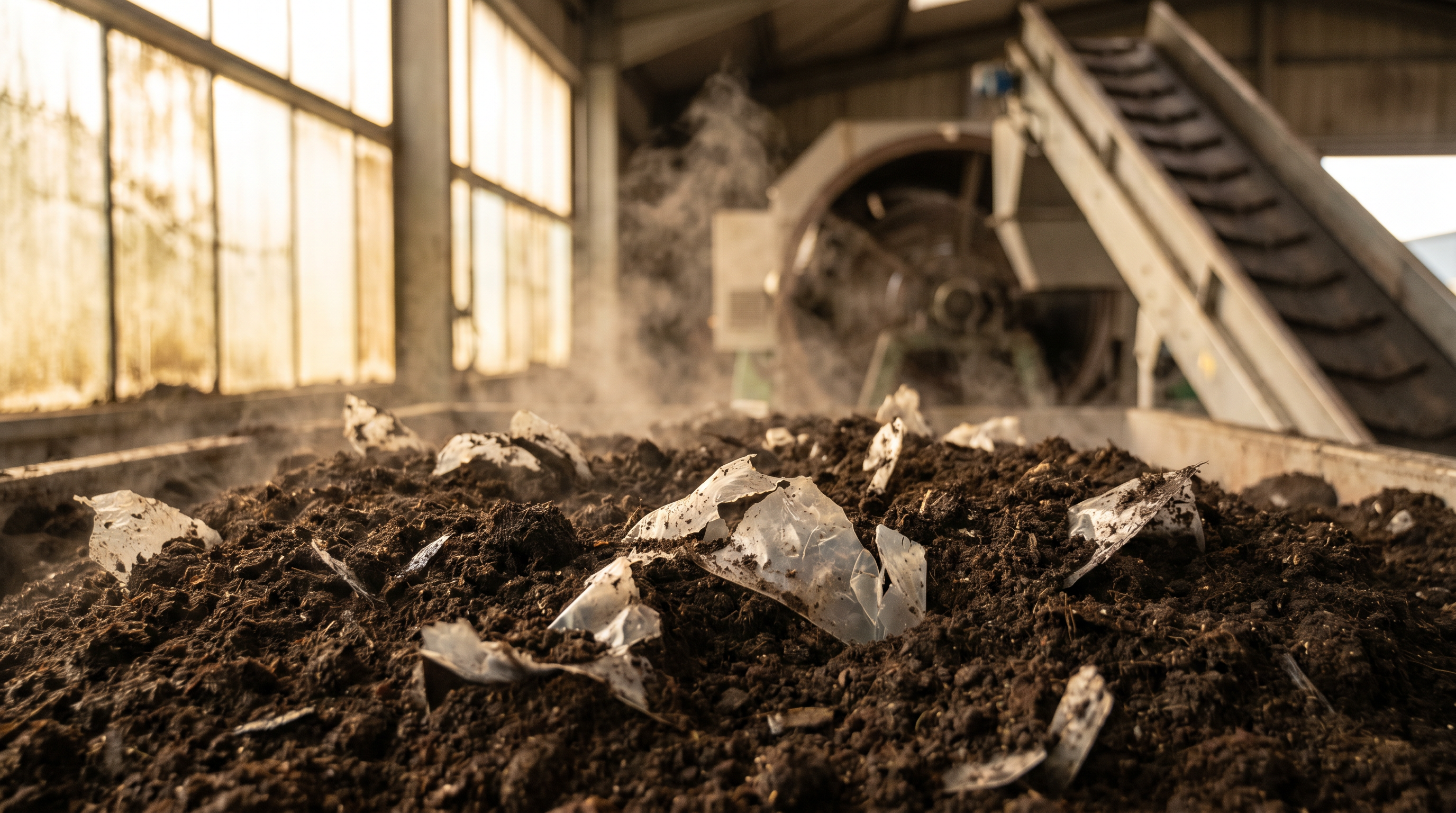
The temperature requirement is the critical variable. PLA waste can fully decompose into carbon dioxide and water within 3 to 6 months under industrial composting conditions: temperature 58°C, humidity 98%, and microbial activity. That 58°C threshold is not a suggestion. It is mechanistic.
The composting temperature of 58°C induces crystallization by having a structural effect on the polymer, which in turn affects the degradation rate of PLA. PLA biodegradation requires specific conditions of temperature, moisture, and oxygen levels that are only achieved in industrial composting facilities, and the process often takes up to 90 days to degrade over 90%, thus labelled as compostable.
PLA requires industrial composting at 140°F or higher to break down. At ambient temperatures, the picture changes entirely. The best-known form of PLA biodegradation is composting at industrial scales with internal reaction temperatures reaching 55 to 60°C and above. Under such thermophilic conditions, PLA can be broken down first by surface hydrolysis which subsequently enables enzymatic depolymerization. In composts of smaller volume that can only reach mesophilic temperatures, PLA degradation rates are minimal, presumably due to the lack of chemical hydrolysis.
Standard PLA requires the high heat of industrial composting (55 to 60°C) to decompose. It will not break down in standard backyard compost bins.
Dr. Susanne Brander, an ecotoxicologist from Oregon State University, summarized the situation in an interview with Bluedot Living: "Biodegradable polyester does break down faster, but only under certain conditions." PLA will only ever so slightly degrade in natural compost conditions, such as your backyard compost. It only degrades entirely if it is composted in an industrial facility, which utilizes extreme heat and humidity to break the chemical bonds within the compound.
Where the popular framing is right
The chemistry is real. Biodegradable polyesters are legitimate materials that have passed rigorous testing. EN 13432 is the primary European standard for industrial compostability, mirroring ASTM D6400. It is required for most compostable food packaging sold in the EU market.
If a material or packaging complies with EN 13432 we can be sure that it is compostable and, therefore, it will end up by becoming compost, CO2 and water without leaving any trace of microplastics under proper compostability conditions.
The certifications (OK Compost Industrial, BPI, DIN CERTCO, Seedling logo) mean something: the material has been tested and verified to degrade under specific, controlled conditions. A product must pass rigorous laboratory testing by an accredited third party to earn that label.
Disposal of biodegradable fibers could be achieved by industrial composting, but natural fibers are sometimes modified during manufacturing in ways that might influence biodegradation. The science is sound. The infrastructure is not.
Where the popular framing is wrong, and the mechanism for why
The framing fails at the disposal infrastructure level. A textile that biodegrades at 58°C for six months in a controlled facility does not biodegrade in your backyard compost pile, your municipal landfill, or the ocean.
The Big Compost Experiment, a citizen science study conducted by University College London engaging 9,701 UK citizens, provides the most comprehensive real-world data on this question. Of the biodegradable and compostable plastics tested under different home composting conditions, the majority did not fully disintegrate, including 60% of those that were certified "home compostable."
Home composting is not currently a viable effective or environmentally beneficial end of life option for compostable or biodegradable packaging. The compostable and biodegradable plastics that are currently being sold in packaging applications do not fully degrade in home composting conditions, including those that have been certified as home compostable.
The experiment found that the majority (66%) of items tested had remains that were still visible at the end of the composting period while only 34% were no longer visible or not found.
Consumer confusion compounds the problem. The results show that the public are confused about the meaning of the labels of compostable and biodegradable plastics. 14% of sampled plastic packaging items tested were certified "industrial compostable" only and 46% had no compostable certification.
The infrastructure gap is severe in the United States. While there are almost 5,000 composting facilities in the US today, the majority accept only yard trimmings. Currently, only 11% of American households can direct compostable packaging away from the landfill to composting facilities. The Sustainable Packaging Coalition estimates that only 15% of existing composting facilities accept compostable packaging, while only 45% of existing compost facilities accept food waste from residential and commercial sources.
Industrial composting facilities that can accept textiles are even rarer than those accepting food waste. Most municipal composting programs explicitly exclude textiles, even biodegradable ones, because of contamination concerns and the variability in chemical finishes.
Textiles are not processed through material recovery facilities due to a lack of collection infrastructure and limited textile sorting technology.
"Home composting is not currently a viable effective or environmentally beneficial end of life option for compostable or biodegradable packaging."
Finishes matter. A biodegradable base fiber treated with DWR finishes, antimicrobial agents, or synthetic dyes may not compost cleanly even under ideal conditions. The coating can seal the fiber from the microorganisms that would otherwise break it down.
At present there are no specific international or national standards for home compostable packaging and plastics, as the existing EU standards and their nationally adopted versions involve methods of test that simulate industrial scale composting and anaerobic digestion. A Belgian "OK Compost Home" specification is managed by the certification body Vinçotte, who also operate their "OK Compost" (aligned to EN 13432) certification scheme.
Some specialized PLA formulas use enzyme technology to enable breakdown at ambient temperatures (20 to 30°C), making home compostability possible. Home compost certification is extremely rare for standard PLA, as it requires special enzyme-enhanced formulation.
What this means for a product founder
If you are building a brand in the plastic-free activewear space and considering biodegradable polyester as part of your material story, the data points to several structural constraints.
1. The claim requires disposal infrastructure that does not exist at scale
Your customer cannot access industrial composting for textiles in most US markets. Telling them your leggings are "biodegradable" without specifying the disposal pathway creates a claim gap that regulators and informed consumers will notice.
2. The certification is not the same as the consumer outcome
"OK Compost Industrial" certification is rigorous and real. It also describes behavior at 58°C in a controlled facility, not in a customer's backyard or municipal waste stream. The relevant question is not "does this material biodegrade under ideal conditions?" but "does this material biodegrade under conditions my customer can actually access?"
3. Conventional natural fibers have a simpler end-of-life story
Research showed that wool and cotton fabrics biodegraded in soil more rapidly than bio-based poly (lactic acid) fiber. Organic cotton, linen, hemp, and wool biodegrade in home compost conditions, soil burial, and even ambient environments over reasonable timeframes. The infrastructure requirement is lower. The claim is more defensible.
4. If you use biodegradable polyester, spec the disposal pathway on the label
Do not say "biodegradable." Say "industrially compostable per EN 13432" and provide guidance on how the customer might access that disposal pathway. Transparency protects your brand from greenwashing claims and respects your customer's intelligence.
5. The blend problem persists
If your biodegradable polyester is blended with conventional elastane for stretch, the garment is not compostable. Period. The elastane component will persist in the environment, and as the biodegradable fraction breaks down, it can release microfibers that contaminate the resulting compost.
6. Watch the regulatory direction
The FTC Green Guides clearly state that terms like "compostable" require reliable scientific evidence, and third-party certification seals are how you prove it. Expect similar scrutiny of biodegradable textile claims as regulators catch up to the infrastructure gap. The EU's updated Packaging and Packaging Waste Regulation, the FTC's Green Guides revision process, and state-level greenwashing enforcement actions all point toward tighter standards for end-of-life claims.
OHZEHN-TEX™ partners with brands building material stories that close the loop without relying on disposal infrastructure that does not exist. The standard we hold is simple: if the customer cannot realistically access the disposal pathway, the claim is not ready for the hangtag.
The material science is advancing. Blends of PLA with other biodegradable polymers show promise for home-compostable outcomes in the future. But for now, the gap between the lab test and the customer's backyard remains wide.
The numbers do not lie. They just require context.
Sources
https://bluedotliving.com/dear-dot-is-biodegradable-polyester-a-legit-eco-fabric/ https://link.springer.com/article/10.1007/s13762-024-05802-6 https://www.plantswitch.com/blog/why-pla-isnt-actually-compostable https://news.indianaheadlines.com/story/614060/pla-certification-standards-explained-what-compostable-packaging-really-means.html https://www.sciencedirect.com/science/article/abs/pii/S0045653524006222 https://www.openpr.com/news/4526564/pla-certification-standards-explained-what-compostable https://www.esunfiber.net/show_29.html https://www.biorxiv.org/content/10.1101/2025.06.29.662191.full.pdf https://orizonbio.com/en-13432-compostable-standard/ https://primebiopol.com/todo-sobre-la-norma-en-13432/?lang=en https://www.polyflex.uk.com/news/what-is-the-en13432-standard https://www.bpf.co.uk/topics/Standards_for_compostability.aspx https://discovery.ucl.ac.uk/id/eprint/10159613/ https://www.littlegreenduckie.com/food/the-big-compost-experiment/ https://www.frontiersin.org/journals/sustainability/articles/10.3389/frsus.2022.942724/full https://www.ucl.ac.uk/engineering/home-composting-and-compostable-plastics https://files.gao.gov/reports/GAO-25-107165/index.html https://resource-recycling.com/recycling/2023/03/01/a-compostable-future/ https://bpiworld.org/infrastructure https://www.thecooldown.com/green-business/greenwashing-companies-tiktok-consumers/