I once signed off on a cotton lot at 11:47 PM because the buyer needed the ship date or they would miss the launch window. The afterwash step got cut. The fabric still passed its formaldehyde spec on the certificate. It did not pass the kind of test that would have mattered.
This is a post about what "easy care" or "wrinkle-free" actually means when you see it on a non-toxic activewear label. And about what those words hide.
What the marketing page says
The language varies, but the promise is always the same: the garment will look smooth out of the dryer, no iron required. Sometimes it is labeled "easy care." Sometimes "durable press." Sometimes nothing at all, because the resin finish happens upstream and never makes it to the hangtag.
Brands selling non-toxic activewear made from cotton or Tencel blends often promote them as a safer alternative to polyester. And in many ways, they are. Cotton does not shed microplastics. It does not require antimony trioxide to polymerize. But cotton, on its own, wrinkles badly.
So it gets treated.
What actually happens on the line
DMDHEU, or dimethyloldihydroxyethyleneurea, is the basis for about 90% of easy-care and durable press finish products on the market. It is synthesized from urea, glyoxal, and formaldehyde. When applied correctly, it crosslinks the cellulose chains in cotton fiber, locking them in place so the fabric does not swell and wrinkle when it gets wet.
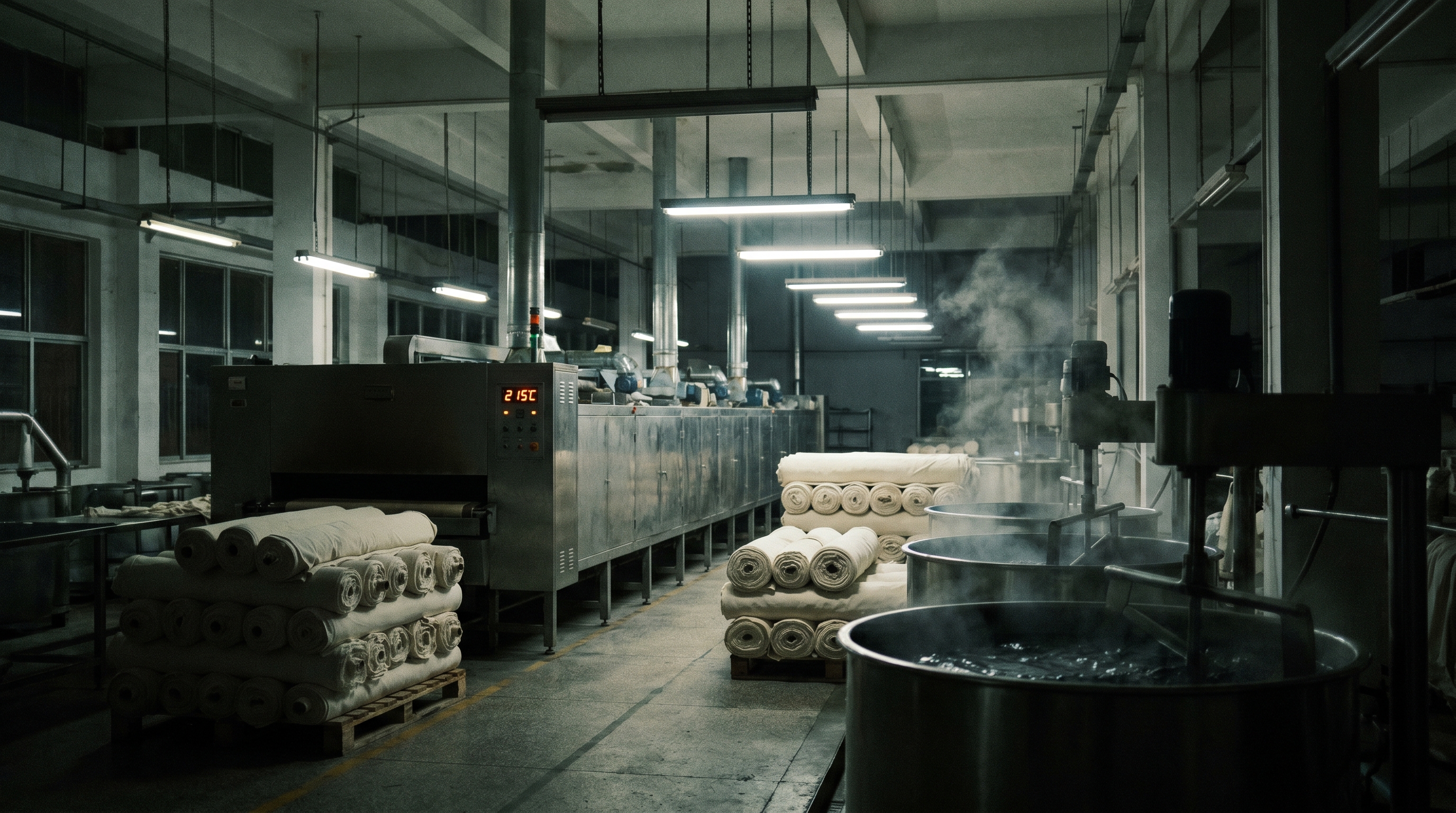
The process works like this: fabric goes through a padding bath containing DMDHEU and a catalyst, usually magnesium chloride. It is dried at 110°C and cured at 150°C for about three minutes. The curing step triggers the crosslinking reaction. The crosslinks are covalent bonds that hold the fabric in its flat, smooth shape.
Formaldehyde-containing finishing agents like DMDHEU achieve significant anti-wrinkle effects but pose health risks due to formaldehyde release. The problem is that the crosslinks are not perfectly stable. The finish will decompose under certain conditions and liberate formaldehyde. Heat accelerates this. Humidity accelerates it. Sweat, which is both warm and wet, accelerates it more.
When making fabrics with an anti-wrinkle finish, manufacturers use a resin that can leak formaldehyde during manufacturing, wearing, and washing.
The people upstairs rarely see this part. They see a wrinkle recovery rating on a tech pack. They see the OEKO-TEX certificate. They do not see the dye house at midnight, when the line lead is running behind and someone has to decide whether to skip the afterwash or miss the container.
An afterwash of the finished fabrics removes not only the free formaldehyde but also decomposes a part of the N-methylol groups not cross-linked with cellulose. But an afterwash is not possible for many articles because of adverse effects on the finished textile fabrics, such as loss of dimensional stability.
So sometimes it gets skipped. Not because anyone wants to hurt the wearer. Because the ship date is the ship date, and the chemist's spec loses to the line lead's schedule.
The trade-off, named honestly
The honest answer is that formaldehyde-free alternatives exist, but they come with trade-offs.
Formaldehyde-free alternatives such as citric acid (CA) and 1,2,3,4-butanetetracarboxylic acid (BTCA) suffer from high costs, severe fabric strength loss, yellowing, or insufficient wash fastness.
Citric acid, in particular, yellows badly. When citric acid is used as a formaldehyde-free cross-linking agent, the α-hydroxyl groups in its molecules suffer dehydration during high-temperature curing at 140–180°C, generating unsaturated aconitic acid containing conjugated double bonds. This conjugated structure alters the fabric's light absorption properties in the visible spectrum, resulting in significant yellowing.
So brands face a choice: use the formaldehyde-based chemistry that works well and keeps the cost down, or use the formaldehyde-free alternatives that yellow the fabric, weaken the hand, and cost roughly twice as much.
DMeDHEU, the formaldehyde-free alternative, costs about twice as much as DMDHEU products. To achieve comparable easy-care and durable press effects, nearly twice the amount of DMeDHEU is needed.
For a brand selling $38 leggings, that math is hard. For a brand selling $98 leggings with a non-toxic story, the margin might support it. But someone on the team has to know to ask.
What testing actually catches
This is where it gets uncomfortable.
AATCC Test Method 112 is a globally recognized standard used to measure formaldehyde release from textile fabrics. This test uses fabric and water in a sealed jar to measure how much formaldehyde the specimen will release over time.
But here is the catch. The average formaldehyde level contained by textiles made in the USA is approximately 100–200 µg free formaldehyde/g as measured by the AATCC Method 112 sealed jar test. Results using AATCC Method 112 are about 4 times higher than those measured using ISO 14184-1 or the Japanese Law 112 Method.
Four times higher. Depending on which test method you specify, the same fabric can pass or fail. And most brand founders do not know which test method their supplier is running.
Fabrics under 100 ppm are deemed safe for daily usage. The US does not regulate formaldehyde levels in textiles. There is no federal requirement in the United States. Japan's standard is 75 ppm. The EU's REACH framework sets different limits by product class.
The OEKO-TEX STANDARD 100 restricted substance list has expanded from 100 substances in 1992 to over 1,000, including formaldehyde, APEOs, PFCs, and heavy metals. An OEKO-TEX certification is meaningful, but it is not magic.
Although a product that is safer for humans could also be better for the planet, STANDARD 100 is not an eco or sustainability claim. It is a product safety screen. It tests what is in the finished garment at the moment of certification. It does not tell you what will release under sweat, friction, and body heat over 50 washes.
Most brands that claim sustainability or safety never submit to this testing. They can't pass it. That is a quote from a brand selling OEKO-TEX certified activewear, and they are not wrong. The number of brands with a non-toxic story but no third-party lab report is higher than anyone wants to admit.
What a brand founder can do about it
If you are sourcing cotton or Tencel activewear and claiming it is non-toxic, here is the honest math:
- Specify formaldehyde-free chemistry. Ask your mill whether they use DMDHEU or a formaldehyde-free alternative like DMeDHEU, BTCA, or citric acid. Get it in writing.
- Ask for lot-level AATCC 112 test reports. Not the certificate. The actual lot-level lab report. AATCC 112 ensures that textiles comply with safety regulations and are suitable for consumer use, particularly regarding skin contact products like clothing. If your supplier cannot produce it, you are trusting their word.
- Specify the afterwash. If your fabric is receiving a durable press finish, the afterwash step is what removes the free formaldehyde that did not bond. Simple laundering with normal commercial detergents greatly reduces formaldehyde or lowers it to non-detectable levels. But it adds time and cost. Build it into the spec.
- Understand the yellowing risk. If you are using citric acid finishes, especially on white or light-colored goods, you will need to test aggressively for yellowing after wash and after storage. The chemistry is cleaner, but the aesthetics are harder.
- Do not assume OEKO-TEX covers everything. OEKO-TEX doesn't cover the environmental impact of the manufacturing process. It is a product safety screen, not a process audit. If you want to make a claim about how the garment was made, you need a different certification or your own factory audit.
For brands building a material story around natural fiber activewear, the plastic-free activewear guide covers what the fiber choice itself does and does not solve. Formaldehyde finishes are a separate problem.
What I would want to see in a supplier's lab report
If I were reviewing a spec for non-toxic cotton activewear today, here is what I would ask for:
- AATCC 112 formaldehyde release test, lot by lot, not just at qualification. The sealed jar method, with the ppm result stated.
- ISO 14184-1 or Japanese Law 112 results if selling into markets that use those standards. The numbers will be different. Know which one your customer's compliance team expects.
- The chemical name of the crosslinking agent used. DMDHEU is formaldehyde-based. DMeDHEU is not. Citric acid is not. BTCA is not. Get the CAS number if possible.
- Afterwash confirmation. Did the fabric go through a post-cure wash to remove unreacted formaldehyde? Yes or no.
- OEKO-TEX STANDARD 100 certificate number, verifiable at oeko-tex.com/label-check. OEKO-TEX makes it easy to verify certificate numbers. If the brand doesn't provide that info, that's your sign.
"The difference between brands claiming 'non-toxic' without testing and brands that are OEKO-TEX certified is the difference between a promise and a guarantee."
That line is from a competitor's marketing page, but it is accurate. I have seen too many spec sheets with "formaldehyde-free" typed in the notes and no lab report attached.
The line lead's job and the chemist's job
I have stood on floors where the chemist's spec said one thing and the schedule said another. The line lead's job is to hit the date. The chemist's job is to hit the spec. When those two conflict, the afterwash is what gets cut.
Not because anyone is malicious. Because production is a system of constraints, and the constraint that matters most is the one with the purchase order attached.
If you want your fabric to actually be what the certificate says it is, you have to build that into the relationship. You have to visit. You have to ask the uncomfortable questions. You have to make it clear that the afterwash is not optional, even when the container is late.
OHZEHN-TEX™ exists in part because this problem is structural, not personal. The dye house is not the enemy. The chemist is not the enemy. The schedule is the enemy, and the only way to beat it is to source from partners who build the margin for compliance into their lead times.
If your supplier says "formaldehyde-free" but cannot show you the lot-level lab report, you do not have a spec. You have a hope.
Sources
https://pmc.ncbi.nlm.nih.gov/articles/PMC12899052/ https://propercloth.com/reference/formaldehyde-clothing/ https://purelivingspace.com/blogs/home-air-quality/the-problem-with-wrinkle-free-clothing-linens https://www.fibre2fashion.com/industry-article/3712/easy-care-and-durable-press-finishes-of-cellulosics-glyoxal-resins https://textilelearner.net/easy-care-finishing-of-cotton-fabrics/ https://irispublishers.com/jtsft/fulltext/easy-care-finishing-of-cotton-fiber-with-dmdheu-crosslinking-agent-for-high-crease-recovery-angle-and-low-washing-shrinkage-properties.ID.000713.php https://www.testinglab.com/aatcc-112-formaldehyde-content-testing-in-textile-fabrics https://www.commerce.senate.gov/services/files/0A80CDD3-5BE5-44C4-B0B2-A3FEF269F5E0 https://www.hohenstein.us/en-us/oeko-tex/output-control/standard-100/faq https://theroundup.org/what-is-oeko-tex-and-does-it-really-matter/ https://wearbonta.com/blogs/news/oeko-tex-certified-vs-conventional-activewear-why-we-lead-in-non-toxic-performance https://vibrantbodycompany.com/blogs/education/non-toxic-activewear https://members.aatcc.org/store/tm112/523/ https://ohzehn-tex.com/plastic-free-activewear/