You are 18 months from a decision you cannot walk back. By January 2027, apparel containing intentionally added PFAS will be illegal to sell in California, New York, Washington, Vermont, and France. Your customer will be asking about it. Your retail partners will require documentation. Your next financing round will include diligence questions about chemical compliance.
The category question is no longer whether PFAS-free clothing matters. It is whether you are building on the right side of the regulatory floor.
The category in 24 months
The activewear and performance apparel market is splitting into two tiers: brands that can prove chemical compliance across multiple jurisdictions, and brands that cannot.
The proof burden is not theoretical. California AB 1817 bans intentionally added PFAS in textiles, effective January 2025, with the total organic fluorine threshold dropping from 100 ppm to 50 ppm in January 2027. New York S.1322/A.994 prohibits apparel with intentionally added PFAS, effective January 2025. Washington State will ban intentionally added PFAS in apparel and accessories made from leather, natural textiles, synthetic textiles, or technical textiles after January 1, 2027.
The patchwork is not limited to US states. France's Law No. 2025-188 bans the manufacture, import, export, and sale of PFAS-containing textiles, footwear, and waterproofing agents for consumer use, effective January 2026. Denmark will ban PFAS in clothing, footwear, and waterproofing agents from July 1, 2026, with a threshold of 50 mg total fluorine per kg. The EU is advancing a universal restriction under REACH. ECHA's scientific evaluation of the proposed restriction is expected to conclude by the end of 2026, paving the way for EU-wide legislation covering over 10,000 PFAS chemicals.
In 2026 alone, new PFAS restrictions took effect across multiple U.S. states and European countries, with additional deadlines approaching throughout the year. Brands operating across multiple markets now face overlapping requirements with different timelines, thresholds, and exemption structures.
The brands that consolidate market share over the next two years will be the ones with supply chain visibility and verified chemical data. The ones that exit will be the ones still relying on marketing claims instead of third-party certification.
What your customer is going to ask
Your customer is already asking. The polyester pushback on TikTok is not a fringe movement. Creators are running content series like "Tired of Polyester" and driving millions of views on hashtags like #antipolyester and #nopolyester. Most activewear gets that soft feel from synthetic fabrics and chemical finishes layered onto petroleum-based materials, one creator noted in a viral sample review. The counter-message: "Softness shouldn't require plastic or chemicals."
A 2022 Mamavation study tested 32 activewear brands for PFAS and found detectable levels of organic fluorine in 25% of the tested garments, with the highest concentrations in the crotch area. The results revealed that LulaRoe leggings had the highest concentration at 284 ppm. The study has been cited by health-conscious influencers and wellness media for years. Your customer has seen it.
"Because most brands are able to produce leggings without the use of PFAS, this tells us it's not essential as a chemical treatment in women's leggings and should be immediately phased out."
That framing matters. The customer expectation is shifting from "is this brand sustainable" to "can this brand prove its claims." PFAS are especially prevalent in activewear because of the tendency for companies to use stain-resistant and water-repellant (marketed as "moisture-wicking") coatings. The brands that win will be the ones that can explain what they use instead, and why it works.
If you are building in the plastic-free activewear category, the question you need to answer is not "are we sustainable." It is "can we show test results."
The cost math
Here is where the strategic decision gets concrete. You have three paths forward:
Path 1: Stay on petroleum-based nylon with PFAS finishes. Current fabric COGS: approximately $6 to $10 per yard for standard nylon. Regulatory exposure: unable to sell in California, New York, Washington, Vermont, France, Denmark by 2027. Potential label requirements, reporting obligations, and litigation risk in additional states.
Path 2: Switch to petroleum-based nylon without PFAS finishes. Fabric COGS: approximately $6 to $10 per yard, plus $0.25 to $0.50 per yard for alternative DWR (durable water repellent) treatments. Regulatory exposure: compliant with PFAS bans, but still synthetic and subject to microplastic scrutiny.
Path 3: Switch to bio-based nylon or bio-cellulosic alternatives. Fabric COGS: Bio-based nylon manufacturing production costs were higher in 2025 and 2026 compared to petroleum-based nylon, limiting adoption among cost-sensitive manufacturers. Current estimates suggest a 15 to 25 percent premium over conventional nylon for comparable denier and performance.
Let's do the math on a legging with a current landed COGS of $11:
| Scenario | Fabric cost delta | New COGS | Gross margin at $68 ASP | |----------|------------------|----------|------------------------| | Current (nylon + PFAS) |, | $11.00 | 83.8% | | Nylon + alternative DWR | +$0.40 | $11.40 | 83.2% | | Bio-based nylon | +$1.80 | $12.80 | 81.2% | | Tencel/organic cotton blend | +$2.20 | $13.20 | 80.6% |
The gross margin compression on a $68 legging is between 0.6 and 3.2 percentage points depending on your material path. That is not a rounding error at scale, but it is also not a barrier. If your current gross margin is 80+ percent, you have room to absorb the switch and still run a healthy DTC or wholesale model.
The question is not whether you can afford to switch. The question is whether you can afford not to switch when California represents 12 percent of US retail.
Where the regulatory floor is moving
The compliance timeline is accelerating faster than most founders expect:
Already in effect (as of May 2026):
- California: PFAS ban in textiles, 100 ppm threshold, outdoor apparel disclosure required
- New York: PFAS ban in apparel
- France: PFAS ban in textiles, footwear, waterproofing agents
- Vermont: PFAS restrictions in textiles at 100 ppm threshold
Taking effect July 2026:
- Denmark: PFAS ban in clothing, footwear, waterproofing at 50 ppm
- Connecticut: labeling and notification requirements for PFAS-containing apparel
- Minnesota: manufacturer PFAS reporting deadline
Taking effect January 2027:
- California: threshold drops to 50 ppm
- Washington: full PFAS ban in apparel and accessories
- Vermont: threshold drops to 50 ppm
In the pipeline:
- EU universal PFAS restriction under REACH: scientific evaluation concluding end of 2026
- Kansas, Missouri, Ohio, New Mexico: active PFAS legislation
The floor is not stabilizing. It is rising. Every quarter you delay reformulation is a quarter closer to a compliance cliff.
What to do this quarter
- Audit your current supply chain for PFAS. Request total organic fluorine test results from your fabric suppliers. If they cannot provide them, that is your answer.
- Map your SKUs to regulatory exposure. Which products ship to California, New York, France? Those are your priority reformulation targets.
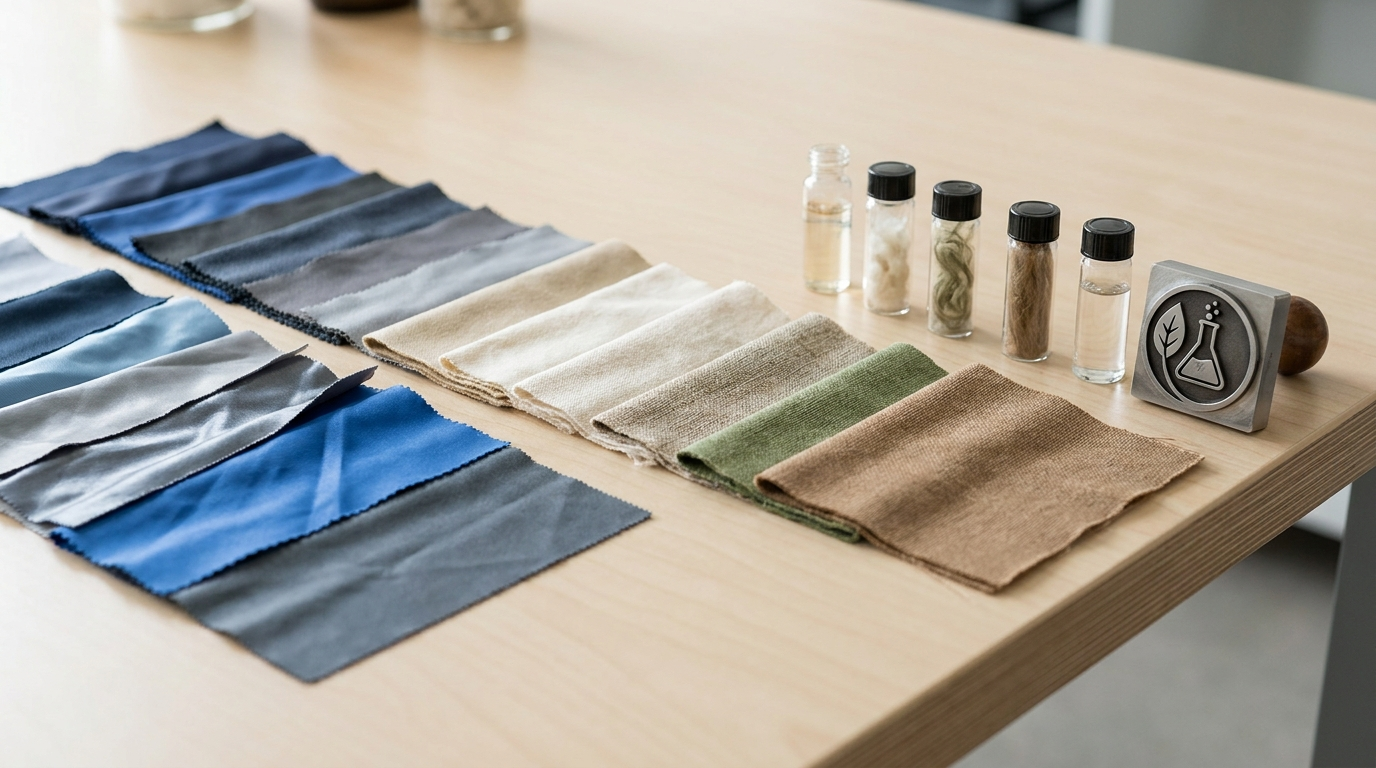
- Get certified. OEKO-TEX Standard 100 and bluesign certification provide third-party verification that your customer and your retail partners will accept. We can now find high-quality synthetic options that are free from harmful finishes and certified safe by third-party standards like OEKO-TEX Standard 100 and bluesign.
- Build your proof stack. Collect test certificates, supplier declarations, and chain of custody documentation. This is what due diligence looks like in 2026.
What to do in the next 12 months
- Reformulate your hero SKUs. Start with your top three sellers by revenue. The cost math above shows you the margin impact. The regulatory math shows you the revenue risk of not switching.
- Build the messaging before you need it. Your customer is already searching "PFAS-free leggings" and "non-toxic activewear." The brands that own that search intent will own the category.
- Consider ingredient branding. The bio-based nylon market is projected to grow from USD 1.69 billion in 2026 to USD 7.77 billion by 2034. The supply side is scaling. The opportunity is to partner with a certified material provider and build that proof into your hangtag and PDP. Platforms like OHZEHN-TEX exist precisely to provide that third-party material proof at the SKU level.
- Price for the floor, not the ceiling. If your current margin can absorb a 2 to 3 point compression and still hit your return thresholds, take the switch now. The brands that wait until 2027 will be competing on price with brands that reformulated in 2025.
"Compliance is no longer a future concern. Brands and manufacturers operating across multiple markets now face overlapping requirements with different timelines, thresholds, and exemption structures."
The regulatory floor is the floor. It only moves in one direction.
Sources
https://www.bluesign.com/pfas-in-clothing https://tocco.earth/article/which-eu-pfas-ban-applies-to-your-brand https://www.ul.com/news/eu-sets-pfas-restrictions-consumer-products https://echa.europa.eu/-/echa-announces-timeline-for-pfas-restriction-evaluation https://www.cirs-group.com/en/chemicals/echa-releases-pfas-restriction-proposal-assessment-timeline-final-opinion-expected-by-2026 https://pfas.foxrothschild.com/2026/02/ringing-in-2026-with-a-look-at-newly-effective-state-regulation-of-pfas-in-products/ https://www.saferstates.org/resource/2026-analysis-of-state-policy-addressing-toxic-chemicals-and-plastics/laws-going-into-effect-in-2026/ https://www.innovationnewsnetwork.com/pfas-product-bans-expand-in-2026-as-us-state-laws-take-effect/68718/ https://www.multistate.us/insider/2026/3/20/state-pfas-legislation-in-2026-hundreds-of-bills-across-23-states https://mamavation.com/product-investigations/non-toxic-activewear-guide-pfas-workout-leggings-yoga-pants.html https://www.thegoodtrade.com/features/pfas-free-clothing/ https://www.tiktok.com/discover/brands-that-dont-use-polyester https://www.giiresearch.com/report/fbs1916451-bio-based-nylon-market-size-share-growth-global.html https://www.fortunebusinessinsights.com/bio-based-nylon-market-113757 https://ohzehn-tex.com/plastic-free-activewear/