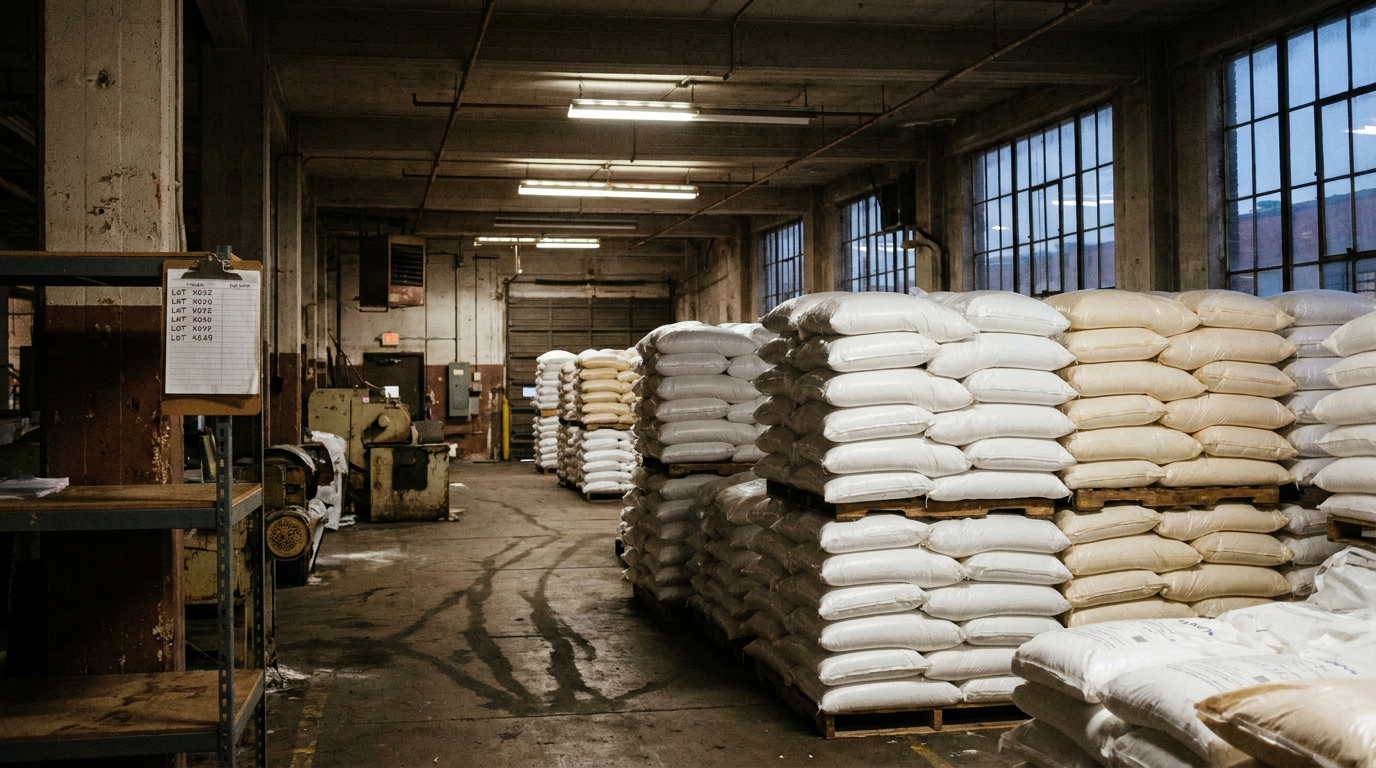
I have stood on a floor where rPET pellets arrive in supersacks from three different suppliers in the same week. The lot numbers are different. The color is slightly different. The melt viscosity is slightly different. And every single one of them carries a certificate that says "recycled content verified." None of the certificates tell you what was in that plastic bottle before it was shredded.
This post is about what "is recycled polyester bad" actually means when you stop asking the question in the abstract and start asking it in the receiving bay. I will walk through what the testing catches, what it leaves out, and what I have seen happen when an activewear brand asks for an honest answer instead of a comforting one.
What the marketing page says
Recycled polyester, often marketed as rPET, is the centerpiece of almost every major activewear brand's sustainability pitch. The story goes like this: bottles are collected, cleaned, shredded into flakes, melted into pellets, and spun into yarn. Virgin petroleum stays in the ground. Plastic stays out of the ocean. Everyone wins.
The industry commitment has been significant. In April 2021, Textile Exchange and the UN Framework Convention on Climate Change's Fashion Industry Charter for Climate Action launched a joint challenge calling on companies to commit to sourcing 45 to 100 percent of their polyester from recycled sources by 2025. According to the Textile Exchange challenge page, the program aimed to increase the global percentage of recycled polyester from 14 percent to 45 percent. As of early 2025, 124 fashion brands had signed on, though only about 58 percent were on track to meet their pledges.
The product pages use words like "planet-friendly," "ocean plastic," and "circular." The hangtag often says certified to a safety standard. The customer buys a pair of leggings and assumes the due diligence is done.
What actually happens on the line
Here is what actually happens between the marketing brief and the ship date.
The pellet supply chain is not clean
Recycled PET pellets do not arrive from a single controlled source. They arrive from aggregators who consolidate bales from municipal recycling programs, informal collection networks, and post-industrial scrap. The bottles themselves carried water, soda, detergent, or motor oil. The caps were made from a different plastic entirely. The labels had adhesive backing. The neck rings had colorants.
When those bottles are shredded and washed, most of the gross contamination is removed. But "most" is not "all." According to bluesign, contaminants remain in mechanically recycled rPET, including "dyes, coatings, softeners, PFAS, or heavy metals." The quality depends heavily on input feedstock, and fibers degrade over multiple cycles.
A peer-reviewed dataset published on NCBI analyzed 28 samples of recycled polyethylene pellets from various regions. The researchers detected and quantified 491 organic compounds, "with an additional 170 compounds tentatively annotated." These included pesticides, pharmaceuticals, industrial chemicals, and plastic additives. Recycled plastic is not a clean slate.
BPA enters through the polyester blend
The Center for Environmental Health (CEH), a California-based nonprofit, tested socks from over 100 brands and found BPA at levels "as high as 31 times over the limit deemed safe by California's Office of Environmental Health Hazards Assessment." The common denominator was polyester-spandex blends. CEH has not found BPA in socks made predominantly from cotton or other natural fibers.
Why is BPA in polyester socks? According to Sourcing Journal, "BPA can be added in the manufacturing of polyester as an intermediary step to improve the natural properties and lifespan of a fabric." It can also be used to create hygroscopic and antistatic fabric with color fastness to washing.
BPA is classified as an endocrine disruptor. According to the CEH press release, the organization sent legal notices to 42 companies after testing showed BPA "at up to 19 times over the safe limit of the chemical, according to California law." The brands included Hanes, Champion, Tommy Hilfiger, New Balance, Fruit of the Loom, Reebok, and Forever 21.
Antimony does not wash out
Antimony trioxide is used as a catalyst during polymerization of PET. According to a 2021 peer-reviewed study published in Regulatory Toxicology and Pharmacology by Biver, Turner, and Filella, antimony is released from polyester textiles into artificial sweat solutions. The study found that "between about 0.05 and 2% of total antimony (or 0.1–1 μg g−1) was mobilized into artificial sweat" under standard test conditions.
The study also noted that "since the first fraction of either extractions mobilized the greatest quantity of antimony, exposure can be minimized by washing articles before use." That is good advice. But how many consumers wash new activewear before the first workout?
The researchers tested polyester textile samples designed to be in contact with human skin, finding total antimony concentrations "ranging from about 125 to 470 μg g−1." The ISO 105-E04 artificial sweat extraction method was recommended for assessing exposure "because its pH is closer to that of human sweat."
Recycled polyester sheds more, not less
In December 2025, the Changing Markets Foundation published laboratory testing results on 51 garments from Adidas, H&M, Nike, Shein, and Zara. According to The Fashion Globe, the research was conducted by the Microplastic Research Group at Çukurova University in Turkey.
The central finding: recycled polyester "sheds more than half again as many microplastic particles during washing as virgin polyester." The study found that recycled polyester released an average of 12,430 microfibers per gram of fabric, compared to 8,028 microfibers per gram from virgin polyester. That is a 55 percent increase.
The particles from recycled polyester were also "nearly 20% smaller," according to The Fashion Globe, "and smaller particles penetrate biological tissue more easily."
According to the Changing Markets press release, Nike's recycled polyester garments shed the most microplastic fibers in the study. The report also found inconsistencies in labeling: "garments marketed online as containing recycled polyester did not state this on their care labels" for some samples purchased from H&M and Nike.
The trade-off, named honestly
The honest answer is this: recycled polyester solves one problem and creates others.
It diverts plastic bottles from landfills. That is real. It reduces reliance on virgin petroleum feedstock. That is real. According to Textile Exchange, mechanically recycled polyester can reduce greenhouse gas emissions compared to virgin production.
But it concentrates contaminants that were dispersed across the original packaging supply chain. It retains antimony at levels that were engineered for beverage contact, not extended skin contact during exercise. It sheds more microplastic fibers, not fewer. And because the feedstock is variable, the quality is variable in ways that virgin polyester from a controlled polymerization reactor is not.
The trade-off is not "good versus bad." The trade-off is "which risks do you want to manage, and do you have the testing infrastructure to manage them?"
What a brand founder can do about it
If you are sourcing rPET yarns for activewear, here is what I would do:
- Require feedstock declarations from your pellet supplier. Ask for the source of the post-consumer bottles, the washing and decontamination process, and the downstream test data. If they cannot tell you, they do not know.
- Run antimony extraction tests on incoming yarn lots. The ISO 105-E04 artificial sweat extraction method is the appropriate standard. It costs money. It takes time. It tells you something the certificate does not.
- Do not assume your safety certification covers microplastic shedding. According to Hohenstein's FAQ on certification, the standard "is not an eco/sustainability claim." It tests for harmful substances in finished textiles. It does not quantify fiber shedding. The updated STeP standard addresses microplastic release at the production facility level, but that is a facility certification, not a product test.
- Ask your fabric mill for a post-wash pilling and shedding report. ASTM D4970 (Martindale pilling) and AATCC TM212 (released fiber quantification) are the relevant methods. If your mill has never heard of AATCC TM212, that tells you something.
- Consider the application. Recycled polyester in a duffel bag is a different risk profile than recycled polyester in a sports bra worn for an hour at 85 degrees Fahrenheit. The closer to skin and sweat, the more the chemistry matters.
What I would want to see in a supplier's lab report
If I were reviewing a fabric supplier for an activewear line today, I would ask for the following:
- Safety certification, Class II (direct skin contact), with the certificate number verified against the certifier's label check portal. Class II has stricter limits than Class III or IV.
- Extractable antimony test result per ISO 105-E04, reported in micrograms per gram. I want to see the number, not just the pass/fail. According to Oeko-Tex, the standard requires extractable antimony under 30 μg/g for clothing textiles.
- Total fluorine content per the 2024 limit value. According to Oeko-Tex's 2024 regulations, the new limit is 100 mg/kg for total fluorine, replacing the previous extractable organic fluorine method. This confirms no intentional PFAS application.
- BPA test result per a validated extraction method. According to OETI, the 2025 regulations include stricter BPA limit values, as "BPA is classified as an endocrine disruptor and is commonly found in textiles with skin contact."
- Microfiber release quantification per AATCC TM212 or equivalent. I want to see a number for fibers released per gram per wash cycle.
- GRS (Global Recycled Standard) certificate for traceability on the recycled content claim, with chain of custody documentation back to the pellet supplier. According to Textile Exchange, this is the standard they own for third-party verification of recycled input.
If the supplier cannot provide these reports, they are not lying to you. They simply do not have the data. That is common. It is also a risk you are taking on behalf of your customer.
For founders exploring alternatives to synthetics entirely, the plastic-free activewear guide walks through the material options that avoid these chemistry questions altogether. OHZEHN-TEX™ exists precisely because some brands decide the answer to "is recycled polyester bad" is "it is complicated enough that we would rather not manage the variables."
Sources
https://textileexchange.org/2025-recycled-polyester-challenge/ https://www.sciencedirect.com/science/article/pii/S0273230020302506 https://ceh.org/bpasocks/ https://ceh.org/latest/press-releases/breaking-bpa-in-socks/ https://sourcingjournal.com/topics/raw-materials/testing-california-harmful-chemical-socks-adisa-champion-reebok-new-balance-gap-310952/ https://changingmarkets.org/report/spinning-greenwash/ https://changingmarkets.org/press-releases/fashions-green-strategy-is-making-microplastics-pollution-worse-study/ https://thefashionglobe.com/recycled-polyester-microplastics https://www.hohenstein.us/en-us/oeko-tex/output-control/standard-100/faq https://www.oeko-tex.com/en/news/press-releases/oeko-tex-new-regulations-2024-press-release/ https://www.oeti.biz/en/news/oeko-tex-releases-new-regulations-2025-stricter-limit-values-greater-transparency https://www.bluesign.com/polyester-recycling-chemical-risks https://www.ncbi.nlm.nih.gov/pmc/articles/PMC10641591/ https://orbasics.com/blogs/stories/is-recycled-polyester-harmful https://ecocult.com/is-clothing-made-from-recycled-polyester-and-bottles-toxic/
The certificate says one thing. The extraction test says another. I have learned to trust the extraction test.